
How do platform stairlifts accommodate different types of wheelchairs?
Platform stairlifts accommodate many manual and powered wheelchairs by using a load-rated platform with suitable clear space, access ramps, safety barriers and securement points. The correct configuration depends on the wheelchair’s dimensions, weight, turning requirements and control method, so an assessment is needed to confirm safe access and fit in the home.
Platform stairlifts accommodate different wheelchairs by carrying the user and chair together on a load-rated platform, configured to suit the wheelchair’s dimensions, weight, access method and the available staircase space. Manual wheelchairs, many powered wheelchairs and some mobility scooters may be suitable, but compatibility must be confirmed through an assessment rather than assumed from the chair type alone.
The platform is selected and configured around the wheelchair’s overall footprint. This includes its width, length, height, turning circle, footrests, armrests, joystick and any attached equipment. The chair must sit fully within the platform’s usable area, with enough clearance for the user to enter, leave and remain safely positioned during travel. A wheelchair that folds may require less space when stored, but it still needs to be assessed in the condition in which it will normally use the stairlift.
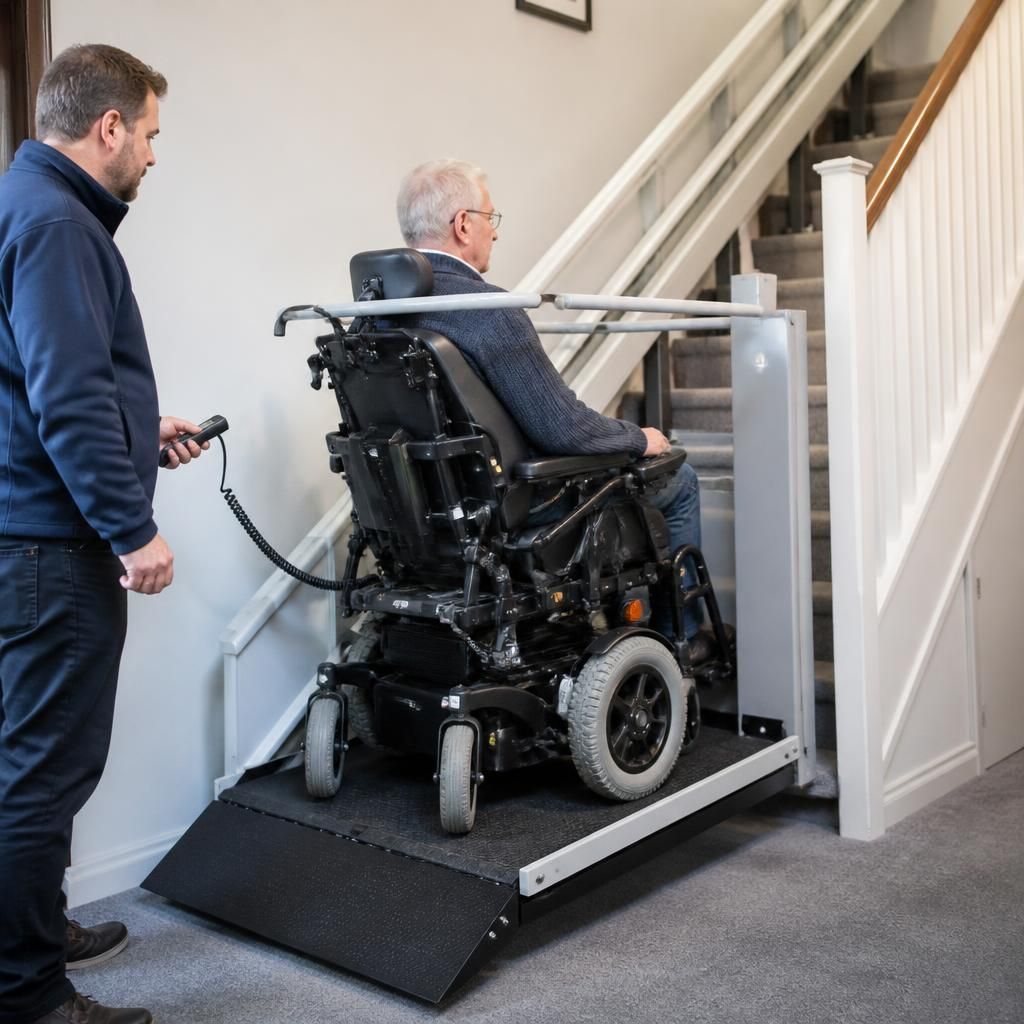
Manual wheelchairs are often straightforward to accommodate because they are comparatively light and have a compact profile. The platform may include access ramps to help the user roll on and off, along with raised edges or barriers to help prevent the wheels from moving beyond the platform. If the wheelchair has detachable footrests, large rear wheels or a reclining back, these features are included in the dimensional assessment.
Powered wheelchairs can also be compatible, provided the platform’s rated capacity and usable dimensions are suitable. Their batteries, motors and larger frames can make them heavier and longer than manual chairs. The assessment should account for the combined weight of the user and wheelchair, not the wheelchair’s weight in isolation. The chair must also be able to approach the platform, cross the ramp and stop in the correct position without the controls or joystick catching on surrounding structures.
Some powered wheelchairs use a joystick, while others have attendant controls or alternative driving systems. The platform layout and operating controls should allow the user or carer to operate the stairlift without stretching into an unsafe position. In some installations, a carer may need to guide the wheelchair onto the platform, so the available approach space and the position of doors or landings are important.
Mobility scooters and specialised wheelchairs need particular attention. A scooter’s tiller, turning circle and longer chassis may require a larger platform or a different approach arrangement. Specialist chairs with reclining mechanisms, elevated seats, standing functions, oxygen equipment or other accessories may need additional clearance. Equipment should not be left protruding into the stairway or obstructing safety barriers, gates or controls.
Platform stairlifts use several features to keep a wheelchair stable during movement. Depending on the design, these can include an entry ramp, folding or fixed access barriers, raised platform edges, safety arms, interlocked gates and wheelchair restraint or securing points. The wheelchair must be positioned as instructed, with its brakes applied where appropriate and any required restraint fitted correctly. These features are not a substitute for staying within the platform’s rated capacity or for following the manufacturer’s operating instructions.
Access direction is another important consideration. Some platforms are entered from the front, while others may be arranged for side access or access from a landing. The most suitable arrangement depends on whether the wheelchair user can turn independently, whether assistance is available and how the stairlift fits at the top and bottom of the stairs. A platform that accommodates the wheelchair in theory may not be practical if there is insufficient room to approach it squarely or to leave it safely at the destination.
Fold-up platform designs can help preserve access to the staircase when the lift is not in use. However, the folded position, parked position and platform travel path must all be checked against handrails, doors, radiators, furniture and circulation routes. Narrow stairs, intermediate landings and changes in direction can limit the platform size or influence the type of installation that is feasible.
An assessment should record the wheelchair’s measurements and combined load, observe how the user approaches and controls it, and check the staircase and landings at both ends. It is useful to have the user’s usual wheelchair available during the survey, together with any cushion, footrests, batteries, oxygen cylinder or other equipment that will travel on the platform. If the wheelchair may change in future, this should also be discussed before the platform configuration is finalised.
Compatibility can change if the user moves to a larger powered chair, adds specialist equipment or needs to be accompanied by a carer. For that reason, the platform should be chosen for the person’s expected day-to-day use rather than based only on the current chair’s basic width. Independent Stairlifts can assess the wheelchair, the user’s transfer and access needs, and the home layout together, then advise whether a platform stairlift is appropriate or whether another accessible-living solution would be safer and more practical.
Platform stairlifts can accommodate many manual and powered wheelchairs, provided the platform is large enough and rated for the combined weight of the user and chair. Powered wheelchairs usually need particular attention because their batteries, joystick, footrests and larger frame can affect the available clearance and approach.
During an assessment, the usual wheelchair should be measured and tested at the staircase. The survey also checks access ramps, safety barriers, restraint points, turning space and the room available at each landing. This confirms that the user can approach, board, travel and leave the platform safely, rather than relying on the wheelchair type alone.
Arrange a Wheelchair Compatibility Assessment
Arrange a wheelchair compatibility assessment with Independent Stairlifts to check your wheelchair, access requirements and home layout. We can advise whether a platform stairlift is suitable and identify the safest configuration for your needs.