
What should I consider when choosing between reconditioned and new straight stairlifts?
Choosing between a reconditioned and new straight stairlift depends on your budget, required features and preferred warranty. A reconditioned model may offer good value after professional inspection and servicing, while a new stairlift provides the latest specification and typically offers more choice of options; both must be correctly assessed, installed and safety-checked for your staircase.
Choosing between a reconditioned and new straight stairlift usually comes down to the balance between purchase cost, available features, warranty protection and the condition of the individual lift. A professionally reconditioned stairlift can provide a practical, lower-cost solution when it has been thoroughly inspected, serviced and installed for your staircase. A new stairlift generally offers the widest choice of specifications, seating options and manufacturer support.
Both options should start with a proper assessment of the staircase and the person who will use the lift. Although a straight stairlift follows a linear staircase, the survey still needs to consider the number and position of steps, available space at the top and bottom, landings, doorways, radiator positions and whether the user can transfer safely in and out of the seat. The installer should also discuss how the lift will be used rather than recommending a model based on appearance or price alone.
Cost and overall value
Reconditioned stairlifts are often less expensive because the main equipment has previously been installed and is being prepared for further use. This can be appropriate where the required specification is straightforward and keeping the initial cost down is important. However, compare the complete cost rather than the advertised equipment price. Ask whether the quotation includes the survey, delivery, removal of an existing lift if necessary, installation, testing, user instruction and any warranty cover.
A new stairlift may have a higher initial price, but it can offer more choice and a longer expected period before components may need replacing. A reconditioned lift may still be excellent value when its age, condition, servicing history and warranty are clearly explained. The most suitable option is the one that meets the user’s needs reliably over the period it is expected to remain in use, not simply the one with the lowest purchase price.
Condition and reconditioning standards
“Reconditioned” should mean more than simply being second-hand. Before agreeing to a reconditioned stairlift, ask what inspection and preparation have been carried out. This may include checking the motor and drive system, batteries, charging points, controls, sensors, seat mechanism, belts and safety edges, as well as cleaning and replacing worn parts where necessary.
You should also be told whether the lift has been tested under load and safety-checked after installation. Find out whether the rail and carriage are being reused, adapted or replaced, and whether compatible replacement parts remain available. The condition of the equipment should be recorded clearly, with any limitations explained before you commit.
Safety and suitability
A properly installed reconditioned stairlift can be safe to use, just as a new stairlift can be unsafe if it is poorly selected or installed. Safety depends on the suitability of the model, the quality of the installation, regular servicing and correct use.
Important features may include a correctly positioned seat belt, swivel or powered swivel seat, adjustable armrests, pressure-sensitive safety edges, obstruction detection, reliable braking and controls that the user can operate. Consider whether the user has reduced grip, limited flexibility, visual difficulties or problems remembering instructions. A reconditioned model may have fewer adjustment options, so check that the seating position and controls can be set up safely for the individual.
Where more than one person may use the lift, consider differences in height, weight, mobility and transfer ability. The equipment must remain within the manufacturer’s stated operating limits. If the user’s needs are changing, a new model may provide more scope for selecting supportive features, although a suitable reconditioned model may also be available following an assessment.
Warranty, servicing and aftercare
Warranty terms can differ substantially between new and reconditioned stairlifts and between suppliers. Check what is covered, how long the cover lasts, whether it includes parts and labour, and what exclusions apply. Clarify whether batteries, accidental damage, misuse and call-out charges are included or excluded.
Ask how faults are reported and who will provide aftercare if the lift stops working. A local or national service arrangement can be important, particularly if the stairlift is the user’s main way of accessing another floor. You should also receive advice about routine checks, keeping the charging points clear, using the lift as instructed and arranging servicing when recommended. Good aftercare matters for both new and reconditioned equipment; it is especially important when buying a model with a previous installation history.
Features and personalisation
New stairlifts generally provide the broadest choice of colours, upholstery, controls and optional features. Depending on the model, these may include powered swivel or folding mechanisms, a powered footrest, remote controls, different seat sizes and alternative control positions. A reconditioned lift may be available with some of these features, but the choice can be limited to the equipment currently in stock.
Do not assume that a particular feature is necessary or that a basic model will be adequate. For example, a manual swivel seat may be suitable for someone who can safely operate it, while a powered mechanism may be more appropriate for someone with limited strength or movement. The assessment should identify which features improve safety and independence rather than adding options that the user will not be able to operate.
Installation and future changes
A straight stairlift is usually installed to the staircase rather than fixed directly to the wall, but the rail still needs to be positioned carefully. The installer should check that it does not obstruct doors, handrails or household movement and that the user can approach the seat safely at both ends of the stairs. A reconditioned lift may require a different rail length or additional adjustments, so compatibility with the staircase must be confirmed rather than assumed from a previous installation.
Consider how long the stairlift is likely to be needed and whether the property may change. If the user expects to move home, ask whether the lift can be removed, relocated or adapted. A reconditioned model may be suitable for a temporary or immediate requirement, while a new stairlift may offer more choice where long-term use and future support are priorities.
Questions to ask before making a decision
- Has the stairlift been fully inspected, serviced and safety-tested?
- Which components have been replaced, and are compatible parts available?
- What is included in the quoted price?
- What does the warranty cover, and who provides repairs?
- Can the seat, controls and safety features be configured for the intended user?
- Will the rail and carriage fit the staircase without obstructing access or doors?
- What happens if the user’s mobility needs change?
- What servicing and battery-care arrangements are recommended?
The best choice is therefore not automatically new or reconditioned. Choose a reconditioned straight stairlift when a thoroughly checked model provides the right fit, features and aftercare at a suitable cost. Choose new when you need a particular specification, greater choice of adaptations or the reassurance of a new system and its associated warranty. An assessment and detailed quotation from Independent Stairlifts can help you compare both options on suitability, safety and long-term value.
A reconditioned straight stairlift is a previously used lift that has been inspected, serviced and prepared for further installation. Its suitability depends on the condition of the motor, batteries, carriage, rail, controls and safety features, as well as whether it can be correctly fitted to the user’s staircase.
Before choosing one, ask the installer to explain what has been checked and replaced, whether the lift has been tested after installation, and what warranty and repair support are included. A new stairlift usually offers more choice of seating, controls and optional features, while a reconditioned model may provide the required functions at a lower initial cost.
- Confirm that the lift is suitable for the intended user and staircase.
- Check which parts have been replaced or retained.
- Compare the complete price, including installation and aftercare.
- Make sure the warranty covers the parts and labour you may need.
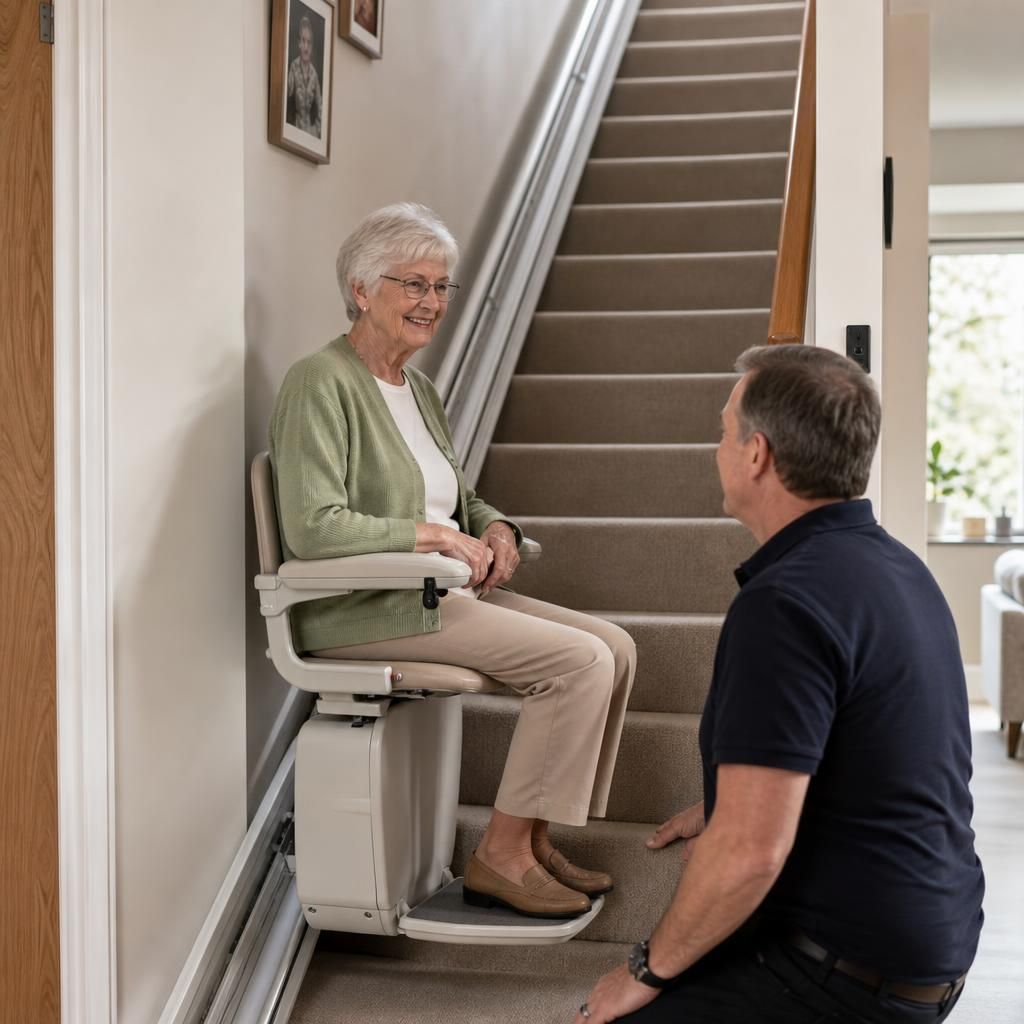
Discuss your reconditioned or new straight stairlift options
Speak to Independent Stairlifts about your reconditioned or new straight stairlift options. We can assess your staircase, discuss the intended user’s needs and provide advice on the most suitable solution.