
What maintenance is required to keep a straight stairlift in optimal condition?
A straight stairlift stays in optimal condition through regular cleaning, basic safety checks and servicing by a qualified engineer. Keep the track and seat free from obstructions, charge the batteries as instructed, and arrange professional maintenance promptly if you notice unusual noises, juddering or reduced performance.
A straight stairlift stays in optimal condition through regular cleaning, sensible daily checks, correct charging and servicing by a qualified stairlift engineer. Keep the rail, seat, footrest and controls free from dirt and obstructions, use the lift as instructed, and report changes such as unusual noise, juddering, reduced travel speed or battery warning tones rather than continuing to use it until a fault develops.
Keep the stairlift clean and clear
- Wipe the seat, armrests, controls and footrest with a soft, slightly damp cloth. Use cleaning products only if they are suitable for the materials and recommended by the manufacturer.
- Keep the rail and the area around the drive mechanism free from dust, pet hair, clothing and other debris. Do not place objects on the track or steps where they could interfere with the lift.
- Check that the seat belt, swivel mechanism, armrests and footrest move as intended. Do not use the stairlift if a safety component is loose, damaged or failing to lock correctly.
- For an outdoor stairlift, remove leaves, mud, standing water and other debris from the steps and rail. Check the cover and weather seals for damage, particularly after severe weather.
Check the charging system
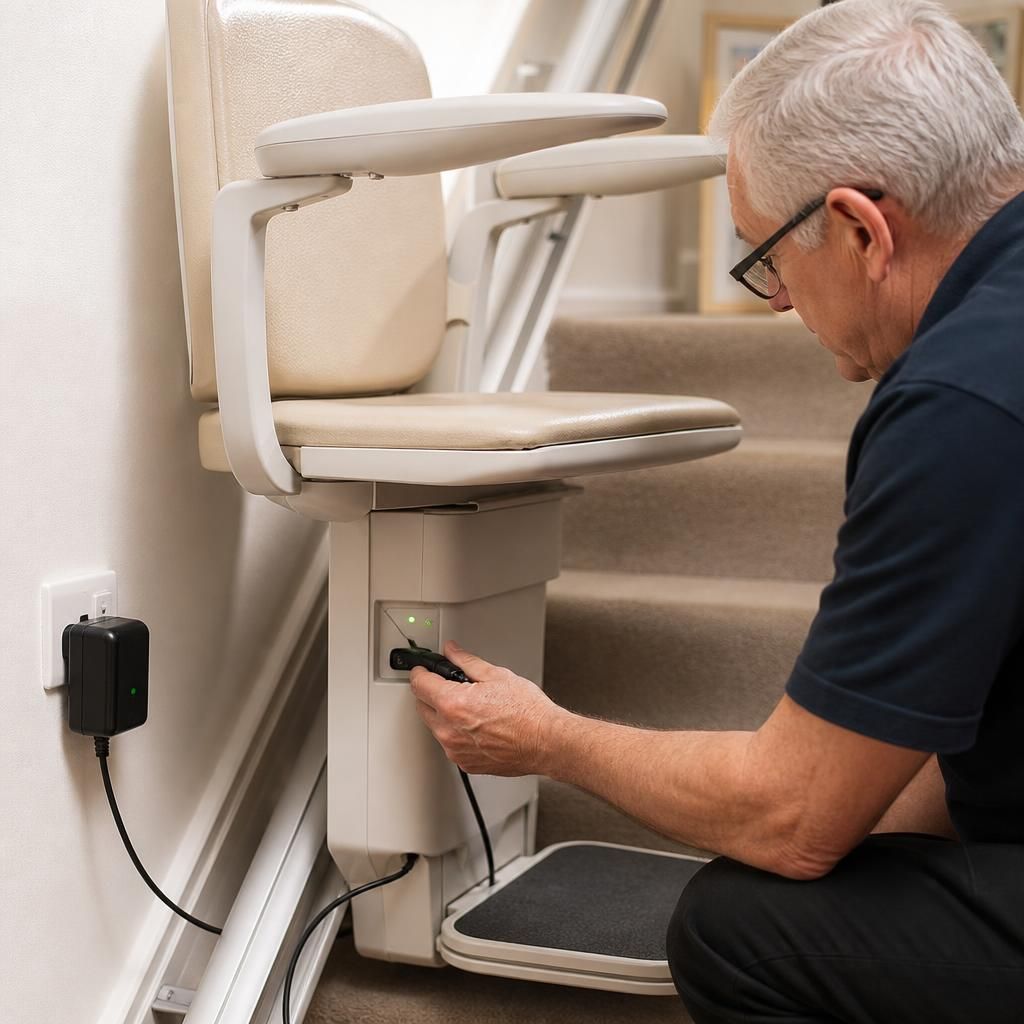
Most straight stairlifts use rechargeable batteries and should be left on their charging points when parked, following the instructions supplied with the specific model. If the lift is not charging properly, you may hear warning tones or notice that it travels less reliably. Check that the power supply is switched on, the charging points are clean and the stairlift is positioned correctly at its charging location. Do not attempt to open the battery compartment or charger unless this is specifically permitted in the manufacturer’s instructions.
Batteries are consumable components and eventually lose capacity. A battery fault may be indicated by repeated low-charge warnings, slower movement or the lift stopping away from its usual charging point. Arrange an inspection rather than repeatedly charging, disconnecting or replacing components yourself. If the stairlift will not be used for an extended period, obtain advice on the correct storage procedure, as simply switching it off may allow the batteries to discharge.
Carry out simple safety checks
Before use, make sure the stairway is clear and the stairlift is not obstructing anyone who needs to use the stairs. Confirm that the seat is properly positioned, the armrests and footrest are secure, and the seat belt fastens correctly. Once seated, keep hands, feet and clothing inside the lift and use the controls as instructed. Do not carry loads that could affect balance, obstruct the sensors or exceed the model’s specified capacity.
Pay attention to changes in operation. Squeaking, grinding, clicking, hesitation, vibration, uneven movement or a burning smell should not be ignored. Also report a seat that does not swivel or lock correctly, a footrest that feels loose, a control that intermittently fails, damaged wiring or a rail that appears loose. Stop using the stairlift if there is an immediate safety concern, isolate it only if you can do so safely, and contact Independent Stairlifts or the appropriate service provider for advice.
Arrange professional servicing
A qualified engineer should service the stairlift at the interval recommended for its model and usage. During a service, the engineer can inspect the rail, drive system, batteries, charging points, wiring, safety sensors, seat belt, swivel seat, armrests, footrest and controls. They can also test the stairlift under operation, identify wear before it causes a breakdown and replace parts using components suitable for the equipment.
Do not lubricate the rail, drive components or other moving parts unless the manufacturer or engineer specifically instructs you to do so. The wrong lubricant can attract dirt, affect sensors or interfere with the drive system. Similarly, avoid removing covers, bypassing safety switches, altering settings or attempting electrical repairs. These actions can create a safety risk and may make it harder to diagnose the original fault.
Keep useful information available
Keep the stairlift’s instruction manual, service records and model details where they can be found easily. Tell the engineer about any changes in use, such as increased frequency of travel, a change of user or installation in a particularly dusty, damp or exposed environment. For reconditioned stairlifts, maintenance requirements are still determined by the installed model and its condition, so servicing should follow the engineer’s recommendations rather than an assumed schedule.
Regular cleaning and charging will not prevent every fault, and batteries and other wearing parts will eventually need attention. However, combining these simple checks with professional servicing helps maintain safe, smooth operation and allows problems to be dealt with before the stairlift becomes unreliable.
Correct charging is one of the most important parts of straight stairlift maintenance because rechargeable batteries power the lift when it is travelling. Leave the stairlift on its charging point when parked, as instructed for the model, and make sure the power supply is switched on.
- Keep the charging contacts clean and free from dust or debris.
- Check that the stairlift is positioned correctly at its charging location.
- Act on repeated warning tones, slower movement or reduced travel promptly.
- Do not open the battery compartment or charger unless the manufacturer’s instructions specifically allow it.
Batteries gradually lose capacity and may eventually need replacing. If the stairlift is not charging, repeatedly stops or cannot reach its charging point, stop relying on it and contact Independent Stairlifts or your service provider for advice. An engineer can test the batteries, charger and connections safely.
Need help maintaining your straight stairlift?
If you need advice about maintaining your straight stairlift or have noticed a change in its operation, contact Independent Stairlifts to arrange support from a qualified engineer.