
How do straight stairlifts ensure safety during use?
Straight stairlifts support safe use with a secure seat, powered swivel and safety belt, while sensors help stop the lift if an obstacle is detected. Smooth start and stop controls, reliable braking and easy-to-use controls help you travel between floors steadily and with greater confidence.
Straight stairlifts ensure safe use by combining a stable seat, a secure restraint, controlled movement and automatic safety features. The lift travels along a fixed rail, with sensors, brakes and user controls designed to help prevent movement when the stairlift is not positioned or being used correctly.
Secure seating and positioning
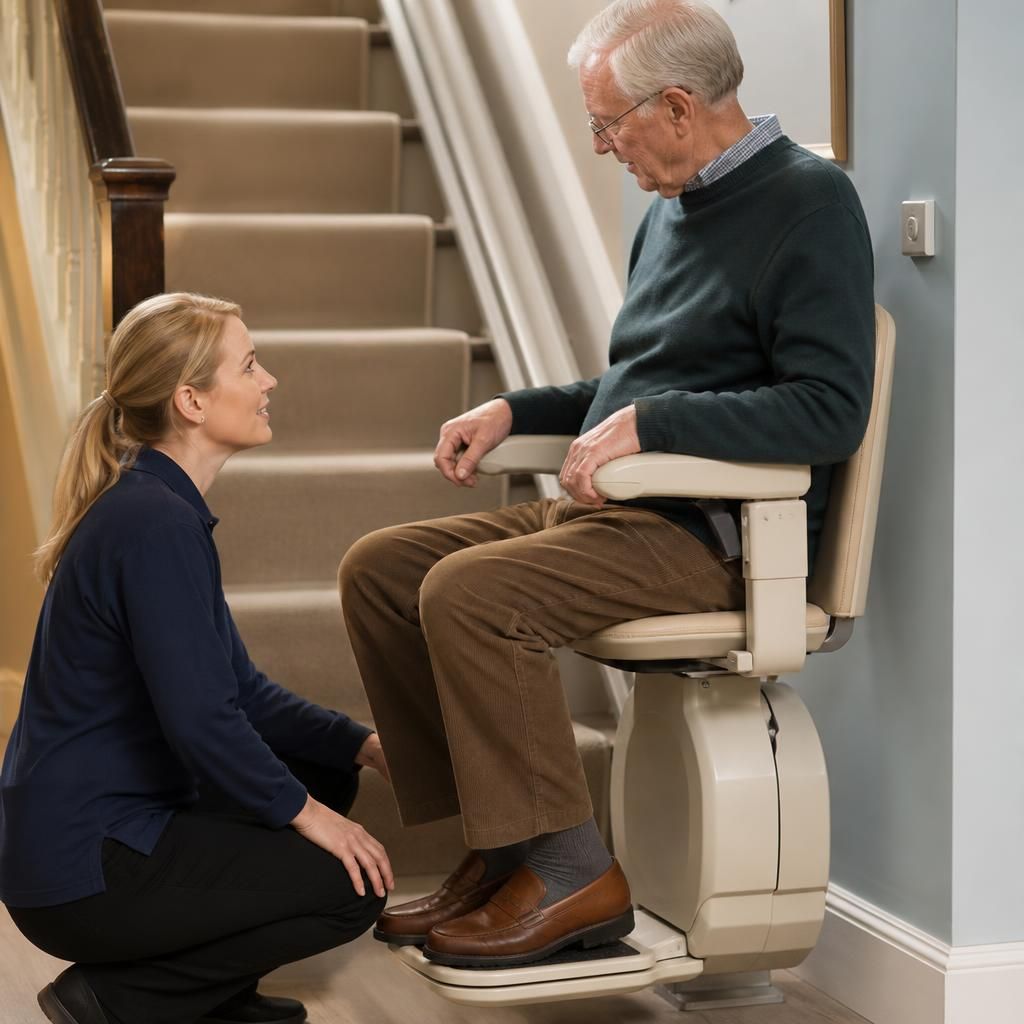
The seat provides a stable position while the stairlift is moving. Armrests help you remain centred, while the footrest supports your feet and reduces the risk of them coming into contact with the stairs or nearby surfaces. On many models, the seat, armrests and footrest can be folded when the stairlift is parked, helping to keep the staircase available for other users.
A safety belt or harness should be fastened before every journey. It helps keep you securely in the seat, particularly when the stairlift starts, stops or travels around a change in gradient. You should sit fully back in the seat, keep your arms within the armrests and place both feet on the footrest unless your installer or occupational therapist has advised a different position.
Swivel seats for safer access
A powered or manual swivel seat allows you to turn towards the landing when getting on or off the stairlift. This can reduce the need to twist while standing and gives you a more direct route away from the stairs. The seat should be fully swivelled and locked in the correct position before you stand up. Do not attempt to leave the stairlift while it is still moving.
Some models include additional features such as powered swivelling, a powered footrest or hinged sections of rail. These can be useful where there is limited space at the top or bottom of the staircase. Their operation varies, so make sure you understand which controls to use before your first journey.
Obstacle detection and automatic stopping
Straight stairlifts are commonly fitted with safety sensors around the carriage, footrest or other vulnerable areas. If a sensor detects an object in the path, the stairlift is designed to stop or prevent travel in that direction. This helps protect people, pets and belongings, but it is not a substitute for keeping the stairs clear.
If the lift stops because it has detected an obstruction, release the control and check the stairs carefully. Remove the object only when it is safe to do so, then follow the instructions for resetting the stairlift. Never force the lift past an obstruction or try to bypass a safety sensor.
Controlled starts, stops and braking
The motor and control system regulate acceleration and deceleration so the stairlift does not move abruptly during normal operation. A braking system holds the carriage securely when it stops, including when it reaches a designated parking position. The stairlift should also stop at its travel limits rather than continuing beyond the end of the rail.
Even with controlled movement, remain seated and keep the safety belt fastened throughout the journey. Do not lean out, reach towards the track or try to adjust the seat while the lift is travelling. Unusual juddering, noise, delay or movement should be reported rather than ignored.
Simple controls and safety interlocks
The operating control is normally located on an armrest, allowing you to travel in the required direction while keeping your other hand available for stability. A remote control may also allow an authorised user to call the stairlift to a different floor. Controls are generally designed to require continued pressure, so releasing the control stops the lift.
Safety interlocks help prevent travel when essential parts are not in the correct position. Depending on the model, the stairlift may not operate unless the seat is locked, the armrests and footrest are correctly positioned, or the safety belt is fastened. Keep the key, isolator and remote controls away from children or anyone who has not been shown how to use the stairlift.
Battery operation and power failure protection
Most domestic stairlifts use rechargeable batteries, allowing them to continue operating for a limited time during a mains power cut. The batteries recharge when the stairlift is parked correctly on its charging point. For this reason, leave the lift at its designated charging position when it is not being used, unless your installation instructions say otherwise.
A power cut does not remove the need to use the stairlift correctly. If the lift will not move, check that it is switched on, the key is inserted if required, the seat and belt are correctly positioned, and the carriage is not obstructed. Do not attempt to repair electrical or mechanical components yourself.
Safe installation and day-to-day use
Safety begins with a proper assessment of the staircase and the user’s needs. During installation, the rail is secured to the stairs or an appropriate supporting structure, and clearances are checked at landings, bends, doors and nearby furniture. The installer should also demonstrate the controls, charging position, emergency procedure and manual lowering or release process where applicable.
- Fasten the safety belt before setting off.
- Keep the stairs, landing and rail area free from bags, toys, clothing and other obstructions.
- Keep loose clothing, blankets and mobility aids clear of the moving parts.
- Travel only while seated and facing the correct direction.
- Do not exceed the stairlift’s stated user weight or carry unsuitable items on the seat or footrest.
- Park the stairlift in its recommended position so it can charge and does not obstruct the staircase.
- Keep children and pets away while the stairlift is moving.
Regular servicing and prompt attention to faults are also important. Keep the rail and accessible surfaces clean according to the manufacturer’s guidance, but do not apply unapproved oils or cleaning products. Arrange professional checks at the recommended intervals and contact Independent Stairlifts if the stairlift stops unexpectedly, the safety belt or swivel mechanism does not lock correctly, the battery is not charging, or a sensor, control or brake appears unreliable.
Safety features differ between models and installations, so the user manual and installation demonstration should always take priority. If your circumstances change, such as reduced balance, a new mobility condition or difficulty using the controls, ask for the stairlift to be reassessed rather than adapting it yourself.
Obstacle sensors help a straight stairlift stop automatically if an object is detected in its path. Sensors are usually positioned around the carriage and footrest, helping to protect people, pets and belongings from contact with the moving lift.
If the stairlift stops unexpectedly, release the control and check the stairs, rail and footrest area for an obstruction. Remove it only when safe, then follow the reset instructions in your user manual. Never force the stairlift to move or attempt to bypass a sensor. Keep the staircase clear as part of normal use, because sensors are an added safeguard rather than a replacement for careful operation.
Get advice on straight stairlift safety
Contact Independent Stairlifts for practical advice on the safety features, controls and installation requirements for your straight stairlift.