
Can straight stairlifts be customised to fit unique home environments?
Yes. A straight stairlift can be tailored to many home environments through a made-to-measure rail, suitable seat and controls, plus options such as a folding or powered seat, while an assessment confirms that the staircase, landings and access points are suitable.
Yes. Straight stairlifts can be customised for many individual home environments, even when the staircase is narrow, the landing is restricted or there is a door or walkway close to the bottom or top step. Customisation usually involves measuring the staircase accurately, selecting a rail length and parking arrangement, and choosing seat and control features that suit the user’s mobility and the available space.
A straight stairlift is designed for a staircase without a change of direction or intermediate landing. Although the rail itself follows a straight flight, it is not usually a standard, one-size-fits-all component. During an assessment, the installer considers the angle and length of the stairs, the position of the steps, the clearance around the rail and the space available for getting on and off the lift.
Common ways a straight stairlift can be adapted include:
- Made-to-measure rail: The rail is prepared to suit the measured length and layout of the staircase. This helps the stairlift travel smoothly while maintaining suitable clearance from walls, banisters and adjacent features.
- Parking position: The stairlift can often be arranged to park at the top or bottom, depending on where it causes the least obstruction and provides the safest transfer.
- Extended rail: Where there is limited space at the top or bottom, an extended section may allow the user to get on or off away from the edge of the stairs. Whether this is suitable depends on the landing and surrounding access.
- Hinged or powered rail: If the rail would interfere with a doorway, hallway or circulation route, a hinged section may fold away when the stairlift is not in use. A powered option can be useful where operating a manual hinge would be difficult.
- Seat configuration: Seats may be available with features such as swivel operation, adjustable arms, a folding seat or powered movement. The appropriate choice depends on the user’s balance, flexibility, leg strength and ability to transfer safely.
- Controls: Controls can usually be positioned to suit the user. A remote control may also allow the stairlift to be called to another level when it has been left at the opposite end of the stairs.
- Track and finish options: The rail and upholstery may be available in different finishes, although the choices depend on the model selected. The important consideration is that the equipment remains suitable for the staircase and the user’s needs.
Staircase width is assessed alongside the user’s posture and the space needed for other people to pass. A narrow staircase may still accommodate a stairlift, particularly if a compact or folding seat is appropriate. However, the lift must leave adequate clearance and should not create an unsafe obstruction. Measurements alone are not enough: the installer also needs to consider how the user approaches the seat, turns on the landing and places their feet on the footrest.
Unusual features in the home should be discussed during the assessment. These can include a radiator, cupboard, door, window, newel post, low ceiling, uneven landing or a staircase that finishes close to another flight. In some cases, the rail position or parking arrangement can resolve the issue. In others, a different seat, a hinged rail or changes to the surrounding area may be recommended. A straight stairlift cannot usually be adapted to negotiate a bend; a staircase with a corner or intermediate landing may require a curved stairlift instead.
The user’s needs are just as important as the building. Someone who can stand and transfer reliably may manage a standard swivel seat, while someone with restricted hip movement, reduced balance or limited upper-body strength may need additional powered assistance. Controls should be reachable without leaning, and the seat, armrests and footrest should support a stable position throughout the journey. If more than one person will use the stairlift, their differing requirements should be considered before a model is selected.
Power and access arrangements can also be planned around the home. Most domestic stairlifts use rechargeable batteries, allowing normal operation during a power cut provided the unit has been left charged and maintained correctly. The charging points should be positioned where the stairlift can park reliably. If the stairlift is being considered for an external staircase, the equipment must be specifically designed and installed for outdoor conditions; an indoor model is not suitable simply because the staircase is straight.
Reconditioned stairlifts can sometimes be fitted to individual staircases, but the available customisation may be more limited than with a new installation. The condition, specification and compatibility of the rail and components need to be checked carefully. A professional assessment confirms whether the stairlift can be adapted safely and whether the proposed arrangement provides suitable access for the intended user.
The most reliable way to establish what is possible is to arrange a home assessment before choosing the stairlift. The assessment should review the full route, not just the stairs: entry and exit points, doors, landings, head clearance, electrical access and the space needed when the lift is folded or parked. You should also explain any changes in mobility that may affect future use, rather than selecting equipment only for current ability.
Customisation can make a straight stairlift practical in a wide range of homes, but it does not remove every restriction. A stairlift must remain compatible with the staircase, leave safe access for other occupants and provide a secure transfer for the user. Once the measurements and personal requirements have been reviewed, the installer can explain which adaptations are suitable and whether a straight stairlift is the right solution for that particular home.
A straight stairlift can be customised to suit the measured length, angle and surrounding space of an individual staircase. Although the rail follows one uninterrupted flight, it is usually made or selected to match the staircase rather than supplied as a fixed, universal size.
During a home assessment, the installer checks features that could affect safe use, including doors, radiators, banisters, narrow landings and nearby walkways. The stairlift may then be configured with a suitable parking position, extended rail or hinged rail where appropriate. A folding seat, adjustable controls or powered options may also help where space is restricted or the user has difficulty transferring.
Customisation has limits. The stairlift must leave adequate clearance for other people and provide a stable area for the user to get on and off. If the staircase includes a bend or intermediate landing, a straight model will not normally be suitable; a curved stairlift may be needed instead. A professional assessment confirms which adaptations are safe for both the home and the intended user.
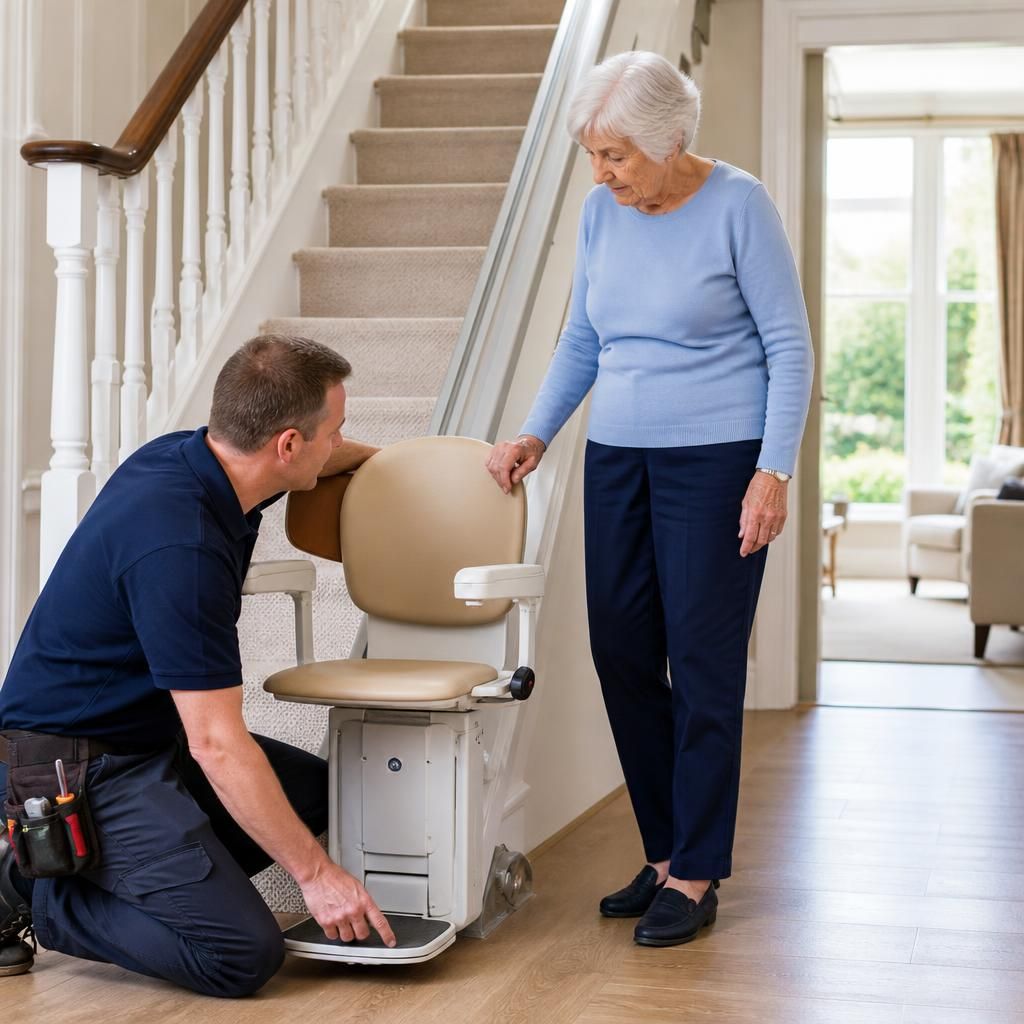
Arrange a Home Assessment for Your Straight Stairlift
Arrange a home assessment with Independent Stairlifts to confirm which straight stairlift customisations are suitable for your staircase, access points and mobility needs.