
What measures are in place to ensure the safety and reliability of straight stairlift installations?
Safety and reliability are supported by a detailed home survey, correct rail and seat selection, secure installation to the staircase and thorough testing before handover. Your straight stairlift is also supplied with safety features, clear operating guidance and ongoing support for servicing, repairs or adjustments.
Safe, reliable straight stairlift installation depends on four stages: assessing the staircase and user’s needs, selecting compatible equipment, securing the lift correctly, and testing it thoroughly before handover. The installation should be completed by a trained technician in accordance with the manufacturer’s instructions, with the finished stairlift checked for safe operation and the customer shown how to use it.
Before fitting, the installer carries out a detailed survey of the staircase and surrounding area. This normally includes checking the stair width, tread and riser dimensions, landing space, available headroom, the position of doors and radiators, and the condition of the stairs and banister. The survey also considers how the user will approach the stairlift, transfer on and off the seat, fasten the safety belt and reach the controls. These checks help identify practical risks that may not be apparent from measurements alone.
The survey also confirms whether a standard straight rail is suitable. A straight stairlift is designed for a staircase without a change of direction or intermediate landing on the travelling route. If the stairs include a bend, a distinct change in gradient or another obstruction, a different configuration may be needed. Identifying this before installation prevents unsuitable equipment from being fitted and helps ensure that the lift will stop in usable positions at the top and bottom.
Equipment is selected to match both the staircase and the person using it. The seat, controls, safety belt, footrest and rail must be suitable for the user’s mobility, posture and weight, as well as for the available space. Where more than one person may use the stairlift, this should be discussed during the assessment so that the chosen arrangement does not create avoidable difficulties for other household members.
The rail is fixed securely to the stair treads or another approved supporting structure, rather than relying on a weak or unsuitable surface. The installer checks the condition of the stairs and uses the correct fixings and installation method for the property. A stairlift rail is generally fitted close to the staircase, but it must still leave sufficient clearance for the user’s feet and for people who may need to use the stairs when the lift is parked.
Care is taken around the top and bottom landing areas. The lift needs to stop where the user can get on and off safely, without being forced towards a doorway, wall, step edge or other obstruction. If the stairlift has a swivel seat or a powered option, its position and operation are checked to ensure that the user can turn and transfer without unnecessary twisting or reaching.
Electrical safety is included in the installation checks. The power supply and charging points must be positioned and connected in accordance with the equipment requirements. Cables are routed so that they are protected from damage and do not create a trip hazard. Most stairlifts charge through contacts on the rail or at designated parking points, so the installer confirms that the lift charges correctly at the positions where it is intended to park.
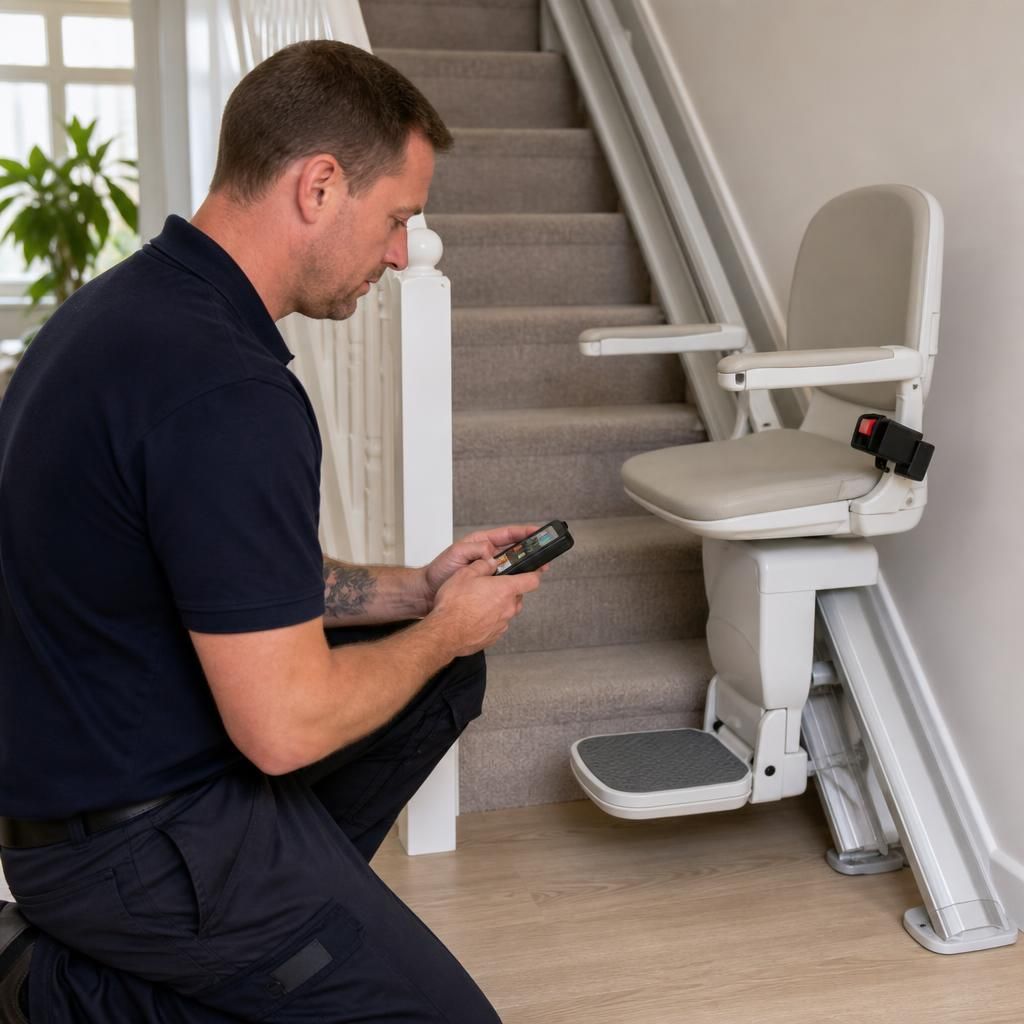
Once the stairlift is fitted, the technician tests its movement along the full rail. This includes checking smooth travel, starting and stopping, charging, the controls, the safety belt, the footrest and any swivel or folding mechanisms. Safety edges and sensors are checked so that the lift responds correctly if an obstruction is detected. The technician also confirms that the stairlift will not operate when a condition that should prevent travel is present, such as an unfastened safety belt where the model includes that interlock.
Other checks are made before handover, including:
- the rail and mounting points are secure, with no movement or abnormal noise;
- the seat, armrests and footrest lock correctly in their operating positions;
- the controls work from the seat and, where supplied, from remote controls;
- the lift stops accurately at the intended parking and transfer positions;
- the batteries charge correctly and the relevant indicators operate;
- the stairlift does not travel when a safety control or obstruction sensor has been activated; and
- the staircase and surrounding area are left clear, clean and safe to use.
Reliability also depends on correct handover. The installer should demonstrate starting and stopping, use of the safety belt, operation of the controls, swivel-seat procedures, parking, charging and what to do if the lift stops unexpectedly. You should be given instructions appropriate to the model installed and have the opportunity to operate the stairlift yourself. This is an important part of the installation because safe use depends on understanding the equipment’s controls and limitations.
A straight stairlift should not be used to carry other people, heavy loads or objects that could interfere with the controls, seat or sensors. The footrest should be kept clear, the belt should be used as instructed and the lift should be parked at a designated charging point when it is not in use. The staircase should also be kept free from items that could obstruct the lift or be caught by moving parts.
After installation, ongoing reliability is supported by following the operating guidance and arranging servicing when recommended. Keep the rail, charging contacts and surrounding area reasonably clean, but do not use liquids on electrical components or attempt to dismantle the lift. Report unusual noises, jerky movement, repeated fault indications, reduced battery performance or a damaged belt, seat or rail rather than continuing to use the stairlift if it may be unsafe.
If the staircase, surrounding layout or the user’s mobility changes, contact Independent Stairlifts so the installation can be reviewed. Adjustments may be possible, but they should be assessed and completed by a qualified technician. Similarly, repairs, battery replacement and alterations to the controls or seating should not be carried out as informal DIY work. Keeping the installation records and contacting the support team promptly helps maintain safe operation throughout the stairlift’s working life.
Thorough testing before handover is a key measure for ensuring a straight stairlift is safe and reliable. Once the lift has been fitted, the technician runs it along the full rail to check smooth travel, accurate stopping, charging and the operation of the controls.
The safety belt, footrest, swivel seat, obstruction sensors and safety edges are also checked, where fitted. The stairlift should not travel when a safety control has been activated, and the rail, mounting points and landing areas must remain secure and unobstructed. You will then be shown how to use the lift, park it correctly, charge it and respond if it stops unexpectedly, with the opportunity to operate it yourself before the installation is completed.
Arrange Your Straight Stairlift Assessment
Arrange your straight stairlift assessment with Independent Stairlifts so we can check your staircase, access requirements and the most suitable installation approach. Contact our team to discuss your needs and arrange a convenient survey.