
What happens if repairs or adjustments are needed after my straight stairlift has been installed?
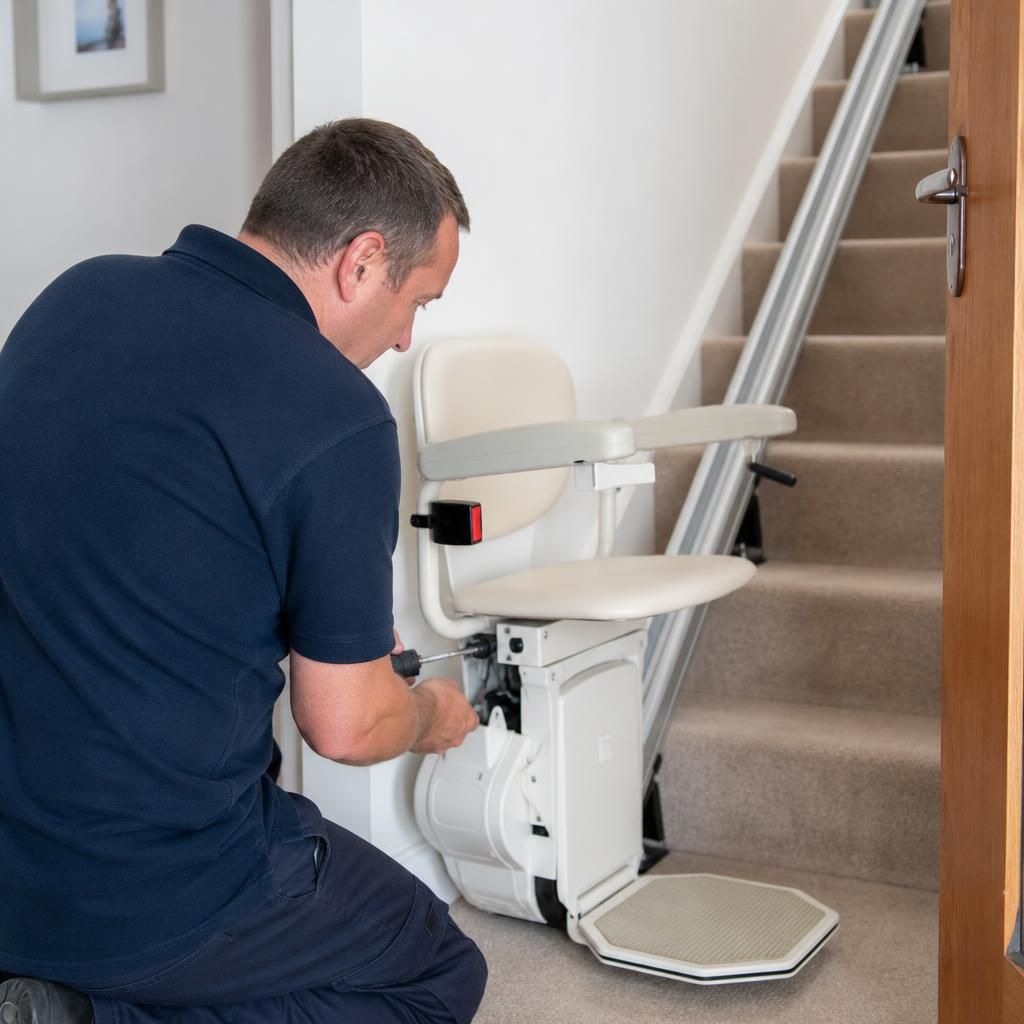
If your straight stairlift needs a repair or adjustment after installation, contact us so we can assess the issue and arrange the appropriate support. A trained engineer can check the lift, track and power supply, make necessary adjustments or repairs, and confirm that the stairlift is operating safely before you use it again.
If your straight stairlift needs a repair or adjustment after installation, contact us before attempting to alter it yourself. We will discuss the symptoms, assess whether the stairlift is safe to use, and arrange the appropriate support. A trained engineer can inspect the lift, rail, seat, charging points, controls and safety systems, then make the required adjustment or repair and test the stairlift before it is returned to normal use.
What to do when you notice a problem
- Stop using the stairlift if it is stopping unexpectedly, moving irregularly, making an unusual noise, failing to charge, or showing a warning indicator.
- Leave the stairlift in a safe position where possible, without forcing it along the rail or repeatedly operating the controls.
- Check simple user-accessible points, such as whether the lift is switched on at the wall and whether it is positioned correctly on its charging point. Do not remove covers or work on electrical components.
- Contact us with a description of the problem, when it occurs, and any display message or audible warning. A photograph or short video may also help us understand the issue, provided you can record it safely.
We may be able to identify a straightforward operating issue during the initial discussion. For example, the stairlift may not run if an armrest control is switched off, the seat is not fully in its travelling position, a safety edge is detecting an obstruction, or the batteries are not receiving a charge. If the cause is not clear, an engineer visit will be arranged rather than asking you to carry out work that could compromise safety.
What the engineer will check
The inspection depends on the symptoms, but may include the following:
- the movement of the carriage along the rail, including alignment, fixings and any visible obstruction;
- the seat, swivel mechanism, armrests, footrest, seat belt and operating controls;
- safety sensors and edges, which are designed to stop the stairlift if an obstacle is detected;
- the batteries, charging contacts, charger and power supply;
- the diagnostic indicators, control circuits and connections; and
- the limit switches and other components that control starting, stopping and positioning.
Some problems only require an adjustment. This could involve correcting the position of a safety sensor, tightening an accessible fitting, aligning a component, adjusting the seat or footrest, or clearing an obstruction from the rail. Other faults may require a replacement part. The engineer should explain what has been found, what work is recommended and whether any part needs to be ordered.
Testing after a repair or adjustment
Following the work, the engineer will operate the stairlift and check the relevant safety functions. This normally includes travelling along the rail, stopping and starting, checking the controls and confirming that the stairlift charges correctly. Where a component has been adjusted or replaced, additional checks may be needed to make sure it works correctly under normal operating conditions.
Do not resume regular use until the engineer has confirmed that the stairlift is safe to operate. If the repair cannot be completed during the visit, you should be told whether the stairlift must remain out of use and what temporary arrangements or further steps are necessary.
Repairs covered by warranty or service arrangements
Whether a repair, call-out or replacement part is covered depends on the terms that apply to your stairlift, including its age, model, installation agreement and any service plan. We can check the relevant records and explain any charge before chargeable work is carried out. Normal wear, accidental damage, misuse and issues caused by changes to the home may be treated differently from a manufacturing or installation fault.
Keep your installation documents and any service information available when you contact us. If the stairlift has been relocated, exposed to water, affected by building work or disconnected from its usual power supply, mention this because it may help the engineer diagnose the problem safely.
When an adjustment may be needed
A follow-up adjustment is not necessarily a major fault. Your position on the stairlift, the way you use the controls, or a change in how the seat, armrests or footrest feels may indicate that a setting needs reviewing. Contact us if the stairlift feels uncomfortable, you are having difficulty using the swivel seat or controls, or another household member is using it differently. Adjustments should be made by a suitably trained person so that comfort is improved without affecting clearances or safety features.
Also report repeated charging problems, unusual battery drain, changes in travel speed, jolting, a persistent warning tone, or a stairlift that stops before reaching the top or bottom. These symptoms can indicate an issue that should be investigated rather than ignored.
Important safety points
- Never bypass a safety switch, sensor or seat belt, and do not continue pressing the controls if the stairlift is not responding normally.
- Do not use household lubricants, alter the rail, remove covers or attempt electrical repairs unless specifically instructed by a qualified engineer.
- Keep the stairs clear while the stairlift is being inspected or tested, particularly if other people need to use the staircase.
- If the stairlift has stopped with someone on it, follow the user instructions and contact us for guidance. Avoid trying to lift or move the passenger manually unless there is an immediate danger.
Prompt reporting gives us the best opportunity to identify the cause and arrange the correct remedy. Once the engineer has completed the inspection and confirmed that the stairlift is operating as intended, continue to follow the user instructions and report any recurring fault rather than waiting for it to worsen.
After a straight stairlift repair or adjustment, the engineer should test the lift before it is returned to normal use. This confirms that the original problem has been resolved and that the stairlift’s movement, charging and safety systems are working correctly.
Testing may include travelling along the full rail, checking the controls, seat, swivel mechanism, footrest and safety edges, and confirming that the lift starts and stops as intended. The engineer should also check that it returns correctly to its charging point and explain any further work that may be needed.
Do not use the stairlift again until you have been told that it is safe to operate. If a replacement part is required or the repair cannot be completed during the visit, we will explain whether the stairlift must remain out of use and what happens next.
Need help with a straight stairlift repair or adjustment?
If your straight stairlift needs a repair or adjustment, contact us with details of the problem so we can assess the issue and arrange the appropriate support. Do not continue using the stairlift if it is operating unusually or showing a warning.