
How do you assess my home's specific requirements for a straight stairlift installation?
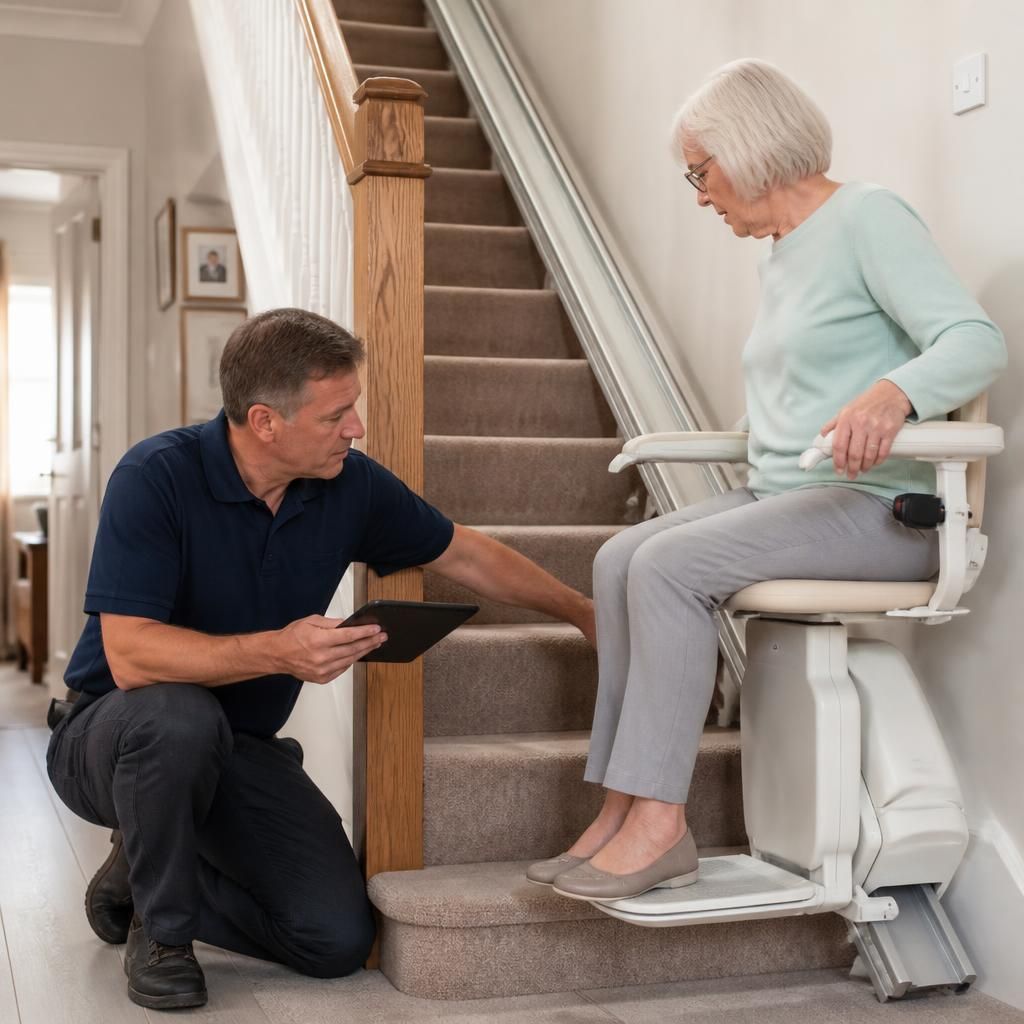
We assess your staircase layout, available space, access points and power supply, while also discussing the user’s mobility, transfer needs and preferred controls. This home assessment confirms whether a straight stairlift is suitable and allows us to recommend the safest configuration and installation approach for your property.
We assess your home by examining the staircase, landings, access points and power supply, then considering the intended user’s mobility and transfer needs. This confirms whether a straight stairlift is suitable and allows us to specify the safest rail position, seat configuration and controls for your property.
The assessment is carried out in your home so that we can consider the actual environment rather than relying on standard measurements. We will usually look at:
- The staircase layout: We check that the flight is straight and identify any bends, intermediate landings, changes in width or obstructions that could affect the installation. A staircase with a bend or separate flight may require a different stairlift solution.
- Available space: We measure the stair width, tread area and clearances at the top and bottom. We also assess whether the stairlift, when parked or in use, will leave practical access for other people using the stairs.
- Top and bottom landings: The position of doors, hallways, radiators, furniture and other fixed features is considered. We check where the chair can park safely and whether a powered or manual swivel seat, hinged rail or alternative parking position would improve access.
- Stair and wall condition: We inspect the condition and construction of the steps, wall and fixing points. Most straight stairlifts are secured to the stairs rather than the wall, but the installer still needs to confirm that the structure is suitable for the proposed brackets and rail.
- Access around the stairlift: We consider how the user will approach the chair, sit down, stand up and move between the stairlift and nearby rooms. Where a user has difficulty bending, turning or transferring, the seat height, swivel action, armrests and control position may need particular attention.
- Electrical arrangements: We identify the most suitable power supply location and check how the charger can be positioned without creating a trip hazard. Stairlifts normally use rechargeable batteries, which are replenished when the unit is parked at a charging point.
We also discuss the user’s day-to-day requirements. This includes their ability to walk short distances, transfer from a wheelchair or walking aid, operate controls, maintain an upright seated position and use the stairlift independently. If another person will assist, we consider their position and access as well. These details can influence the choice of seat, armrest controls, safety belt, swivel mechanism and remote controls.
Where appropriate, we review practical details such as whether the user needs to carry a walking stick, whether a landing is used as a main access route, and whether pets, children or other household members could be near the stairlift. We can then explain suitable operating practices and any features that help reduce avoidable risks.
During the assessment, we will explain the proposed installation clearly, including where the rail will run, where the stairlift will park, how much of the staircase it will occupy and whether any minor adaptations are recommended. We will also identify anything that needs to be moved before installation, such as furniture or items close to the stairs. A straight stairlift installation generally does not require major structural work, but the assessment confirms whether the property presents any unusual fixing, access or electrical considerations.
The assessment also helps distinguish between a standard and a more tailored straight stairlift installation. For example, a narrow staircase may require a particularly compact design, while limited space at the bottom could make a hinged rail or different parking arrangement more appropriate. If the staircase is not genuinely straight, or if the available clearances are unsuitable, we will explain why a straight model may not be appropriate and discuss the relevant alternatives.
Once the inspection and discussion are complete, we can recommend a configuration based on the home and the person who will use it. We will outline any preparation needed, the expected installation approach and the controls and safety features included. If your circumstances or home layout change before installation, tell us so that the proposed design can be reviewed rather than assuming the original assessment still applies.
A straight stairlift assessment considers both the staircase and the person who will use it. The assessor checks how the user approaches the seat, transfers on and off, remains seated and operates the controls, because these factors can affect the most suitable seat, swivel mechanism, armrests and control position.
We also consider walking aids, wheelchairs, assistance from another person and access to the rooms at the top and bottom of the stairs. This helps identify practical arrangements, such as a suitable parking position or remote control, while keeping the staircase usable for other members of the household.
Book your free, no-obligation straight stairlift assessment
Book your free, no-obligation straight stairlift assessment so we can check your staircase, available space and personal requirements. We’ll explain the most suitable installation approach for your home and answer any questions before you decide.