
Are there any specific power supply requirements for installing a straight stairlift in my home?
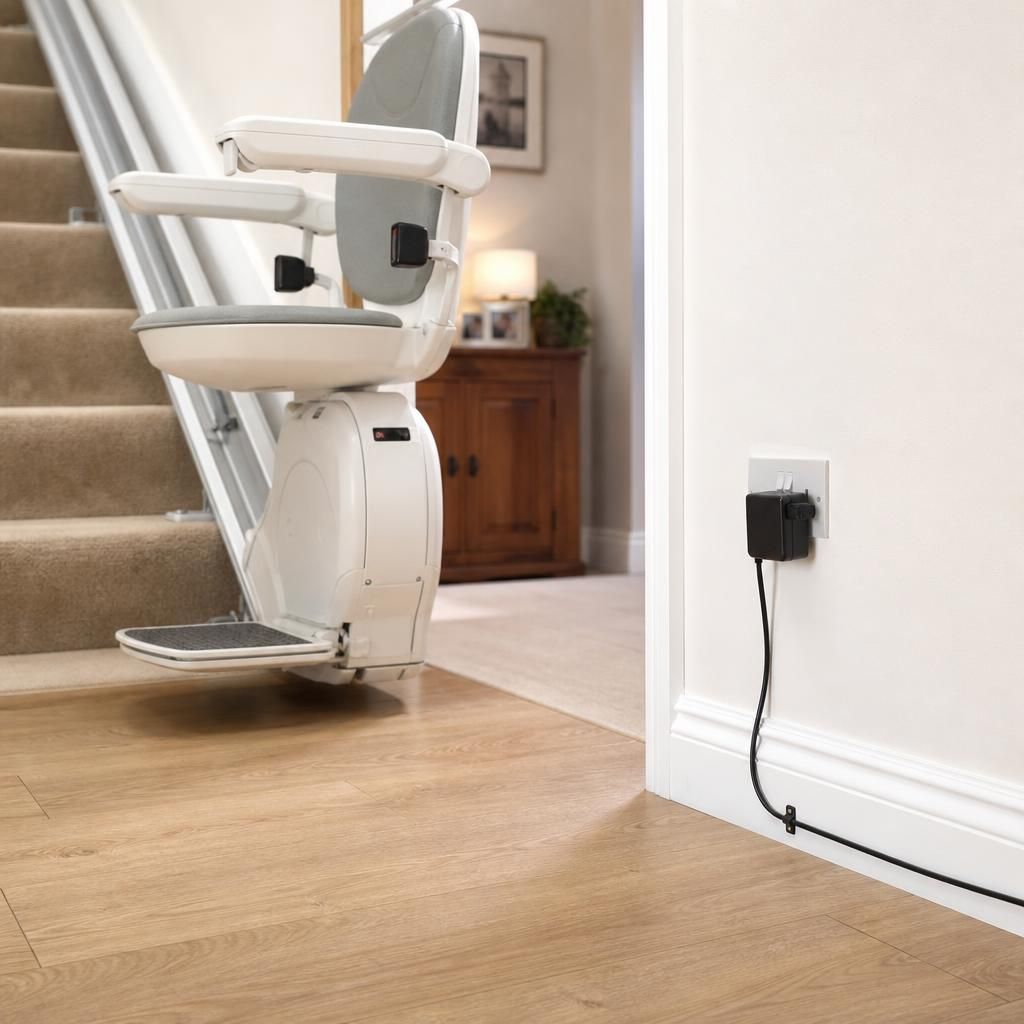
Most straight stairlifts can be connected to a standard domestic mains socket near the top or bottom of the staircase, with the stairlift’s battery providing power during use and short outages. During the assessment, we will check the socket, wiring, earthing and cable route, and advise if an additional socket or other electrical work is needed to provide a safe, compliant installation.
Most straight stairlifts can be installed using a suitable standard domestic mains socket close to the top or bottom of the staircase. The stairlift normally runs from rechargeable batteries, while the mains supply recharges them when the lift is parked at its charging point. During the assessment, we will check that the available socket, circuit and cable route are suitable and advise if any electrical work is required.
What the electrical supply usually needs to provide
- A correctly wired and earthed domestic socket within reach of the stairlift’s charger or charging lead.
- A reliable mains supply that can remain switched on so the batteries recharge whenever the stairlift is parked.
- Safe cable routing, with the lead secured away from the steps, moving parts and normal walking routes.
- Protection from the electrical installation’s appropriate safety devices, such as circuit protection and residual current protection where applicable.
A straight stairlift does not normally require a high-power dedicated circuit. However, the nearest socket may not be suitable simply because it works for another appliance. It must be checked for its condition, earthing, polarity, protective devices, accessibility and compatibility with the charger. A socket that is loose, damaged, overloaded or regularly switched off should not be used.
Where the socket is located
The charger may connect at the top or bottom of the stairs, depending on the stairlift design and where the lift is intended to park. The charging position must allow the stairlift to recharge reliably without creating a trip hazard or obstructing a doorway, landing or passage. If the existing socket is too far away, poorly positioned or difficult to keep on, an additional socket may be recommended.
Any new socket or alteration to fixed wiring should be completed by a suitably qualified electrician and tested in accordance with current UK electrical requirements. We can explain what is needed and coordinate the work where appropriate, but the exact arrangement depends on your property and the installation findings.
Why the stairlift uses batteries
Battery operation allows the stairlift to continue working if the mains supply is temporarily interrupted. The batteries are charged automatically while the lift is parked at a powered charging point. This means the stairlift is not usually dependent on a mains connection while travelling, but it still needs a permanent supply for the batteries to remain ready for use.
If the power has been off for an extended period, or the stairlift has not been returned to a charging position, the available battery capacity may reduce. The lift may eventually stop to protect the batteries. Keeping the charging supply switched on and reporting charging or battery warnings promptly helps avoid this.
Checks made during the assessment
- The position and condition of the nearest suitable socket.
- Whether the circuit appears appropriate for the charger and is protected correctly.
- Whether the socket can remain accessible and switched on without interfering with everyday use.
- The safest route for the charger cable, including around doors, landings and skirting boards.
- Whether additional electrical work is needed before or during installation.
Do not use an extension lead, trailing cable or multi-way adaptor as a permanent substitute for a properly positioned socket. These can be damaged, unplugged or left across a walking route. If the charger cannot reach the existing socket safely, contact us so that a suitable solution can be agreed before installation.
In most homes, the required power arrangement is straightforward and does not involve structural changes. The important points are that the socket and circuit are safe, the charger remains connected when the stairlift is parked, and the cable is installed without creating an obstruction. If your home has older wiring, unusual socket locations, a frequently tripped consumer unit or a history of electrical faults, tell us during the assessment so these issues can be considered before the stairlift is fitted.
A straight stairlift usually charges through a standard domestic mains socket while parked at its charging point. The socket must be safely wired, correctly earthed and left switched on, with the charger cable secured away from the stairs and walking routes. If the existing socket is unsuitable or too far away, an additional socket may be needed. Do not use an extension lead or multi-way adaptor as a permanent solution; any new socket or fixed-wiring alteration should be carried out and tested by a suitably qualified electrician.
Arrange Your Straight Stairlift Power Supply Assessment
Contact Independent Stairlifts to arrange an assessment of your home’s socket, wiring and safest charger cable route. We will confirm whether your existing power supply is suitable or advise if additional electrical work is required before installation.