
What ongoing maintenance is required for a split-level chairlift after installation?
A split-level chairlift needs regular servicing in line with the manufacturer’s guidance, including checks of the track, drive system, seat, controls, batteries, safety sensors and any turns or landing sections. Everyday care involves keeping the track and charging points clear, charging the lift as instructed, and reporting unusual noises, movement or fault warnings promptly rather than attempting repairs yourself.
After installation, a split-level chairlift requires routine professional servicing, regular safety checks and simple day-to-day care. The service should cover the complete system, including the bespoke rail, drive unit, seat, controls, batteries, charging points, safety sensors and any bends, joins or landing sections. Always follow the service interval and care instructions supplied for your particular model, as requirements vary between installations.
Split-level systems need particular attention because the rail may follow more than one flight or include turns, transitions and intermediate landings. A small problem with alignment, a joint or a moving section can affect the lift’s operation across the whole route. Maintenance should therefore be carried out by a suitably trained technician rather than treated as a standard straight-stairlift check.
Professional servicing should normally include:
- Inspecting the rail for secure fixings, damage, obstruction and signs of movement, with particular attention to curves, joins and changes in direction.
- Checking the drive mechanism, rollers, gears and other moving components for wear, correct adjustment and smooth travel.
- Testing the seat, armrests, footrest, swivel mechanism and any powered or manual locking features.
- Testing the hand control, remote controls, direction switches, stop controls and other user-operated functions.
- Checking safety edges, sensors and interlocks that prevent movement when the seat, armrests, footrest or any landing mechanism is not in the correct position.
- Testing the batteries, charger and charging contacts, including whether the lift returns to or remains correctly positioned at its charging point.
- Checking unusual noise, vibration, hesitation or changes in speed that could indicate wear or a developing fault.
- Cleaning and lubricating components where the manufacturer permits it, using the correct products and methods.
Do not apply oil, grease or household cleaning products to the rail or drive system unless the instructions specifically permit this. Incorrect lubrication can attract dust, affect traction or damage components. A technician will know which parts require lubrication and which should remain dry.
Everyday care is also important. Keep the track, steps, landings and charging points clear of clothing, furniture, toys, pet items and other objects. Wipe accessible surfaces with a slightly damp cloth and keep the seat, controls and footrest free from dirt and spills. Do not place weight on the footrest, hang items from the chair or allow anyone to stand on it while the lift is moving. If the installation has a hinged or moving rail section, use it only as instructed and make sure it is fully secured before operating the lift.
Charge the lift as directed. Many stairlifts are designed to charge when parked at a designated point, so avoid leaving the chair away from its charger for extended periods unless the operating instructions allow this. If the lift is not used regularly, it may still need to remain connected to its charging system. A battery that repeatedly loses charge, gives a low-battery warning or cannot complete the journey should be reported rather than repeatedly recharged as a workaround.
Contact the service team promptly if you notice grinding, squeaking, jolting, unexpected stopping, slower travel, difficulty negotiating a turn, a loose seat, a rail movement, repeated fault tones or a warning light. Stop using the chairlift if it behaves unpredictably, if a safety feature does not work, or if there is visible damage. Do not remove covers, bypass sensors, adjust the rail or attempt electrical or battery repairs yourself. These actions can create a safety risk and may affect the manufacturer’s warranty or service arrangements.
Routine servicing does not replace the checks made before each journey. Before sitting down, check that the route is clear, the seat is locked in the correct position, the safety belt is available and the armrests and footrest are correctly positioned. Fasten the belt where provided, keep hands and clothing inside the seat area, and follow the instructions for travelling through turns and landing sections. Other people should stay clear of the stairs while the lift is moving.
Keep the installation and service information in an accessible place, along with details of the model and any previous repairs. This helps a technician identify the correct parts and understand recurring issues. If the chairlift is used by someone whose mobility or posture has changed, ask for an assessment rather than altering the chair or accessories independently; the seating position and controls may need to be reviewed.
Battery replacement, worn rollers, switches and other parts are normal maintenance matters over the working life of a chairlift. The timing depends on usage, the age and condition of the equipment, the length and complexity of the rail, and the environment in which it is installed. Outdoor or damp locations may require additional checks for moisture, corrosion and weather-related damage. Your service technician can confirm what is needed for the specific split-level configuration and whether any part should be monitored more closely.
In practical terms, the maintenance routine is straightforward: keep the route and charging points clear, use the lift as instructed, carry out the recommended professional service, and report changes in performance early. Particular care around turns, rail joints, landing mechanisms and battery charging helps maintain safe, reliable operation throughout a split-level home.
Professional servicing is particularly important for a split-level chairlift because its rail may include bends, joins, transitions and landing sections. A trained technician should check the rail fixings and alignment, drive mechanism, rollers, seat, controls, safety sensors, batteries and charging points, while confirming that the chair travels smoothly across the complete route.
Use the service interval provided for your model and installation, and report changes such as unusual noise, jolting, hesitation, slower movement or difficulty negotiating a turn. Do not adjust the rail, bypass a safety sensor or attempt electrical repairs yourself, as these could make the chairlift unsafe and affect its service arrangements.
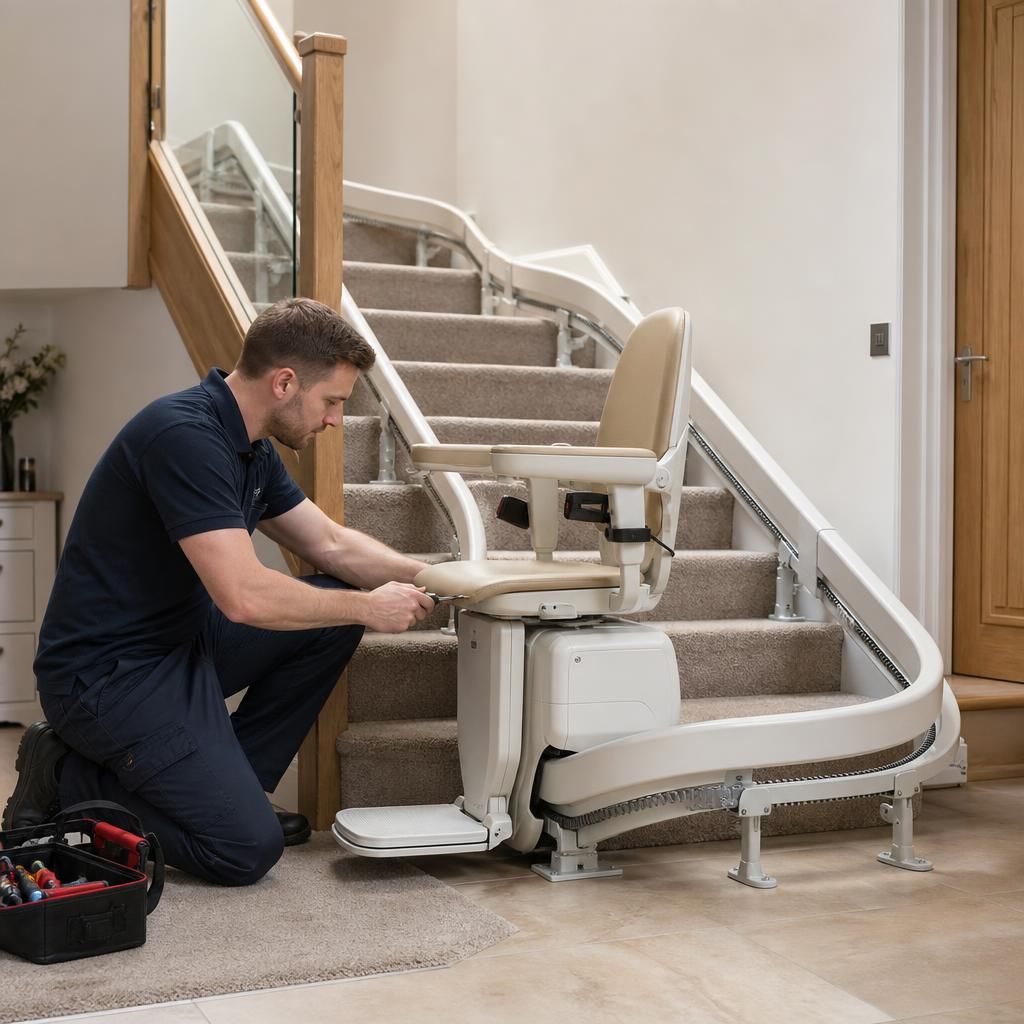
Arrange a professional chairlift maintenance check
Arrange a professional chairlift maintenance check with Independent Stairlifts to confirm that your split-level system is operating safely and smoothly. Contact our service team to discuss servicing, repairs or any changes in performance.