
What maintenance is required for chairlifts in split-level homes?
Chairlifts in split-level homes require routine user checks, regular professional servicing and prompt attention to wear or faults. Maintenance typically covers the track, drive system, batteries, seat, sensors and safety controls, with the schedule set by the manufacturer and the lift’s level of use.
Chairlifts in split-level homes need the same core maintenance as other stairlifts, with additional attention to the curved track, intermediate landings, charging points and any joins between sections. Routine user checks, professional servicing and prompt reporting of faults help keep the lift safe, reliable and suitable for the way it is used.
Follow the manufacturer’s maintenance schedule. The required service interval depends on the model, track design, usage and environment. A split-level chairlift that travels around bends or stops at more than one landing has more track sections, charging locations and control components than a simple straight installation. The service schedule supplied with the lift should therefore take priority over general guidance. Keep the service record and note any changes in performance between visits.
Routine checks for the user
- Keep the track, steps and landings clear of clothing, furniture, toys and other items that could obstruct the chair or carriage.
- Check that the chair starts, stops and travels smoothly, without unusual juddering, grinding or repeated hesitation.
- Make sure the seat, armrests, footrest and swivel mechanism are secure and free from damage.
- Test the seat belt and use it every time the lift is operated.
- Check that the remote controls, call stations and direction controls respond correctly.
- Confirm that the lift reaches its charging points and that the charging indicator behaves as described in the user instructions.
- Wipe the seat, armrests and accessible surfaces with a suitable product, taking care not to allow moisture into electrical controls.
Do not lubricate the rail, carriage or drive mechanism unless the manufacturer specifically instructs you to do so. Applying the wrong lubricant can attract dirt, affect sensors or interfere with components. Cleaning the track and surrounding area is usually appropriate, but mechanical adjustments should be left to a trained engineer.
What a professional service normally covers
- Inspection of the rail, brackets, fixings and transitions between straight and curved sections.
- Checks on the drive system, rollers, gearbox, motor and braking components.
- Testing of safety edges, obstruction sensors, limit switches and controls.
- Inspection of the seat swivel, locking mechanism, armrests, footrest and seat belt.
- Testing of batteries, charging contacts and power connections, including charging points on intermediate landings.
- Operational testing through the full route, including turns, stops and changes in direction.
- Inspection for wear, loose fixings, corrosion or damage, particularly where the stairlift is exposed to heavy use, damp or temperature changes.
On a split-level staircase, the engineer should assess the complete route rather than servicing only the section where a problem has been noticed. A fault at a landing, transition or charging point can affect travel elsewhere on the track. The engineer may also check that the lift stops in the correct position for safe transfer and that the swivel seat operates properly at each required landing.
Batteries and charging
Most chairlifts use rechargeable batteries and should remain connected to the mains when parked, unless the instructions for your particular model state otherwise. If the lift is regularly left away from a charging point, its batteries may discharge and eventually lose capacity. Warning sounds, slower operation, failure to start or the need to recharge more frequently can indicate a battery or charging fault. Do not replace batteries or electrical parts yourself; arrange an assessment so the charging system and batteries can be tested together.
When to stop using the lift
Stop using the chairlift and contact the service team if it moves unevenly, stops unexpectedly, makes a new mechanical noise, fails to charge, shows a fault code, or has a damaged seat belt, armrest, footrest or safety sensor. Do not bypass a sensor, continue operating after an impact, or attempt to force the chair past a stopping point. If someone is left unable to move safely between levels, follow the supplied emergency procedure and seek appropriate assistance rather than attempting a repair on the stairs.
Planned servicing does not remove the need for daily care. It is also important to tell the engineer about changes in use, such as more frequent journeys, a new user, mobility changes or alterations to furniture near the stairs. These details can affect how the chairlift is operated and whether its settings or accessories remain appropriate.
Outdoor split-level chairlifts require extra checks for water ingress, corrosion, dirt and temperature-related battery performance. Keep outdoor charging areas and controls protected as instructed, and report damage to covers or seals promptly. If the chairlift is used in a dusty, damp or particularly busy environment, the recommended service frequency may need to be reviewed.
For the correct maintenance plan, refer to the lift’s manual and service documentation. If you are unsure whether a noise, warning light or charging behaviour is normal, contact Independent Stairlifts before the issue develops into a breakdown. A trained engineer can identify whether the lift needs adjustment, replacement parts or a full service, while keeping the split-level track and its safety systems working as intended.
Professional servicing of a chairlift in a split-level home should cover the complete track route, including curves, transitions, intermediate landings and every charging point. Servicing only the section where a fault is noticed may miss an issue elsewhere in the system.
An engineer will typically inspect the rail, fixings, drive system, sensors, controls, seat, batteries and charging contacts, then test the chairlift through its full journey. They should also confirm that it stops accurately at each landing and that the swivel seat and safety controls work correctly for safe transfers.
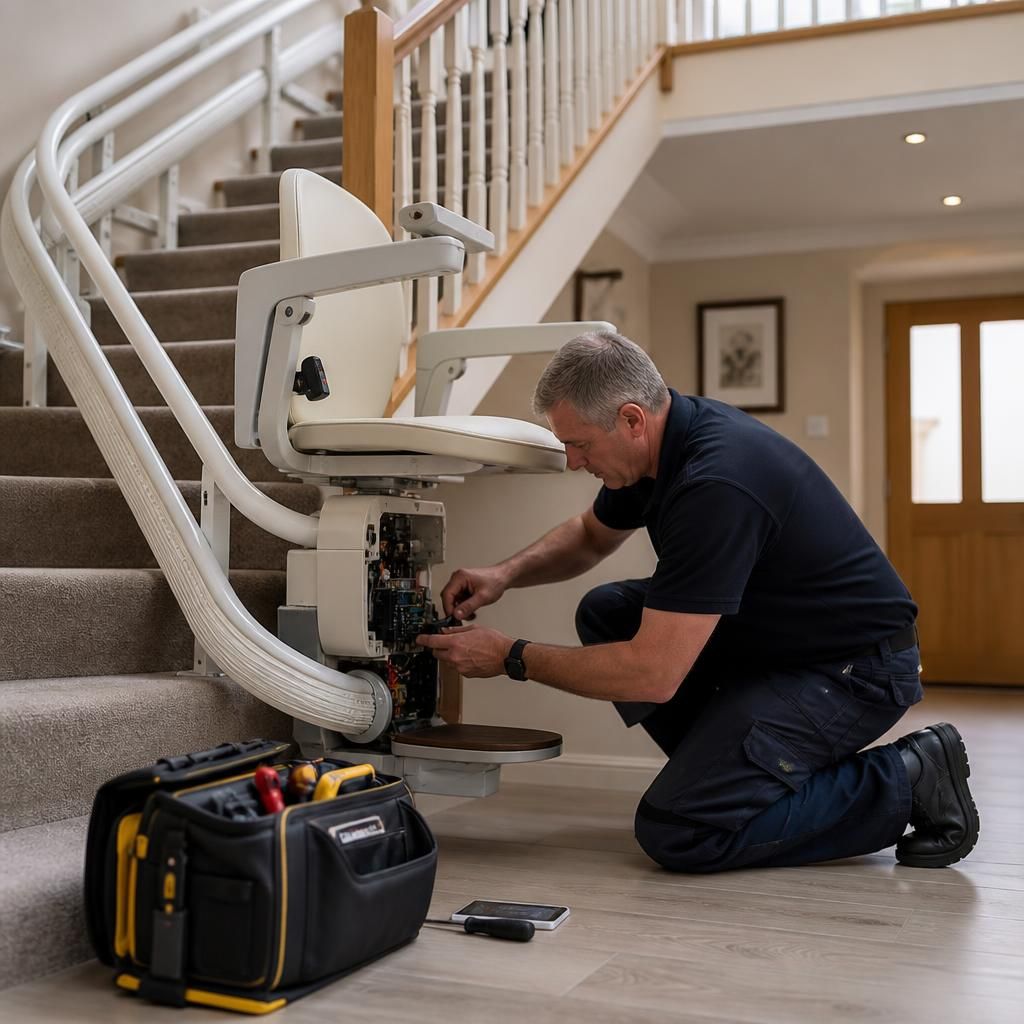
Arrange professional servicing for your split-level chairlift
Arrange professional servicing for your split-level chairlift with Independent Stairlifts to check the complete track, charging points, safety controls and drive system. Contact our service team if you notice unusual noises, uneven movement, charging problems or any change in performance.