
What are the safety features included in a chairlift for split-level stairs?
A chairlift for split-level stairs typically includes a secure seat belt or harness, swivel seat, stable footrest, obstruction sensors, safety brakes, and a controlled start and stop. Battery backup can keep the lift operating during a power cut, while the track and controls are assessed and configured to suit the staircase’s turns, landings and changes in level.
A chairlift for split-level stairs is designed to keep the passenger secure while the lift travels through turns, intermediate landings and changes in gradient. Typical safety features include a seat belt or harness, supportive armrests, a swivel seat, a stable footrest, obstruction sensors, controlled acceleration and braking, and battery backup. The exact specification depends on the stairlift model and the configuration identified during the home assessment.
Secure seating and positioning
- Seat belt or harness: This helps keep the passenger correctly positioned throughout the journey. Some designs use a lap belt, while others may offer a different restraint arrangement. It should be fastened before travelling and adjusted so that it is secure without being uncomfortable.
- Swivel seat: A swivel seat turns towards the landing when the lift reaches the top or bottom. This allows the passenger to get on or off facing away from the stairs, rather than twisting on the staircase. On a split-level installation, the position and direction of the swivel may be particularly important at intermediate landings.
- Armrests and footrest: Armrests provide lateral support, while the footrest gives the feet a defined, stable position. Depending on the model, the footrest may include raised edges or a safety sensor to help prevent the feet from moving into the path of the carriage or track.
- Seat and swivel interlocks: The lift is normally prevented from travelling unless the seat is in the correct position and the swivel mechanism is locked. This reduces the risk of movement while the passenger is getting on or off.
Protection from obstacles on the stairs
Obstruction sensors are fitted around the carriage, footrest or other vulnerable points. If the lift detects an object on the track or in its path, it should stop or prevent travel. This is especially relevant on split-level stairs, where a track may pass close to walls, doors, banisters or the edge of an intermediate landing. The installer checks these areas during the survey and confirms whether household objects, door openings or changes in floor level need additional safeguards.
It is still important to keep the staircase clear. Sensors are a protective feature, not a replacement for removing items from the steps or checking that children and pets are away from the lift before it moves.
Controlled movement and stopping
A suitable chairlift should start gradually, travel at a controlled speed and slow down before stopping. Smooth acceleration and braking help reduce sudden movement, particularly when the carriage travels around a bend or approaches a landing. Mechanical and electrical braking systems are designed to stop the lift safely if the normal drive system is interrupted or a fault is detected.
On a curved split-level installation, the track is manufactured or configured to follow the staircase rather than forcing the carriage to make an abrupt change in direction. The track design, carriage controls and stopping positions are checked together so that the lift stops in the intended location at each access point.
Controls and emergency stopping
- A simple control on the armrest allows the passenger to start, stop and guide the lift. It is normally designed to operate only while the control is being used, so releasing it stops the chair.
- Remote controls may allow the chair to be sent between floors when it is not occupied. These can be useful in a split-level home but should be kept where they cannot be operated accidentally.
- An emergency stop control is available on many models. Once activated, it stops the lift until the control is reset in accordance with the manufacturer’s instructions.
- Some systems provide audible alerts or display fault information. These warnings can help identify a low battery, an open safety circuit or an obstruction.
Battery backup and power protection
Most modern chairlifts use rechargeable batteries. The batteries normally allow the lift to complete journeys during a mains power failure, provided they are adequately charged and in good condition. A charging point is positioned so the chair can recharge when parked at a designated end of the track; some installations also include charging points elsewhere on a long or complex route.
Battery backup does not provide unlimited operation during a prolonged outage. If the lift will not operate, do not try to move it manually or bypass a safety device. Contact the appropriate service team and follow the emergency guidance supplied at installation.
Safety at intermediate landings
Split-level staircases can require more than one boarding or exit position. The assessment should identify where the passenger can transfer safely and whether the seat needs to swivel or stop in a particular orientation. A powered swivel, folding or hinged rail, and carefully selected parking position may be used where the staircase layout creates a risk of blocking a doorway or walkway. These features are specified according to the space available and the passenger’s mobility, not simply the number of levels.
Installation, checks and ongoing protection
Safety depends on correct fitting as well as the equipment itself. During installation, the track is secured to suitable parts of the staircase, clearances are checked, and the lift is tested at every turn and stopping point. The installer should explain the belt, controls, emergency procedure, charging routine and any restrictions that apply to the particular layout.
Regular use of the seat belt, keeping the track and steps clear, charging the batteries and arranging servicing when recommended help the safety systems work as intended. Do not use the chairlift if it behaves unexpectedly, stops repeatedly, makes an unusual noise or shows a fault warning. Park it safely, follow the manufacturer’s instructions and contact Independent Stairlifts for advice. A site assessment remains the most reliable way to confirm which safety features are needed for your split-level staircase and whether any additional adaptations are appropriate.
A chairlift for split-level stairs uses obstruction sensors to detect objects in the carriage’s path and stop the lift before contact. These sensors are particularly important where the track passes close to walls, doors, banisters or an intermediate landing.
Safety sensors work alongside controlled acceleration and braking, helping the chair start and stop smoothly as it approaches a bend or landing. Keep the steps and track clear, however, as sensors are a safeguard rather than a substitute for removing household items, pets or other obstacles.
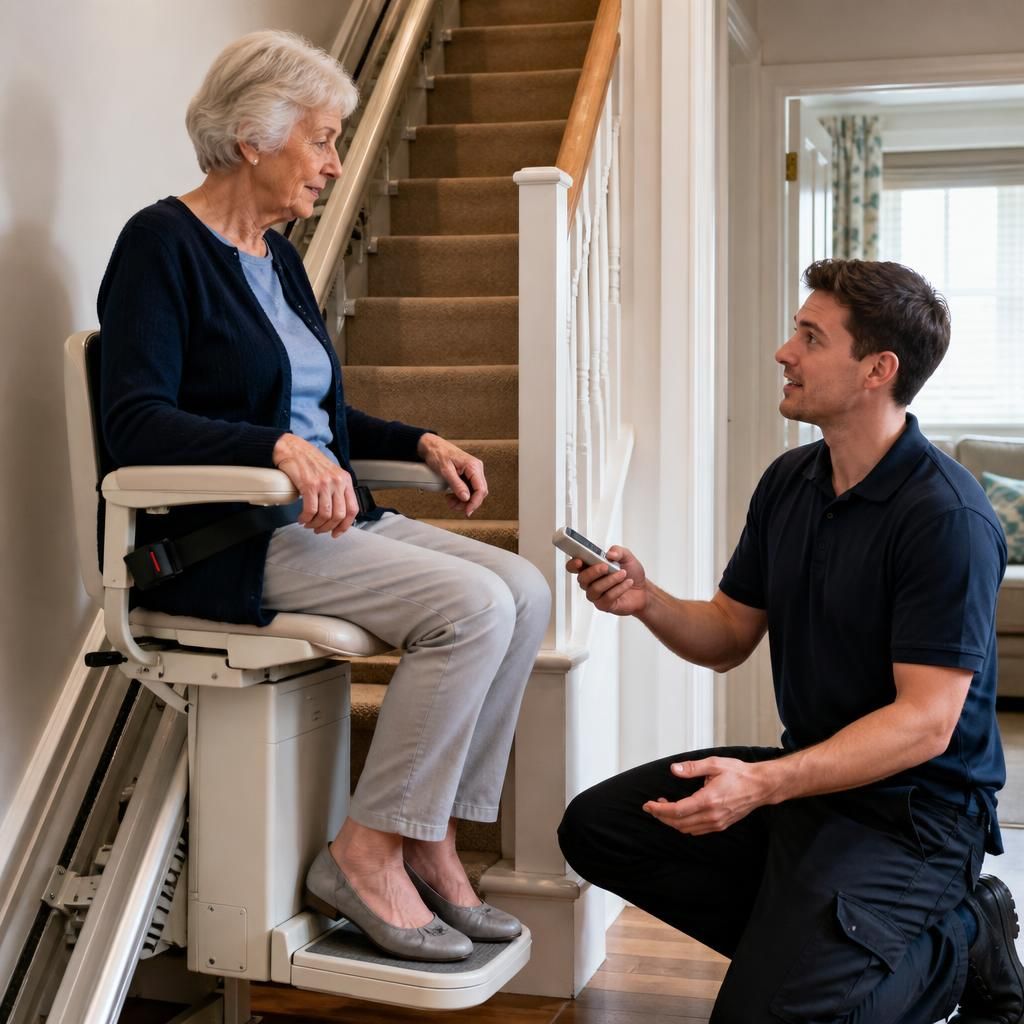
Discuss the right safety features for your split-level stairlift
Discuss the right safety features for your split-level stairlift with Independent Stairlifts, including seating, sensors, stopping positions and battery backup.