
What safety features do standing and low profile stairlifts include to ensure reliable and secure usage in everyday settings?
Standing and low profile stairlifts use safety features such as secure supports or seat restraints, non-slip footrests, obstruction sensors, controlled braking and battery backup to help provide stable, reliable travel on the stairs. User controls, safety switches and swivel or fold-away mechanisms are designed to support safe boarding, movement and dismounting, subject to the model and individual assessment.
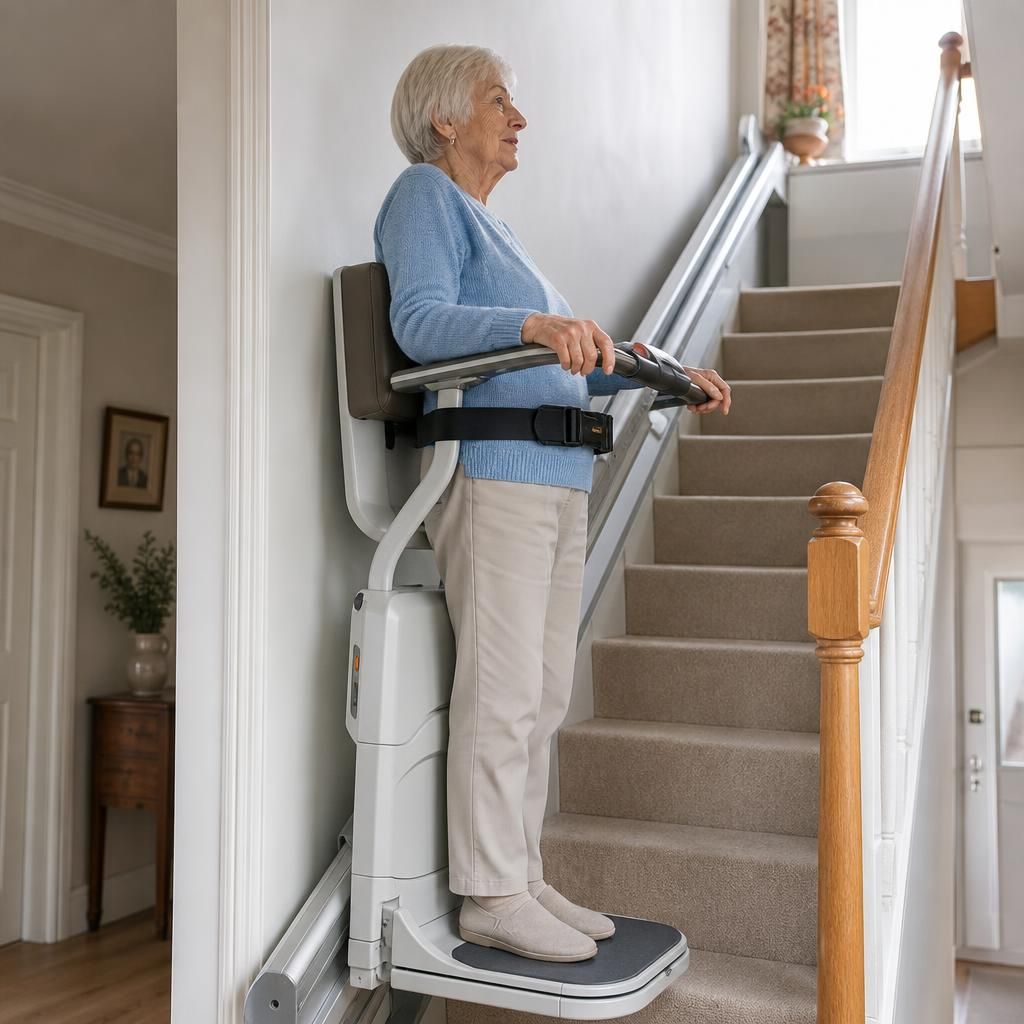
Standing and low profile stairlifts are designed with several layers of protection to support safe boarding, controlled travel and secure dismounting. Depending on the model, these can include a secure standing or perch position, a seat belt or harness, non-slip foot supports, obstruction sensors, automatic braking, safety interlocks, user controls and battery backup. The exact combination should be confirmed during the individual assessment, as safety requirements depend on the user, staircase and chosen configuration.
Support and restraint for the user
Standing and perch stairlifts generally provide a stable support arrangement rather than a conventional seated position. This may include a padded perch, support handles, a chest or waist support, and a restraint such as a seat belt or harness. These features help the user maintain their position while the lift is moving and reduce the risk of leaning too far forwards or sideways.
A low profile stairlift normally uses a compact seat. Its safety features can include a seat belt, supportive armrests, a shaped seat and a swivel mechanism that helps the user turn towards the landing before getting off. The seat, arms and footrest should be used as intended and kept in their locked travel position while the lift is moving.
Non-slip surfaces and foot protection
Standing users need reliable foot placement, so standing models commonly include a non-slip platform or foot supports. Low profile models generally have a footrest with a non-slip surface to help keep the feet clear of the steps and carriage mechanism. Some designs include a safety edge around the footplate. If the edge meets an object on the stairs, it can stop the lift so the obstruction can be removed safely.
Keeping feet, walking sticks, clothing and household items clear of the stairway remains important. A stairlift’s sensors are an additional safeguard, not a substitute for checking the route before travel.
Obstruction detection and controlled stopping
Safety sensors are positioned around areas that could meet an obstruction, including the footrest, carriage or lower part of the lift. When triggered, the lift should stop or prevent travel in the affected direction. This helps protect people, pets and objects on the stairs, although the precise sensor arrangement varies between models.
The drive system is also designed for controlled acceleration, travel and braking. The lift should not move unless the relevant controls and safety switches are correctly engaged. If a safety circuit is interrupted, the lift will normally stop rather than continue operating.
Controls and safety interlocks
Simple controls allow the user to start, stop and direct the lift. A hand control, armrest control or remote control may be available, depending on the design. Controls should be positioned so they can be operated without stretching or releasing the required support.
Safety interlocks help prevent travel when the seat, perch, swivel mechanism, armrests or other components are not in the correct position. For example, a swivel seat is normally required to be locked before the lift can move. A key switch or similar control can also prevent unauthorised operation, which is useful where children or visitors may use the stairs.
Battery backup and power failure protection
Most modern stairlifts charge through points on the rail or at designated parking positions and use rechargeable batteries. This allows the lift to complete journeys during a mains power cut, subject to the battery’s condition and available charge. The lift will usually provide an audible or visual warning when it needs to return to a charging point.
It is important to park the stairlift correctly so that it can recharge. A battery that is old, discharged or not receiving a proper charge may reduce the lift’s ability to operate during a power interruption. Servicing helps identify battery and charging problems before they affect reliability.
Safe boarding and dismounting
Standing and low profile models are selected partly for the way the user transfers on and off the lift. A standing user may need a firm handhold and enough landing space to turn safely. A seated user may benefit from a powered or manual swivel seat that faces them towards the landing before they stand.
Fold-away seats, arms, footrests and supports can help preserve access to the staircase when the lift is parked. They must be fully folded or deployed as instructed, and the user should wait for the lift to stop before releasing the restraint or leaving the seat. Where a landing is tight, the parked position and transfer space should be checked during the assessment.
Emergency measures and maintenance
Stairlifts normally include an emergency stop control and may provide diagnostic lights or audible alerts if a fault, low battery or safety interruption is detected. Some installations include a manual lowering or release procedure for use under professional guidance. Users should know how to stop the lift and who to contact if it does not operate normally.
Routine servicing checks the drive system, batteries, charging points, rail fixings, restraints, sensors, braking, controls and safety edges. Do not bypass a sensor, continue using a lift that stops unexpectedly, or attempt repairs without suitable technical knowledge. Keep the rail and steps clear, follow the operating instructions and report unusual noises, jerky movement or warning signals promptly.
How safety is confirmed for your staircase
Safety depends on the installation as well as the equipment. An assessment should consider the user’s balance, strength, height, weight, transfer ability and preferred posture, together with the staircase width, landings, doors and potential obstructions. The installer can then confirm whether a standing or low profile design provides adequate support, clearance and stopping space.
These features make everyday use more controlled, but they do not remove the need for correct fitting and operation. Before installation, ask which restraints, sensors, battery arrangements and emergency controls are included with the proposed model, and request a demonstration of boarding, travelling, stopping, parking and responding to a power cut.
Standing and low profile stairlifts use obstruction sensors and safety interlocks to stop travel when an unsafe condition is detected. Sensors around the footrest, carriage or platform can stop the lift if it meets an object, while interlocks prevent movement unless the seat, perch, swivel mechanism and supports are correctly positioned.
These safeguards help protect the user, pets and household items, but the staircase should still be checked before each journey. Keep feet, clothing, walking aids and other objects clear of the steps, and stop using the lift if it stops unexpectedly, moves unevenly or displays a warning.
Arrange a Safety Assessment for Your Stairlift
Arrange a safety assessment with Independent Stairlifts to confirm whether a standing or low profile stairlift provides the right support, clearance and controls for your staircase. We can discuss your needs, demonstrate suitable features and explain how the lift would be installed and used safely.