
What is the installation process for standing and low profile stairlifts, and how long does it typically take?
The installation process normally involves a home assessment, measuring the staircase, confirming the most suitable standing or low profile model, and securely fitting and testing the lift. A straightforward installation can often be completed within a few hours, although bespoke staircases, electrical work or other access requirements may make the appointment longer.
Installation of a standing or low profile stairlift usually involves a home assessment, detailed staircase measurements, confirmation of the correct configuration, secure fitting of the rail and lift, and a full safety test. On a straightforward staircase, the fitting can often be completed within a few hours. More time may be needed where the staircase is curved, unusually narrow, has irregular landings, or requires electrical or building work.
The process normally begins with a home assessment. An assessor reviews the staircase, the available space at the top and bottom, and the way the user approaches and leaves the lift. This is particularly important with standing and low profile models because the standing position, footplate, seat or support arrangement, and clearance beside the rail must suit both the user and the staircase.
The assessment will usually consider:
- the staircase shape, width, gradient and number of flights;
- available clearance at the top and bottom of the stairs;
- doorways, radiators, banisters and other potential obstructions;
- where the user will stand or sit before boarding and after reaching the landing;
- the most suitable rail position and parking location;
- the user’s height, mobility, balance, transfer ability and preferred method of operation;
- the position of a suitable electrical supply for charging; and
- whether a folding rail, hinged section or other space-saving option is required.
Measurements are taken at this stage to establish whether a standard configuration is suitable or whether the lift and rail need to be adapted. A standing stairlift may require careful consideration of the user’s standing posture and hand support, while a low profile model needs sufficient room for safe boarding and movement without making the staircase feel unnecessarily restricted. Where the staircase has a bend, tight turn or unusual landing, the rail may need to be made to follow its exact route.
Once the design has been confirmed, the installation is planned around the property. The installer will explain where the rail, controls, charging points and any additional safety equipment will be positioned. The lift is normally fixed to the stair treads rather than the wall, which helps avoid relying on the strength or condition of the wall beside the staircase. The exact fixing method depends on the model, staircase construction and manufacturer’s installation requirements.
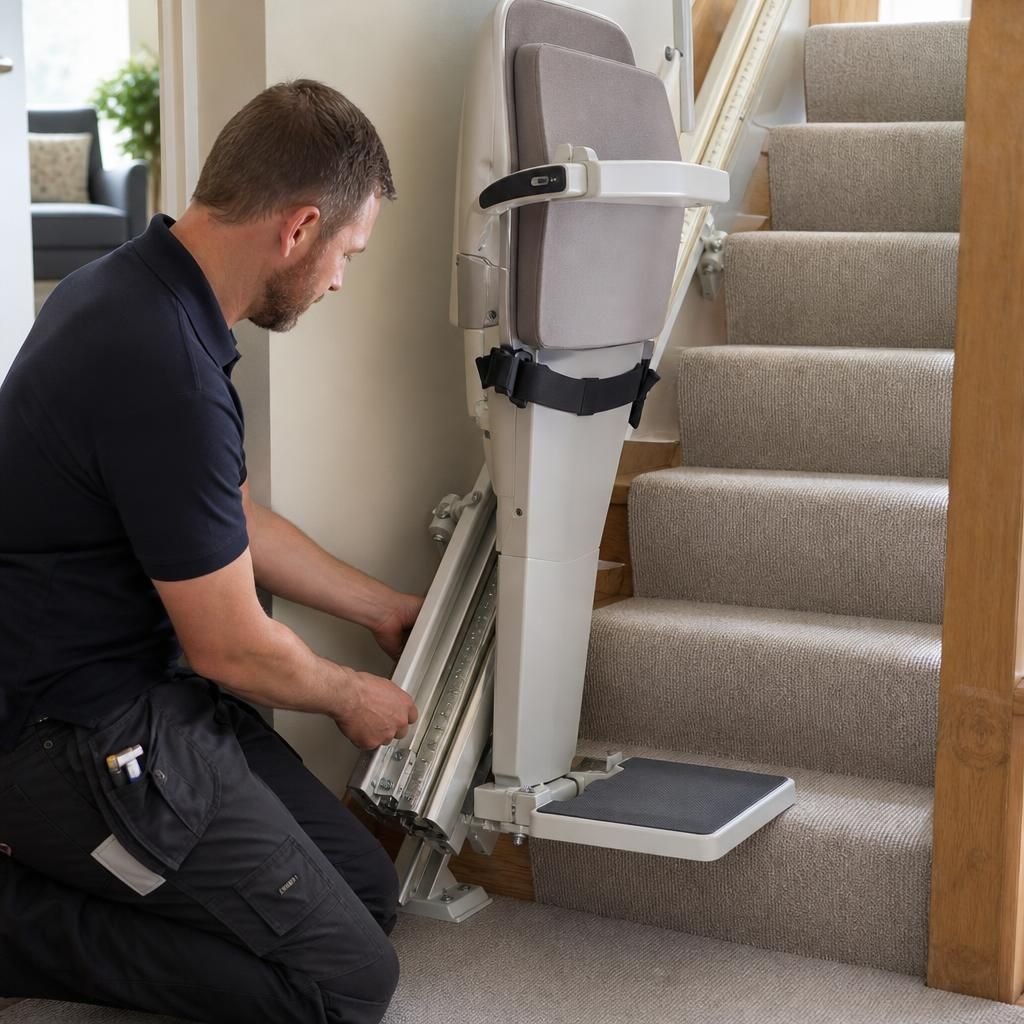
On the fitting day, the installer prepares the work area and checks that the agreed measurements and configuration remain suitable. The rail is assembled or delivered in the sections needed for the staircase and secured in position. The carriage, standing or low profile support system, footrest, arm supports where applicable, controls and safety components are then fitted. A charging point is installed or connected in the agreed location, subject to the existing electrical arrangements and any work that has been separately identified.
For a straight staircase, the rail and lift are generally simpler to position, so the installation is often completed during one visit. A curved or bespoke staircase usually requires more preparation because the rail follows the individual shape of the stairs. Irregular landings, restricted access, a narrow hallway, a hinged rail or the need to move furniture can also affect the time required. If electrical alterations, repairs to the staircase or other property work are necessary, these may need to be completed before or alongside the stairlift installation.
After fitting, the stairlift is thoroughly checked before it is handed over. The installer tests the movement of the lift along the full rail, its stopping points, charging operation and controls. Safety features such as the seat or standing support, seat belt where fitted, swivel or transfer mechanism, obstruction sensors, footrest sensors, braking and emergency stop controls are checked according to the model. The installer also confirms that the lift parks safely and that it does not obstruct doors, landings or normal use of the staircase.
The user is then shown how to operate the lift safely. This normally includes boarding and leaving the lift, using the controls, securing any belt or support, positioning the lift for charging, responding to an obstruction and using the emergency controls. Where someone else will assist with everyday use, that person should also receive the demonstration. Instructions and information about servicing, charging and reporting faults should be kept somewhere accessible.
Although the fitting itself may be completed in a few hours, the overall timescale depends on whether the required model is available, whether the staircase needs a bespoke rail, and whether additional work is identified during the assessment. A straightforward straight-stair installation can often be arranged and completed more quickly than a curved or architecturally unusual installation. The most reliable estimate is provided after the staircase has been assessed and the specification has been agreed.
Before the installation date, it helps to keep the staircase and landing clear, identify any furniture that may need moving, and tell the installer about changes in the user’s mobility or support needs. If the user is likely to need help transferring, standing for a short period or reaching the controls, this should be discussed during the assessment rather than left until fitting day. These details can affect the recommended configuration and help ensure that the completed installation is safe, practical and comfortable to use.
On installation day, the installer secures the rail to the stair treads, fits the standing or low profile support system, connects the controls and charging point, and tests the complete lift. The stairlift is normally fixed to the stairs rather than the wall, although the exact method depends on the staircase construction and the chosen model.
A straightforward straight-stair installation can often be completed within a few hours. A curved rail, tight landing, restricted access, hinged rail or required electrical work may make the appointment longer. Before the visit, keep the stairs and landings clear and identify any furniture that may need moving.
Before handover, the installer checks movement, stopping points, charging, controls, obstruction sensors and emergency functions. You will also be shown how to board, use the support or seat belt where fitted, park and charge the lift, and respond if an obstruction occurs. If a family member or carer will assist with everyday use, they should attend this demonstration.
Book Your Standing or Low Profile Stairlift Assessment
Book your standing or low profile stairlift assessment to confirm the right configuration, staircase fit and installation requirements for your home.