
What is the cost range for standing and low profile stairlifts, and are there financing options available?
The cost of a standing or low profile stairlift depends on the staircase, model, installation requirements and whether you choose a new or reconditioned lift, so an accurate price requires an assessment and quotation. Finance options may be available for eligible customers, with suitability, terms and repayment costs confirmed before you proceed.
The cost of a standing or low profile stairlift is usually several thousand pounds, but there is no single standard price. A new lift for a simple staircase will generally cost less than a bespoke solution for a curved, narrow or unusually configured staircase. Reconditioned models can reduce the initial cost, while finance may be available to eligible customers subject to assessment and agreed terms.
What determines the price?
- Staircase design: A straight stairlift is normally less complex to supply and install than a curved lift. Landings, bends, intermediate floors, spiral sections and changes in gradient can require a made-to-measure rail.
- Lift specification: Seat or standing-platform design, controls, powered swivel or folding features, safety sensors, weight capacity and the finish selected can all affect the quotation.
- Installation requirements: The survey will identify whether the lift can be fixed directly to the stairs, whether access is restricted and whether any minor alterations or additional electrical work are needed.
- New or reconditioned equipment: A reconditioned stairlift may offer a lower purchase price, although availability depends on the model, rail configuration and the suitability of the available equipment for your staircase.
- Aftercare: Check whether the price includes delivery, installation, demonstration, warranty cover and any agreed servicing. These inclusions can make quotations easier to compare accurately.
Standing and low profile stairlifts can be more specialised than conventional seated models. A standing lift is designed for someone who has difficulty bending the knees or sitting down, while a low profile model is intended to reduce the space taken up on the stairs or to make access easier where a conventional seat is unsuitable. Their price therefore depends not only on the staircase but also on the assessment of how the user will approach, stand on, balance on and leave the lift.
Why an assessment is needed
A remote estimate cannot reliably account for every factor. During an assessment, the adviser can measure the staircase, consider the available space at the top and bottom, check landings and doorways, discuss the user’s mobility and confirm which controls and safety features are appropriate. This helps establish whether a standing or low profile design is suitable and prevents a low headline price from being followed by unexpected installation costs.
The quotation should set out the recommended model, the rail and installation work, what is included in the warranty, and any items excluded from the price. It is sensible to ask whether the quoted amount includes VAT, removal of an existing lift, future servicing and call-out cover. If the staircase is unusual or access is limited, request confirmation that the price is based on the actual survey rather than a standard estimate.
Finance options
Finance may be available for eligible customers, but it is not automatic and approval is subject to the lender’s assessment. The terms can include a deposit, an agreement period, interest or other charges, and a total amount payable that is higher than the cash price. The important figures to review are the amount borrowed, the repayment amount, the frequency and number of payments, the annual percentage rate where applicable, and the total cost of the agreement.
Before accepting finance, make sure you understand:
- the cash price of the stairlift;
- the deposit, if one is required;
- the regular repayment and the total repayment;
- the interest rate and any administration or arrangement charges;
- what happens if a payment is missed;
- whether early repayment is permitted and whether it carries a charge; and
- which warranty and aftercare services are included.
Finance should be arranged only if the repayments remain affordable alongside existing household costs. If an application is declined or finance is not suitable, ask whether a cash quotation, a reconditioned option or a different specification is available. Choosing a lower-cost model should not mean compromising on the assessment, installation quality or safety features required for the user.
How to obtain an accurate cost
The most reliable way to establish the cost of a standing or low profile stairlift is to arrange a home assessment. Have details available about the user’s height, balance, ability to stand and transfer, and any difficulty with bending or gripping controls. The adviser can then compare suitable options rather than quoting a price for equipment that may not fit the staircase or meet the user’s needs.
Ask for the recommendation and price in writing, including any finance illustration requested. This gives you a clear comparison between new and reconditioned equipment and confirms exactly what you are agreeing to before installation.
The cost of a standing or low profile stairlift can only be confirmed after assessing both the staircase and the user’s mobility needs. A home assessment checks the rail route, available space, access at the landings and the features needed for safe standing, transferring and leaving the lift.
Ask for a written quotation showing the equipment, installation, warranty and any additional work included. If finance is available, the illustration should also state the deposit, regular repayments, interest or charges and total amount payable. This makes it easier to compare a new or reconditioned option and confirm that the proposed repayments are affordable.
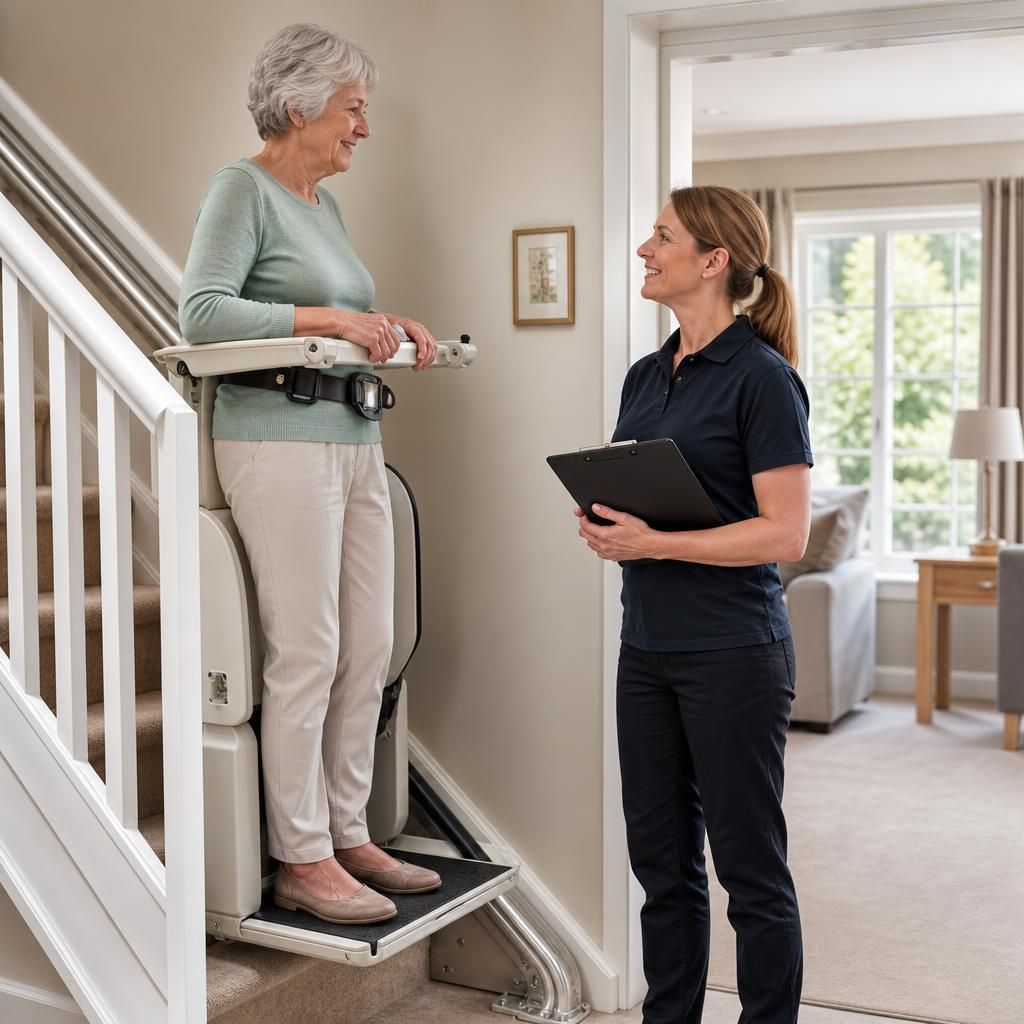
Arrange Your Standing or Low Profile Stairlift Assessment
Arrange a home assessment to confirm whether a standing or low profile stairlift suits your staircase and mobility needs, and receive a clear quotation based on the recommended specification. Ask about new, reconditioned and available finance options before making your decision.