
What are the differences between standing and low profile stairlifts in terms of their features and suitability for different homes?
Standing stairlifts are designed for users who find sitting difficult and use a compact perch or standing position, while low profile stairlifts have a slimmer rail and seat arrangement to preserve staircase and hallway space. Both can suit different homes, but the best choice depends on mobility, balance, stair width, landing layout and the available clearance at the top and bottom of the stairs.
Standing and low profile stairlifts solve different access problems. A standing, or perching, stairlift is designed for someone who cannot comfortably bend their knees or sit deeply, using a small seat or support in a semi-standing position. A low profile stairlift is designed to occupy less space on or beside the staircase, with a slim rail and compact seat or carriage that can help preserve usable hallway and landing space. The right choice depends on the user’s mobility and balance as well as the staircase and surrounding layout.
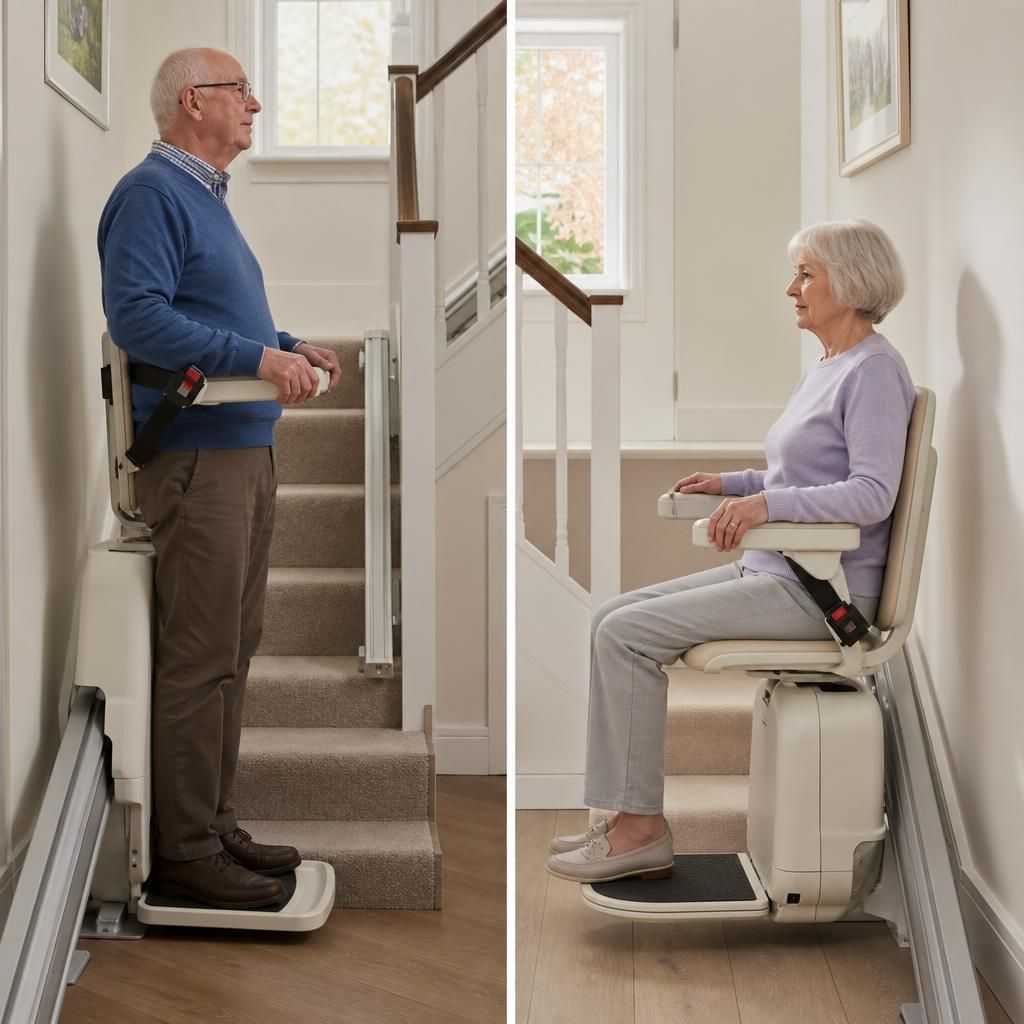
Standing stairlifts: Standing models typically have a raised or perch-style seat, a support belt or harness, handles and a footrest. The user usually approaches the lift, holds the supports, and travels in a semi-standing position rather than lowering into a conventional chair. This can make transfers easier for people with stiff hips, painful knees or restricted ability to flex their legs.
A standing stairlift may also be suitable where the staircase is narrow. Because the user’s legs remain closer to the stairs and the carriage can be relatively compact, it may require less width than some conventional seated designs. However, the user must be able to stand securely for the journey, maintain sufficient balance and follow the operating instructions. A standing model is not automatically suitable for everyone who finds sitting uncomfortable; an assessment is needed to check posture, strength, balance and transfer ability.
Low profile stairlifts: The term low profile generally refers to the lift’s space-saving design rather than a particular seating position. These models may use a slim rail, a narrow seat, folding arms, a compact footrest and a carriage that stays close to the stairway. When folded away, they can leave more room for other people to use the stairs and may reduce obstruction near a doorway, hallway or landing.
A low profile stairlift can be a good option in homes where the staircase is narrow or where the available space at the top or bottom is limited. It can also suit users who need a conventional seated position but want the lift to have as little impact as possible on the rest of the home. Depending on the model and the person’s needs, features may include a swivel seat to make getting on and off safer, adjustable seat or arm positions, a seat belt and controls on the armrest or remote control.
The main differences are as follows:
- Position during travel: a standing stairlift supports the user in a raised or semi-standing posture, while a low profile model generally allows seated travel, although its exact seat design varies.
- Primary purpose: standing models are mainly intended to make transfers and knee or hip movement easier; low profile models are mainly intended to reduce the space taken up by the stairlift.
- Physical requirements: standing models require adequate balance, leg strength and confidence while supported. Seated low profile models may be more appropriate where standing for the length of the journey is difficult.
- Space requirements: both types can be suitable for restricted staircases, but the usable width, folded dimensions and clearance at landings must be checked rather than assumed from the product description.
- Comfort and control: standing models focus on support handles, posture and secure positioning, whereas low profile seated models focus on seat comfort, transfer space and compact folding features.
Suitability for different homes depends on more than the staircase itself. A straight staircase may accommodate either type, but the assessment should consider its width, pitch, obstruction points and the space available to approach the lift. At the bottom, the lift may need to leave enough room to enter or exit without blocking a doorway or route through the hall. At the top, the user needs a safe area to dismount, turn and move away from the staircase.
In a home with a narrow hallway, furniture close to the stairs or a frequently used entrance, a low profile model may help preserve circulation space when folded. A standing model may also work well where the staircase is restricted, provided the user can stand safely and the supports do not interfere with the surrounding walls or handrail. If the stairlift is to be used by more than one person, the design must be assessed against the needs of the least able user rather than selected solely for its compactness.
Staircases with a bend, intermediate landing or unusual turn require additional consideration. A bespoke curved rail may be needed, and the position of the carriage when parked can affect both stair access and landing clearance. On a spiral staircase or a staircase with irregular geometry, a standing or low profile solution may be possible in some circumstances, but suitability cannot be confirmed from photographs or stair width alone. The shape of the rail, the user’s transfer position and the available clearance all need to be measured on site.
Safety and everyday use should be considered alongside space-saving features. A suitable model should provide secure positioning, a seat belt or support system appropriate to the design, obstruction detection, controlled starting and stopping, and a safe method of turning or dismounting where required. Controls should be reachable and understandable for the intended user. Folding parts must be manageable without excessive force, particularly if the lift is used by someone with limited hand strength.
Standing users should be able to place their feet securely, hold the handles throughout the journey and remain within the supported position. Seated users need to be able to transfer onto the seat, fasten the belt and swivel or rise safely at the landing. A low profile design does not remove the need for clear transfers, and a standing design does not remove the need for appropriate support. In both cases, the installation must leave the stairs and landings as clear as reasonably possible for other household members.
Choosing between the two usually starts with the user’s most difficult movement. If sitting down, rising from a chair or bending the knees is the main problem, a standing or perch-style stairlift may be considered. If the user needs to remain seated throughout the journey, a low profile seated model may be more suitable, particularly where the staircase or hallway is tight. If balance is poor, a conventional seated arrangement with suitable support may be safer than a standing model, even when the staircase is narrow.
An in-home assessment can compare both options against the actual staircase. It should review the user’s transfers, posture, balance, preferred controls, weight and height, as well as the rail position, parking points, doorways, handrails and available clearance. The assessment should also consider whether the user’s needs may change, since a model that is manageable now may become less suitable if standing or transferring becomes more difficult.
There is no universal advantage to standing or low profile stairlifts. Standing models prioritise access for people who struggle with a conventional seated posture, while low profile models prioritise a compact installation for homes where space is limited. Where both appear possible, the safest choice is the one that allows the user to transfer, travel and dismount consistently without strain, while leaving adequate clearance for everyone else using the home.
The main difference between a standing and low profile stairlift is the problem each is designed to solve: a standing model supports travel in a raised or semi-standing position, while a low profile model usually provides seated travel within a compact installation.
A standing stairlift may suit someone who struggles to bend the knees, lower into a seat or rise from a chair, but the user must be able to stand securely, maintain balance and hold the supports for the journey. A low profile seated model may be more appropriate when standing is tiring or unsafe, particularly if the user needs a supported seated position throughout.
Space must then be checked against the chosen design. The staircase width, folded dimensions, handrail position and clearance at the top and bottom all affect whether the lift leaves a safe route for other people. An in-home assessment should therefore consider the user’s transfers and balance before comparing compactness, rather than selecting a model from its dimensions alone.
Arrange an assessment for a standing or low profile stairlift
Arrange an assessment for a standing or low profile stairlift so we can compare your mobility needs with the space, clearances and layout of your staircase. We will help you identify the safest and most practical option for your home.