
How do standing and low profile stairlifts accommodate varying user needs, such as weight limits and ease of use?
Standing and low profile stairlifts accommodate different users through appropriate manufacturer weight limits, supportive seating or standing platforms, and simple controls that can be matched to individual mobility needs. A professional assessment confirms the safest model, positioning and features for the user and staircase.
Standing and low profile stairlifts accommodate varying user needs by combining an appropriate weight capacity with a suitable travelling position, supportive equipment and simple controls. A professional assessment is needed to confirm whether standing, perching or seated travel is safest, and to select a model whose manufacturer’s weight limit comfortably supports the intended user.
Weight limits and user suitability
Every stairlift has a stated maximum user weight. This limit applies to the person using the lift and must not be exceeded. It is important to check the specification for the exact model rather than relying on a general weight range, as capacity can vary between manufacturers, designs and configurations. The assessment should also consider body shape, balance, leg strength, ability to transfer on and off the lift, and whether the user can remain in the required position throughout the journey.
A standing or perching stairlift may suit someone who finds sitting down and rising from a conventional seat difficult, but it still requires sufficient strength and stability to stand or lean securely. A user who becomes unsteady, cannot bear weight reliably, or is at risk of their knees giving way may need a seated stairlift or another mobility solution instead. A low profile stairlift generally provides a compact seated or semi-seated arrangement, helping users who need more support while keeping the equipment less obtrusive on the staircase.
Weight capacity is only one part of the assessment. The stairlift must also provide enough room for the user’s hips, knees and feet, with the arms and any support features positioned comfortably. If the user wears outdoor clothing, uses a walking aid or needs assistance from a carer, this should be discussed before the model is selected. Walking frames and other aids normally travel separately from the user, so the staircase and landings must allow a safe transfer at each end.
How standing stairlifts support ease of use
- A raised or perching position can reduce the amount of bending needed when getting on and off the lift.
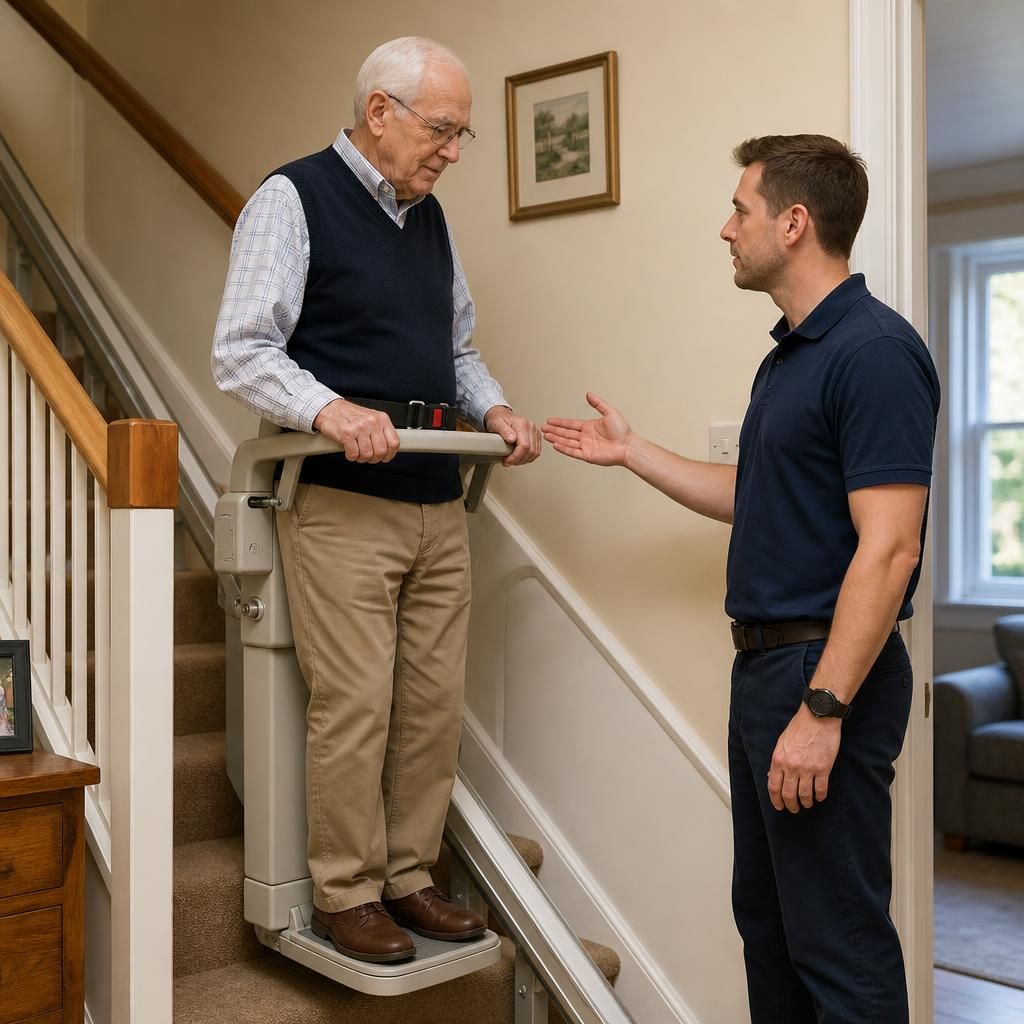
- Supportive armrests, a grab handle, a safety belt and a defined foot position can help the user maintain a stable posture during travel.
- Controls can usually be positioned where they are easy to reach without twisting or leaning.
- A powered swivel seat, if included in the design, can turn the user towards the landing to make the transfer easier.
- Simple directional controls and clear operating instructions can help users with reduced hand strength or limited dexterity.
Standing models are not automatically easier for every user. The correct position depends on balance, joint movement and confidence as well as on the staircase. The user should be able to hold the support, place their feet correctly and remain still while the lift moves. If these actions are difficult, a seated design with suitable transfer features may provide better support.
How low profile stairlifts support ease of use
- A compact seat and narrower overall arrangement can help preserve usable space on the stairs and at the landings.
- Foldable arms, seat and footrest can make it easier for other household members to pass when the lift is parked.
- A supportive seat, backrest and restraint can help users who cannot stand safely for the full journey.
- Adjustable seat height, where available, can improve the transfer between a chair, wheelchair or standing position and the stairlift.
- Remote controls can allow the lift to be called to the required floor, although the controls must be kept accessible and used as instructed.
A low profile design does not mean that the equipment is suitable for every staircase or every user. The seat, rail and footrest still need to clear walls, newel posts, doors and landings. The user must also be able to approach the seat safely and keep their feet within the supported area while travelling.
Controls and day-to-day operation
Ease of use is affected by more than the type of stairlift. A hand control should be mounted on the most convenient armrest or support, with buttons that the user can identify and operate. Some systems use a joystick, rocker switch or press-and-hold control. The user should not need to release a secure handhold, reach behind them or apply excessive force. Controls may be set up for either hand where the design allows this.
Users should receive a practical demonstration covering how to approach the lift, lock the seat or standing platform, fasten the belt, operate the controls, stop the lift and deal with a power interruption. Any family member or carer who may assist should receive the same guidance. The lift should be used only as described in its instructions; standing on a footrest, carrying another person or exceeding the specified capacity is unsafe.
What the assessment should confirm
- The user’s weight, height, posture, balance, strength and transfer ability.
- Whether a standing, perching or seated position is appropriate for the user’s medical and mobility needs.
- The required seat height, width, support arrangement and belt configuration.
- Clearance for knees, feet, hands and clothing throughout the journey.
- Safe boarding and exit positions at the top and bottom of the stairs.
- Whether the staircase, landings, doors and household layout require a particular rail or parking arrangement.
- Any features needed for easier operation, such as powered swivelling, powered folding or remote controls.
It is also worth considering whether the user’s needs are likely to change. A standing lift that is manageable now may become unsuitable if balance or leg strength deteriorates. Conversely, a compact seated model may offer more consistent support where sitting and standing transfers can be managed safely. The assessment should therefore focus on reliable everyday use, not simply whether the user can complete a single demonstration.
The manufacturer’s instructions and weight rating remain the final reference for safe use. If the user’s weight, mobility, posture or medical condition changes, contact the installation team for advice rather than adapting the lift independently. With the correct capacity, support features and operating position, a standing or low profile stairlift can be configured to provide controlled access between floors while matching the user’s practical abilities and the available space in the home.
A stairlift’s weight limit is only safe when considered alongside the user’s posture, balance and ability to transfer on and off the lift. The correct model must support the user comfortably throughout the journey, without exceeding the manufacturer’s stated capacity.
During the assessment, we consider whether a standing, perching or seated position provides the most reliable support. We also check clearance for the user’s knees, feet and clothing, along with the position of the controls, grab handles and safety belt. If the user’s mobility or weight changes, contact the installation team before continuing to use the lift or making any adjustments.
Arrange your standing or low profile stairlift assessment
Arrange your standing or low profile stairlift assessment with Independent Stairlifts to confirm the safest model, weight capacity, support features and controls for your needs and staircase.