
Are standing and low profile stairlifts equally safe and comfortable compared to traditional models?
Standing and low profile stairlifts can be as safe as traditional seated models when correctly assessed, fitted and used, with the right option depending on your mobility, balance and staircase. Traditional stairlifts usually provide greater seating support, while standing and low profile designs can offer more usable space and easier access where sitting or bending is difficult.
Standing and low profile stairlifts can be as safe as traditional seated stairlifts when the correct design is selected, professionally assessed and used as intended. They are not equally suitable for every person, however. Traditional models generally offer more seating support, while standing and low profile models can be safer and more comfortable for people who find sitting down, standing up or bending their knees difficult, or who need additional room on a narrow staircase.
Safety depends on the complete installation rather than on the stairlift style alone. The assessment should consider your balance, leg strength, joint movement, posture, weight, ability to use the controls and the shape of the staircase. It should also establish whether you can remain in the required position throughout the journey and get on and off the lift securely at the top and bottom.
How the different designs support you
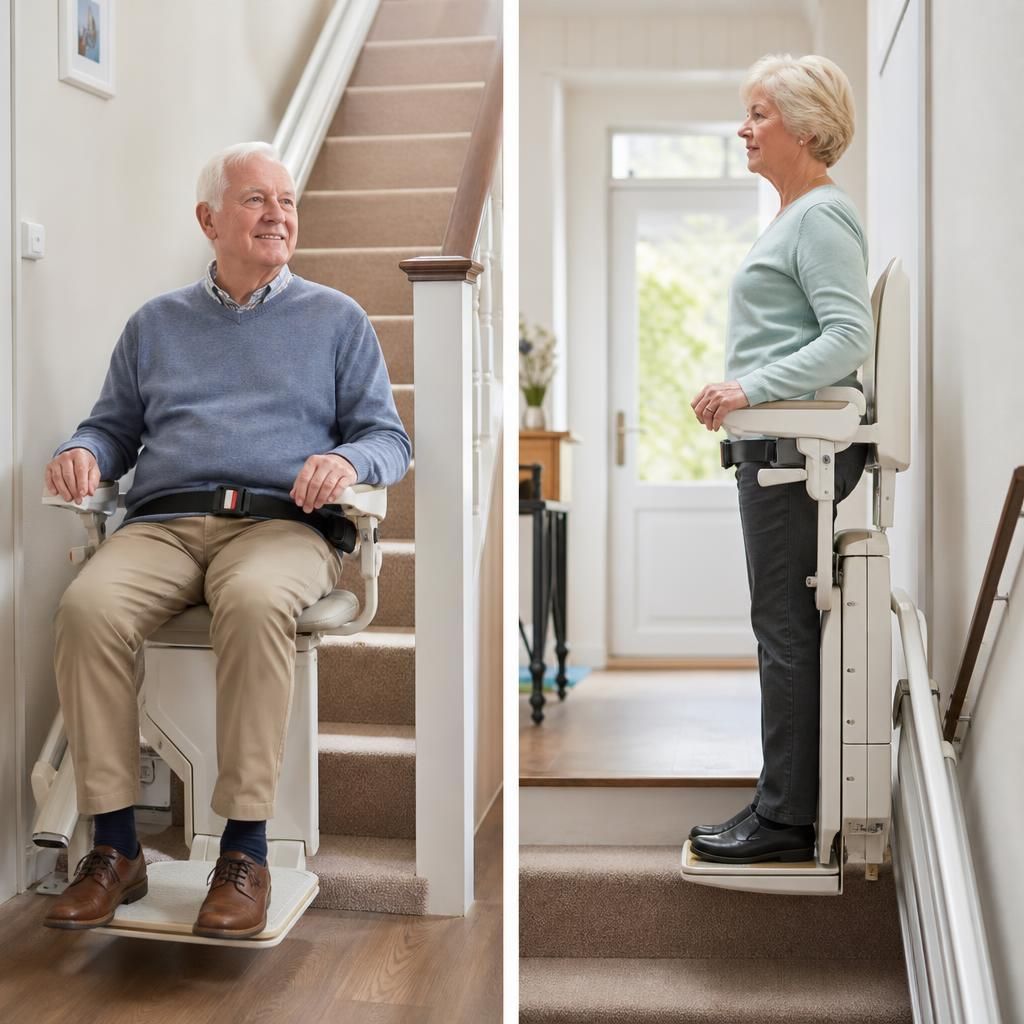
A traditional stairlift carries you in a seated position on a chair. The seat, armrests, footrest and safety belt provide several points of support, which can be helpful if you have reduced balance, fatigue easily or cannot stand for long. A swivel seat can make it easier to turn towards the landing before getting off, reducing the need to twist while standing.
A standing stairlift, sometimes called a perch stairlift, supports you in a semi-standing or perched position. It normally includes a supportive backrest, a small perch seat or support pad, arm supports and a safety belt. This arrangement may reduce the bend required at the hips and knees and can leave more usable space on the stairs. It still requires sufficient leg strength, balance and confidence to maintain the supported position during travel.
A low profile stairlift is designed to occupy less space around the staircase, usually through a compact seat, slimmer carriage or a more upright travelling position. The term can describe different designs, so the exact level of seating and support must be confirmed during the assessment. A low profile model is not automatically a standing model: some provide a compact seat, while others are intended for a perched position.
Safety compared with traditional models
All suitable stairlift types should include core safety features such as a seat belt or harness, sensors that stop the lift if an obstruction is detected, controls that require deliberate operation and a braking system that holds the carriage securely on the rail. Depending on the design, there may also be folding arms, a powered swivel seat, adjustable footrests, grab handles and safety edges around the footrest or carriage.
The main safety difference is the position in which you travel. A seated user has more direct support from the chair, whereas a standing or perched user relies more on their lower-limb strength, balance and the support provided by the backrest, arms and belt. Standing models should therefore not be treated as a safer choice simply because they provide more room. They are safer when that position matches the user’s physical ability and the staircase allows safe access.
Correct fitting is equally important. The rail must follow the staircase accurately, the lift must stop in suitable loading and unloading positions, and the controls must be reachable without leaning or twisting. On a curved or unusually configured staircase, the route, landing positions and any parked position need particular attention. A professional survey also checks doorways, radiator positions, handrails, available headroom and whether other people can still use the stairs safely.
Comfort and day-to-day use
Comfort is personal and involves more than the amount of padding. A seated stairlift may be preferable if you want to rest fully during the journey or have limited stamina. Seat width, seat height, back support, armrest position and footrest dimensions should allow you to sit upright without pressure behind the knees or excessive reaching.
A standing or low profile model may feel more comfortable if a conventional seat is difficult to lower into or rise from. It can also make the staircase feel less obstructed and may allow easier access for a person who needs to keep their knees relatively straight. However, remaining partly upright can be tiring or uncomfortable for someone with weak legs, poor balance, pain when weight-bearing or difficulty holding a steady posture.
Controls should be simple to operate from the intended hand position. A remote control can be useful when the stairlift is parked at the opposite end of the stairs, while a joystick or constant-pressure control may help prevent unintended movement. The belt, arms and any perch support should be easy to position without assistance. A trial or demonstration is often the most reliable way to judge whether the posture, transfer and controls feel manageable.
Who may benefit from each option?
- Traditional seated stairlifts: often suit people who need maximum seating support, cannot stand safely for the journey or become tired quickly.
- Standing stairlifts: may suit people who can stand securely with support but struggle to bend their hips or knees enough to use a conventional seat.
- Low profile stairlifts: may suit people who need a more compact solution on a narrow staircase, provided the chosen model gives adequate support and the user can transfer safely.
These are general indications rather than a substitute for an individual assessment. Conditions such as arthritis, stroke-related weakness, Parkinson’s disease, dizziness, reduced vision or medication-related drowsiness can affect which position is safest. If your ability changes, the most appropriate design may change as well.
How to establish the right choice
- Discuss how you currently use the stairs, including where you feel unsteady, stiff or short of breath.
- Demonstrate getting on and off the lift, not just travelling along the stairs. Transfers are a common point at which support and clearance matter.
- Check whether you can maintain the required posture, operate the controls and release the belt independently, or identify what assistance will be available.
- Confirm the lift’s maximum user weight, seat or perch dimensions and any model-specific restrictions with the installer.
- Review the parked position and the remaining stair width so that other household members can use the staircase safely.
- Ask for operating and emergency instructions, then practise them before relying on the lift every day.
In summary, traditional, standing and low profile stairlifts can all provide secure everyday access, but their safety and comfort depend on matching the design to the person and the staircase. A traditional chair usually offers the greatest seated support; standing and low profile designs can reduce bending and preserve space. The most appropriate option is the one that allows controlled transfers, a stable travelling position, straightforward operation and safe clearance throughout the route.
Standing and low profile stairlifts can be as safe as traditional seated models when the design matches the user’s balance, leg strength and ability to transfer on and off the lift. They are not automatically safer simply because they take up less space.
A seated stairlift provides more support for people who tire easily or cannot stand securely, while a standing or perched model may reduce the bending needed at the hips and knees. During an assessment, the installer should check your posture, controls, belt, clearances and loading positions to confirm that you can travel comfortably and securely throughout the staircase.
Book an assessment for a safe, comfortable stairlift
Book an individual assessment to compare standing, low profile and traditional stairlift options against your mobility needs and staircase layout. We can check transfers, posture, controls and clearances before recommending the safest, most comfortable solution.