
What maintenance is required for slimline stairlifts and how often should it be performed?
Slimline stairlifts should receive routine user checks and a professional service at least once a year, or as specified by the manufacturer. Regular maintenance includes checking the seat, controls, safety sensors, charging points, batteries, track and moving parts, while faults, unusual noises or reduced performance should be reported promptly.
A slimline stairlift should have simple user checks regularly and a professional service at least once a year, unless the manufacturer specifies a different interval. Maintenance covers the seat, controls, safety systems, charging points, batteries, rail and moving parts. Because slimline models are designed to fit narrow staircases, keeping the lift correctly adjusted and free from obstructions is particularly important for safe, dependable operation.
Daily or routine checks
Before using the stairlift, look and listen for anything that seems different. You should check that:
- The seat is secure and locks correctly in its travelling position.
- The armrests, footrest and seat belt are present, clean and undamaged.
- The controls respond normally and the direction switches return correctly.
- The stairlift starts, stops and travels smoothly without jolting, hesitation or unusual noise.
- The safety sensors stop the lift when they meet an obstruction, where this can be checked safely in accordance with the operating instructions.
- The rail and staircase are clear of furniture, clothing, pets and other objects.
- The lift reaches its charging point and shows the expected charging indication when parked.
Keep the rail, seat and controls clean with a soft, slightly damp cloth. Do not pour liquid onto the lift, use abrasive products or apply oil and grease unless the manufacturer specifically instructs you to do so. The rail normally uses a specified lubrication system, and incorrect lubrication can attract dust or affect the lift’s operation.
Professional servicing
A qualified stairlift engineer should inspect and service the lift at least annually. More frequent visits may be appropriate if the lift is used heavily, is installed in a demanding environment, has previously developed faults or is covered by a manufacturer’s maintenance schedule requiring shorter intervals. The recommended interval for your particular model should take priority over general guidance.
During a service, the engineer will typically:
- Inspect the rail, brackets, drive system and other moving components for wear, damage or looseness.
- Test the seat, swivel mechanism, armrests, footrest, seat belt and manual or powered controls.
- Check safety edges, sensors, limit switches, interlocks and emergency stopping functions.
- Examine the batteries, charging contacts and charger, including whether the lift is receiving and holding charge correctly.
- Check the lift’s alignment, travel speed, stopping position and operation on the full length of the staircase.
- Clean, adjust or lubricate parts where the manufacturer’s instructions permit it.
- Identify worn components and explain whether they need adjustment, repair or replacement.
Servicing is more than a visual inspection. A lift may continue to move while its batteries, safety sensors or mechanical components are deteriorating, so an engineer’s functional tests can identify problems that are not obvious during normal use.
Batteries and charging
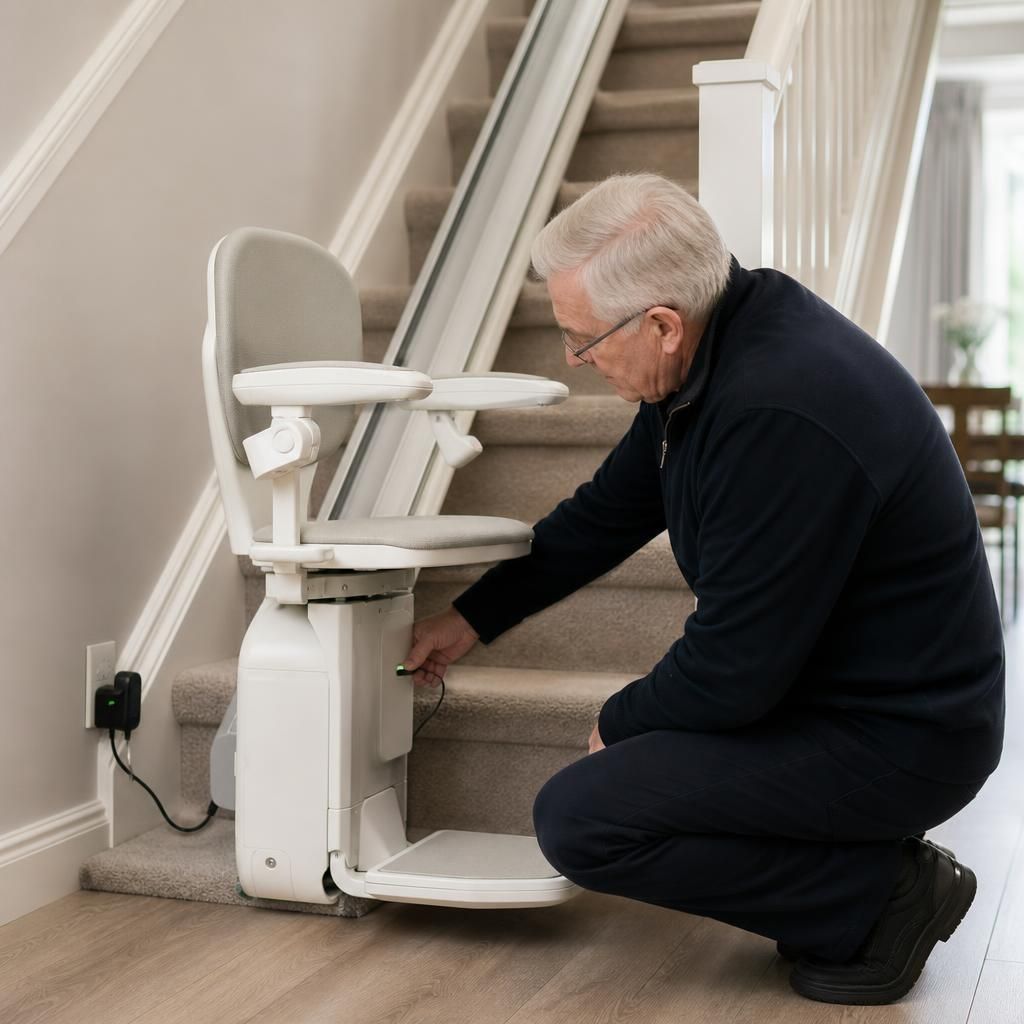
Rechargeable batteries are affected by age, usage and charging conditions. Park the stairlift at its designated charging point whenever it is not in use, rather than leaving it part-way along the rail. If the lift is used only occasionally, regular charging is still important because batteries can lose capacity while standing unused.
Reduced travel distance, a low-battery warning, slower movement or the lift failing to leave its charging point can indicate a battery or charging fault. Battery replacement should be carried out by a suitably qualified person using the correct specification. Do not attempt to open the battery pack or charger yourself.
When to report a fault
Contact Independent Stairlifts or your service provider promptly if you notice unusual noise, vibration, a burning smell, repeated stopping, jerky movement, a fault warning, poor charging, damaged wiring or a safety feature that does not work as expected. Stop using the lift if it is unsafe, if the seat belt or seat mechanism is damaged, or if it moves without the normal control input. Keep the staircase clear and follow the instructions for your model while waiting for advice.
Do not bypass sensors, force the controls, remove covers or try to repair electrical or drive components. Slimline stairlifts contain safety-critical systems, and an apparently minor adjustment can affect stopping distances, clearances or the lift’s ability to detect an obstruction.
Keeping a useful maintenance record
Keep the operating manual, service information and engineer’s reports together. Make a note of service dates, battery replacements, recurring fault messages and any changes in performance. This gives the engineer useful information and helps ensure that maintenance is arranged before a recommended service interval is missed.
Routine cleaning and checks help prevent avoidable problems, but they do not replace professional servicing. Arranging the recommended service each year, reporting changes promptly and using the stairlift as instructed will help maintain its safety and reliability without attempting work that should be carried out by a qualified engineer.
Regular charging is an important part of maintaining a slimline stairlift, because its rechargeable batteries power the lift and its safety systems. Park the stairlift at its designated charging point whenever it is not in use, including after occasional journeys, so the batteries remain ready for operation.
Reduced travel distance, slower movement, a low-battery warning or difficulty leaving the charging point can indicate a battery or charging fault. Report these signs to Independent Stairlifts or your service provider rather than continuing to use the lift until it stops. Battery replacement and charger checks should be completed by a qualified engineer using the correct specification.
Arrange your slimline stairlift service
If your slimline stairlift is due a service, or you have noticed changes in its movement, charging or safety features, contact Independent Stairlifts to arrange an engineer inspection. Our team can advise on the appropriate maintenance for your model and installation.