
What factors should be considered when choosing a slimline stairlift for steep or curved stairs?
When choosing a slimline stairlift for steep or curved stairs, consider the staircase’s dimensions and shape, the lift’s track design, weight capacity, safety features, seating comfort, parking position and installation requirements. A professional assessment is essential to confirm that the model can follow the staircase accurately while leaving sufficient space for other users.
Choosing a slimline stairlift for steep or curved stairs depends on more than the width of the seat or carriage. The staircase geometry, track design, user’s mobility and posture, available parking space, safety requirements and installation conditions must all be assessed together. A professional home survey is essential because a curved or unusually steep staircase normally requires a stairlift configured to the specific shape and gradient of the stairs.
Start with the staircase layout
The first consideration is whether the stairlift can follow the staircase accurately without obstructing the steps, doorways or landings. A survey should examine:
- the width and usable depth of each flight;
- the steepness and consistency of the gradient;
- curves, bends, half-landings and changes in direction;
- the height and shape of the steps;
- the space available at the top and bottom of the stairs; and
- nearby doors, radiators, furniture, bannisters and other obstructions.
On a curved staircase, the rail is usually made to measure so that the carriage follows the route smoothly. On steep stairs, the lift must be suitable for the gradient and any changes in angle between flights. A slimline model is not automatically appropriate simply because it occupies less space than a standard model.
Check how the track will be designed and parked
The rail design affects both safety and the amount of staircase left available for other people. For a curved installation, the track may need to negotiate internal or external bends, landings and changes in gradient. The positioning of the track on the steps, rather than on the wall, can also affect usable stair width and the clearance beside the carriage.
Parking positions should be discussed before choosing the model. A lift may park at the top, bottom or on a landing, depending on the layout. A hinged or powered rail may be useful where the track would otherwise interfere with a doorway or walkway, although the available space and the installation design will determine whether this is possible. The carriage should be left in a position where it does not create a trip hazard or prevent access to a door, hallway or landing.
Consider the steepness and the user’s position
Steep stairs can affect how secure and comfortable the passenger feels during travel. Depending on the model and staircase, features such as a level or swivel seat, a powered swivel mechanism and a seat that maintains a suitable position on the rail may be important. The user should be able to sit back fully, place their feet securely on the footrest and operate the controls without leaning or twisting.
A swivel seat can help the passenger turn towards the landing before getting on or off the lift. This is particularly relevant where the top or bottom of the staircase is tight. However, the space needed to swivel and transfer must be checked carefully. A compact lift is only suitable if the person can use it safely and independently, or with the assistance available to them.
Assess safety features for the specific staircase
Safety features should be considered in relation to the user and the layout, not treated as a standard checklist. Important points include:
- a seat belt that can be fastened and released easily;
- obstacle sensors that stop the lift if something is on the track or stairs;
- controls that are simple to operate and suitable for the user’s hand strength and dexterity;
- armrests and a footrest that provide adequate support;
- an emergency stop or other method of stopping the lift when required;
- battery operation that allows the lift to complete a journey safely during a mains power failure; and
- safety edges, locks or other protective features appropriate to the model.
On a steep or curved staircase, it is especially important to understand how the lift stops at landings and what happens if an obstruction is detected. The installer should explain the controls, charging points, emergency procedures and safe transfer technique during handover.
Match the weight capacity to the passenger
Slimline construction does not mean that weight capacity can be assumed. Check the manufacturer’s stated maximum user weight for the exact model and configuration, and include clothing, footwear and any items the passenger may carry. The lift must not be used above its rated capacity.
Weight distribution, posture and the ability to sit securely may also affect model selection. If the passenger has limited trunk control, involuntary movements, a larger frame or difficulty bending the knees, a more supportive seat or a different carriage configuration may be required. These points should be discussed openly during the assessment so that comfort and safety are considered together.
Allow for entry, exit and everyday use
The passenger needs enough room to approach the seat, sit down, fasten the belt and leave the lift at the destination. This can be more difficult where the staircase starts close to a wall, a door or a piece of furniture. The survey should consider whether the user can transfer safely at both ends and whether a carer or family member needs to stand nearby.
Look at practical controls as well as the physical fit. Remote controls can allow the lift to be called to another floor, while controls on the armrest may be preferable for the passenger. Folding seats, arms and footrests can reduce the space occupied when the lift is parked, but the user must still be able to operate them reliably.
Check installation conditions
Most domestic stairlifts are fixed to the stairs or stair structure rather than relying solely on the wall. The installer will need to confirm that the steps and supporting structure are suitable for the proposed fixings. Uneven, damaged or unusually constructed stairs may require additional preparation or a different installation approach.
For a curved lift, the rail is normally produced to match the surveyed staircase, so accurate measurements are important. Changes made to the staircase after the survey, such as new flooring, alterations to bannisters or building work, should be mentioned before installation because they can affect clearances and parking positions.
Consider the effect on other people in the home
A slimline stairlift should leave a practical route for family members, visitors and carers wherever the staircase allows. On particularly narrow stairs, check the remaining clearance with the lift folded and unfolded, and consider whether the carriage can be parked out of the main walking route. A fold-up seat and compact armrests may help, but they cannot overcome every limitation of a tight or sharply curved staircase.
Where the staircase is the only route between floors, the installation plan should also consider access during fitting and what will happen if the lift is temporarily unavailable. The household should know how to use the manual lowering, charging and emergency procedures applicable to the chosen model.
Compare comfort, appearance and long-term support
For regular use, comfort is as important as compactness. Compare the seat depth, back support, cushioning, armrest position, footrest size and ease of adjustment. A seat that is too narrow or low may make transfers harder, while a larger seat may reduce the remaining staircase clearance. The best balance depends on the passenger rather than on the model’s dimensions alone.
Ask what servicing, fault support, battery replacement and warranty arrangements apply to the specific installation. Curved systems have a bespoke track, so future alterations or replacement parts may need to be matched to that track. Keeping the rail and charging points clear, following the operating instructions and reporting unusual noises, stopping or movement promptly can help maintain safe operation.
Use the home survey to make the final decision
A suitable choice should be based on a measured assessment, a demonstration where practical and a clear explanation of the proposed track route. Before proceeding, confirm that the recommended slimline stairlift:
- can accommodate the full staircase gradient and every curve or landing;
- provides safe clearance for other users;
- has a suitable parking position at each relevant floor;
- matches the passenger’s weight, posture, mobility and transfer ability;
- offers controls and safety features the passenger can use confidently; and
- can be installed, maintained and supported in the home for ongoing use.
Where the staircase is steep, curved or unusually confined, the survey findings should take priority over a general assumption that a slimline model will fit. The right solution is the one that combines an accurately designed track with safe transfers, adequate support and enough remaining space for the household to use the stairs normally.
For steep or curved stairs, the track design is the key factor in determining whether a slimline stairlift will fit safely. A curved rail is made to follow the staircase’s bends, landings and changes in gradient, while the carriage must remain stable and provide sufficient clearance for the passenger and other people using the stairs.
During the survey, the installer should assess the usable stair width, the position of nearby doors and bannisters, and the space available at the top and bottom for boarding and leaving the lift. Parking position is equally important: the stairlift should fold or park where it does not obstruct a doorway, landing or normal walking route. On a particularly tight staircase, a hinged or powered rail may be considered if the layout allows it.
Do not choose a model based on its folded dimensions alone. The passenger must be able to approach the seat, transfer safely, fasten the seat belt and operate the controls without leaning or twisting. A measured home survey and, where practical, a demonstration provide the clearest way to confirm that the proposed slimline stairlift suits both the staircase and the person using it.
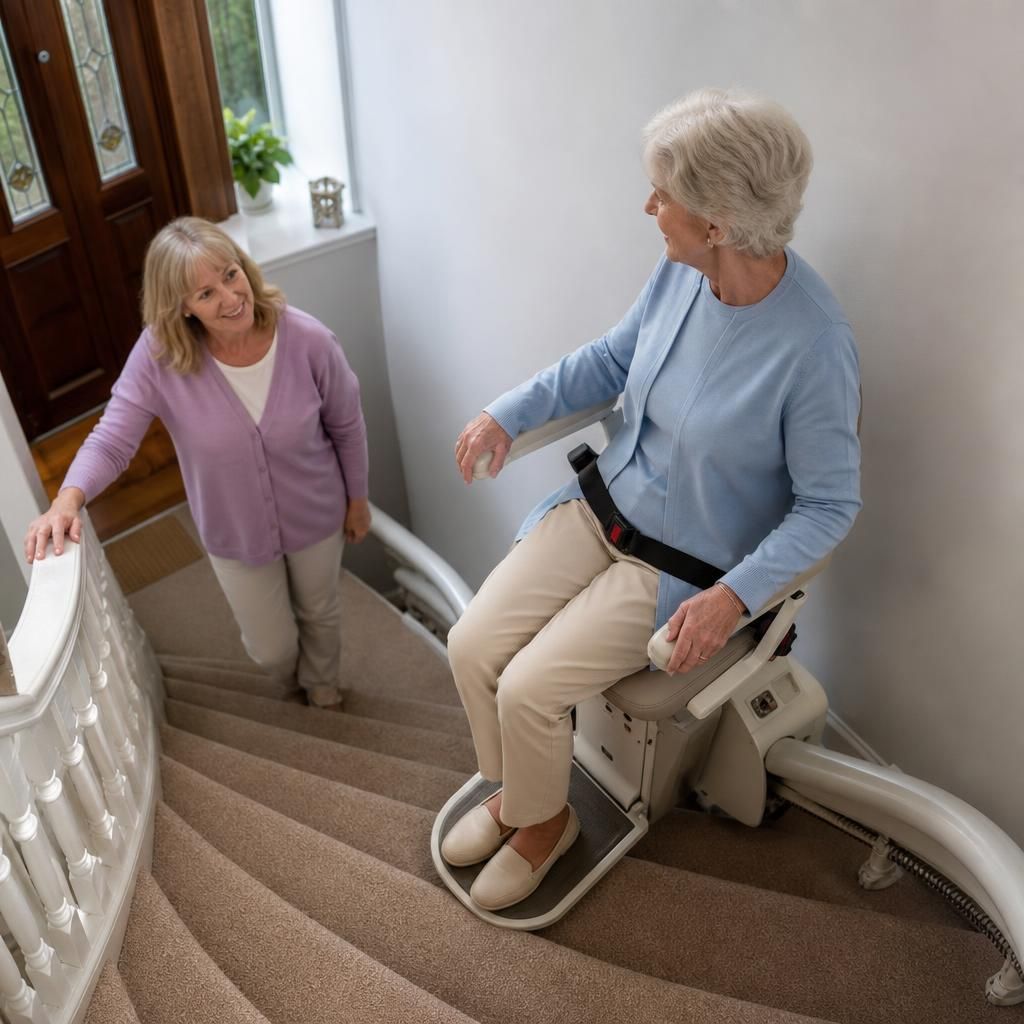
Arrange a Home Survey for Your Slimline Stairlift
Arrange a home survey for your slimline stairlift so we can assess the staircase, available clearances and your specific mobility needs. This confirms whether the proposed solution is suitable for steep or curved stairs before installation.