
What are the main features of slimline stairlifts that make them suitable for narrow spaces?
Slimline stairlifts are designed with a compact rail and narrow-profile seat, allowing them to fit staircases where a traditional model may leave limited clearance. Folding seats, armrests and footrests reduce the space they occupy when parked, while smooth powered movement and safety controls support comfortable, reliable use.
Slimline stairlifts are suitable for narrow spaces because their main components are designed to occupy less room than those of many standard models. A compact rail, narrow-profile seat, folding armrests and footrest help preserve usable space on the stairs and landing, while safety sensors and controlled movement support secure everyday use.
Compact rail design is one of the most important features. The rail is fitted close to the stair treads, rather than taking up unnecessary room beside the staircase. Depending on the layout, it may be installed on the side that provides the clearest passage or best access at the top and bottom. On some staircases, a hinged or powered folding rail can also prevent the rail from projecting into a doorway, corridor or walkway.
A slim seat and narrower chassis reduce the overall width of the stairlift. The seat is shaped to provide appropriate support without adding bulk, and the carriage is engineered to travel smoothly along the rail while remaining close to the stairs. This can make a noticeable difference where another person needs to pass the lift or where the staircase is beside a wall, banister or piece of furniture.
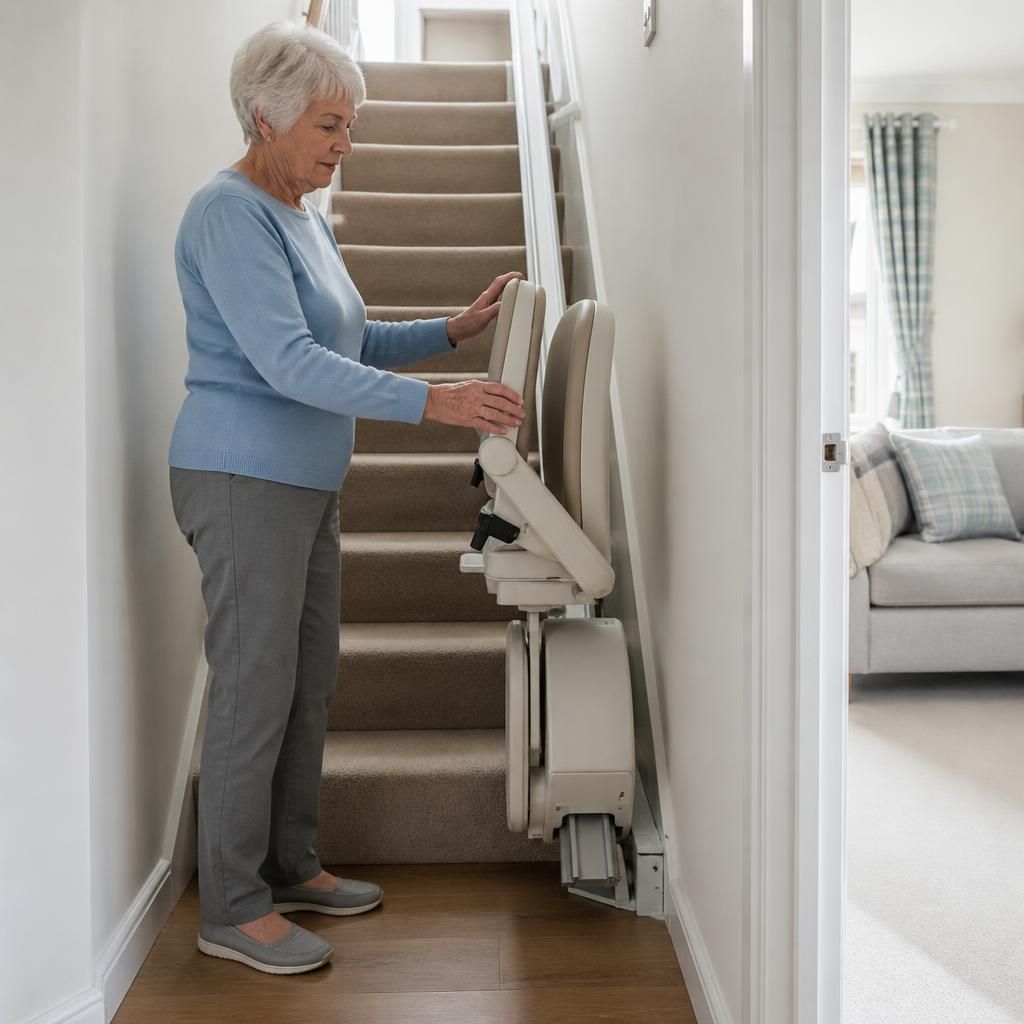
Folding components allow the stairlift to occupy less space when it is not being used. The seat, armrests and footrest can usually be folded away at the parking position. This helps maintain access to the staircase and reduces the risk of someone catching a foot or clothing on a projecting part. Some designs also allow the lift to be parked away from the narrowest section of the stairs, provided the available landing space permits this.
A swivel seat improves access without requiring extra stair width. At the top of the staircase, the seat can turn towards the landing so that the user can get off facing a safer direction, rather than twisting towards the stairs. A swivel mechanism may be operated manually or powered, depending on the model and the user’s strength and dexterity. The landing must still provide enough clear space for the user to turn, stand and move away from the lift safely.
Integrated controls are designed for simple operation in a confined position. Controls are commonly placed on an armrest, with a separate call-and-send control available at the top or bottom of the stairs. Easy-to-operate switches, clear directional controls and suitable control positioning are particularly important when the user has limited grip, movement or vision. A professional assessment should confirm that the user can reach and operate the controls comfortably from the seated position.
Safety systems protect the user and the surrounding space. Obstacle sensors can stop the stairlift if the footrest or carriage meets an object on the stairs. Seat belts or harnesses, braking systems, armrests and secure footrests help maintain a stable seated position during travel. Many battery-powered models also continue to operate during a mains power interruption, although the exact arrangement depends on the equipment selected.
Powered folding and swivel options can be useful where movement is restricted. A powered footrest or powered swivel can remove the need to bend down or use force in a tight area. These features add convenience but may affect the total specification and cost, so they should be selected according to the user’s needs rather than simply because the staircase is narrow.
Space-saving parking arrangements are also significant. The lift may be parked at the top or bottom, depending on which position leaves the best route through the home. For a staircase opening onto a hallway, a living area or a doorway, the assessment should consider the folded dimensions and the direction in which the seat faces when parked. A compact lift is not useful if it blocks a landing, radiator, door or essential escape route.
These features do not mean that every slimline model will fit every narrow staircase. The available width, stair shape, landing arrangement, banister position, doorways and any changes in level all affect the design. Steep, curved or unusually shaped stairs may require a rail made specifically for the staircase, while an outdoor or exposed installation needs suitable weather-resistant equipment.
A home assessment is therefore essential before choosing a slimline stairlift. The installer should measure the staircase and landings, check clearances at bends and doorways, discuss the user’s physical requirements and identify where the lift can park without obstructing normal movement. The assessment should also confirm the appropriate seat size, weight capacity, control arrangement and whether powered options are necessary.
In practical terms, the most useful features for a narrow staircase are a close-fitting rail, compact seat, folding parts, safe swivel access, unobstructed parking and controls that the user can operate easily. Together, these features help the stairlift provide access while preserving as much of the staircase and surrounding living space as the individual home allows.
Folding components are especially useful on narrow staircases. When the stairlift is parked, a folding seat, armrests and footrest reduce the space it occupies, helping preserve access for other people using the stairs. A slimline model should still be assessed carefully to check that its folded dimensions do not obstruct a doorway, landing, handrail or essential route through the home.
Arrange your slimline stairlift assessment
Arrange a home assessment with Independent Stairlifts to confirm which slimline features will suit your staircase, landing and access needs. We can measure the available space and recommend an appropriate stairlift configuration.