
What are the installation requirements for slimline stairlifts in homes with limited space?
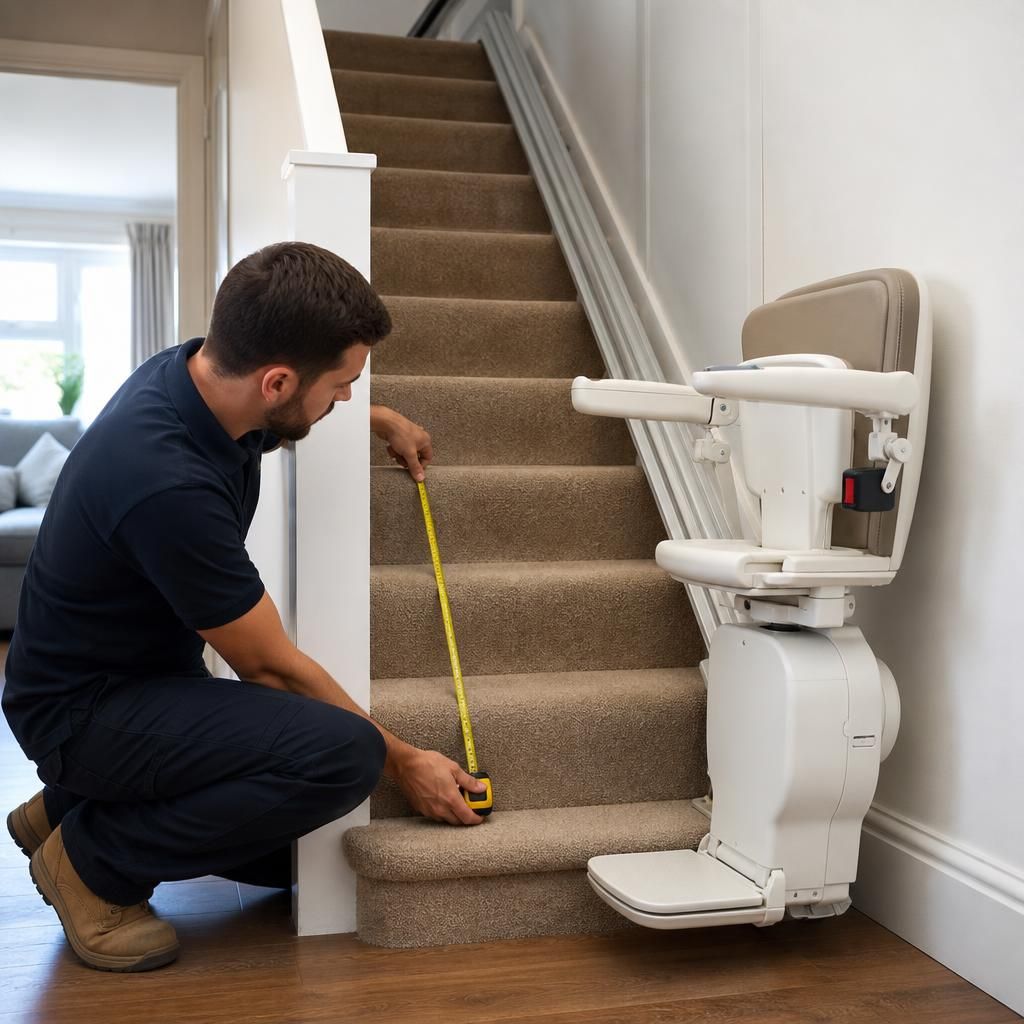
Slimline stairlift installation requires a professional assessment of the staircase, available clearances, landing space, power supply and suitable fixing points. An experienced installer will check that the rail and seat can be fitted safely without obstructing doors, walkways or other household users, then recommend any necessary adjustments for the individual home.
Slimline stairlift installation in a home with limited space depends on a professional assessment of the staircase, available clearances, landing areas, fixing points and power supply. There is no single minimum staircase width that applies to every slimline model: the installer must compare the measurements and layout of your stairs with the specifications of a suitable lift, while checking that it can be used safely without obstructing doors, walkways or other household users.
The assessment should consider more than the width of the steps. A slimline stairlift still needs enough room for the rail, carriage, seat, armrests and footrest. The installer will normally check the following areas:
- Stair width and usable clearance: measurements are taken at different points, including around bends, posts, handrails, radiators and other projections. The folded stairlift should leave a practical route for people who continue to use the stairs on foot.
- Top and bottom landings: there must be sufficient space for the user to get on and off safely. The position of the seat, footrest and any swivel mechanism is considered alongside nearby doors, cupboards, corridors and changes of level.
- Staircase shape: straight, curved, split-level and spiral arrangements require different rail designs. A curved staircase normally needs a made-to-measure rail, with the survey accounting for every turn, transition and landing.
- Obstructions: doors, radiators, newel posts, bannisters, furniture and low ceilings can affect the route of the lift. The installer may recommend a different parking position, a hinged rail or another configuration to keep access clear.
- Fixing points: the rail is generally secured to the stair treads or another suitable structural surface rather than relying on the wall alone. The condition and construction of the stairs must be checked so that the fixings can support the equipment and user safely.
- Electrical supply: the stairlift needs an appropriate charging point and a safe electrical connection. Many systems charge while parked, so the installer will identify a practical position that does not create a trip hazard or require trailing cables.
Compact stairs do not automatically prevent installation. Features such as a narrow seat, folding arms and footrest, a slim rail, a powered swivel seat or a hinged rail may help the lift fit the home and preserve access. These features are not suitable for every layout, however, and can affect the space required at the top or bottom of the stairs. The correct choice is based on how the stairlift will be used as well as how it fits when folded.
For a straight staircase, the survey is usually focused on consistent stair dimensions, landing clearance and the position of the rail at each end. Curved or multi-flight stairs require more detailed measurements because the rail must follow the staircase accurately. The surveyor may record the angle of each section, the location of intermediate landings and the clearances around bends before a bespoke rail is produced.
The staircase and surrounding area should be reasonably accessible for the installation team. Loose items, furniture and decorations may need to be moved temporarily, particularly around the landings. If a handrail, door or other fitting interferes with the proposed route, the installer should discuss any alteration with you before work begins. Structural or electrical changes should only be carried out when necessary and by an appropriately qualified person.
In most homes, the installation is designed to use the existing staircase without major building work. A stairlift is normally fixed to the stairs rather than attached to a load-bearing wall, which can make it suitable for properties where extensive alterations are undesirable. The installer will nevertheless check the condition of the treads, risers and landing surfaces. Damaged or unstable stairs may need attention before the lift can be fitted.
Permission is not usually required for a standard internal stairlift in an ordinary domestic property, but listed buildings, conservation areas, rented homes or properties subject to local restrictions may need additional checks. If you rent your home, obtain the landlord’s agreement before installation. The assessment should also consider whether the equipment could affect an escape route or access to essential doors.
On installation day, the rail and stairlift are positioned according to the approved survey, secured, connected to the power supply and tested. The installer should check operation along the full route, the charging system, the seat and safety features, and the clearances when the lift is parked or folded. You should also receive instructions on using the controls, swivel mechanism, seat belt, charging position and emergency procedures.
Do not rely on a general measurement taken at the narrowest point to decide whether a slimline stairlift will fit. Small differences in stair shape, landing depth or door position can change the safest configuration. A home assessment by an experienced installer provides the measurements needed to confirm suitability and identify practical adjustments before an order is finalised.
The most important installation requirement for a slimline stairlift is a safe, accurate assessment of the staircase and the space around it. An installer measures the stairs, landings, bends and nearby obstructions to confirm that the rail, seat and folded footrest will fit without blocking doors, walkways or the remaining route for people using the stairs.
The survey also checks that the stair treads and surrounding structure can accept secure fixings, and identifies a suitable charging position without trailing cables. On narrow or curved stairs, details such as a swivel seat, hinged rail or compact folding components may improve access, but the right configuration depends on the individual layout. These checks should be completed before installation so that any necessary adjustments are agreed in advance.
Book a Slimline Stairlift Assessment
Arrange a professional assessment of your staircase to confirm whether a slimline stairlift can be installed safely in your available space. Independent Stairlifts can assess clearances, landings, fixing points and charging requirements before recommending a suitable configuration.