
Are slimline stairlifts suitable for all types of narrow staircases?
Slimline stairlifts are suitable for many narrow staircases, including some straight, steep and curved layouts, but they are not suitable for every staircase. The available width, stair shape, landings, bends, access points and user requirements must be assessed before a suitable model can be recommended.
Slimline stairlifts are suitable for many narrow staircases, but not every layout. They are designed with a reduced overall footprint, allowing more room for other users and making them useful where a standard stairlift would leave limited clearance. However, suitability depends on the staircase width, shape, steepness, landings, bends, available headroom and the user’s mobility needs. A proper home assessment is needed before a model can be recommended.
Straight narrow staircases are usually the simplest layout for a slimline stairlift. The lift can often be installed close to the wall, with a slim seat and folding arms, footrest and controls helping to reduce the space needed when it is parked. The stairway still needs enough usable width for safe travel and, where relevant, for other people to pass. The narrowest section matters more than the widest part of the staircase.
Steep stairs may also be suitable, provided the stairlift can be fitted to follow the angle safely. Some models are designed for steeper rises, but the seat position, footrest clearance, user posture and transfer points must all be checked. A lift that fits the staircase physically may not be appropriate if the user would struggle to sit down, stand up or reach the controls securely.
Curved staircases require a more individual assessment. A bespoke rail can be made to follow bends, intermediate landings and changes in direction. On a narrow curved staircase, the rail design and the position of the parked lift are particularly important because the seat, footrest and carriage can reduce clearance around bends. The installer will assess whether the lift can travel smoothly without obstructing doorways, corridors or access to the upper and lower landings.
Other layouts need closer examination:
- Staircases with tight bends: these may need a specially designed curved rail and carefully chosen parking positions.
- Spiral or helical stairs: the changing radius, restricted tread depth and limited access can make installation difficult, although some unusual layouts may still be assessed individually.
- Open-tread stairs: the structure must provide secure fixing points for the rail, and the installation must not create a hazard at the edge of the steps.
- Stairs with narrow landings: there must be sufficient room to approach, leave and park the lift without blocking a doorway or creating a trip risk.
- Staircases with doors or radiators nearby: the lift may need to park in a different position, or the surrounding area may need minor adjustments.
A slimline design does not mean that every component can be reduced indefinitely. The seat, armrests, footrest, safety belt and controls must remain suitable for the person using the lift. The user’s height, weight, leg position, balance, ability to transfer and preferred side of access can all affect the recommended model. A particularly narrow seat may save space but be uncomfortable or difficult to use, so the smallest available option is not automatically the best option.
Clearance should be considered both when the stairlift is moving and when it is folded away. A folding seat, arms and footrest can help preserve access on a narrow staircase, while a powered swivel seat or powered folding footrest may make transfers easier for someone with limited strength. These features can require additional space at the top or bottom of the stairs, so they must be checked as part of the complete installation rather than selected in isolation.
The installation assessment should consider the full route, not just the stair treads. This includes the lower and upper landing, nearby doors, handrails, radiators, windows, light switches and any route used by other members of the household. The assessor will also check how the rail can be fixed securely to the stairs or wall and whether the proposed parking position allows the lift to be left safely without obstructing essential access.
Where a narrow staircase cannot accommodate a conventional slimline model, alternatives may still be available. These could include a different compact configuration, a curved stairlift designed around the specific route, a change to the parking position or, in some cases, a different accessibility solution. Any alternative should be judged against safe transfers, reliable operation and everyday access rather than appearance or footprint alone.
For this reason, measurements taken without an assessment are not enough to confirm suitability. Photographs can help with an initial discussion, but an installer needs to inspect the staircase and understand how the user will approach, sit on and leave the lift. Independent Stairlifts can assess the complete layout and explain which compact options are practical, including any limitations or adaptations that may be needed before installation.
In summary, slimline stairlifts can work well on many straight, steep and curved narrow staircases, but they are not a universal solution. The correct choice depends on the staircase, the available clearance and the person’s individual requirements. A personalised assessment is the safest way to establish whether a slimline stairlift will fit properly and remain comfortable and practical in daily use.
Slimline stairlifts are often suitable for narrow straight staircases, but curved, steep or unusually shaped stairs require a more detailed assessment. The narrowest section of the staircase, rather than its widest point, determines whether the lift can travel safely while leaving adequate clearance.
On curved stairs, the rail is made to follow the individual route around bends and landings. The installer must also check where the lift will park, whether doors and handrails remain accessible, and whether the user has enough room to transfer safely at the top and bottom. A slim design can reduce the lift’s footprint, but it cannot remove the need for suitable clearance and secure fixing.
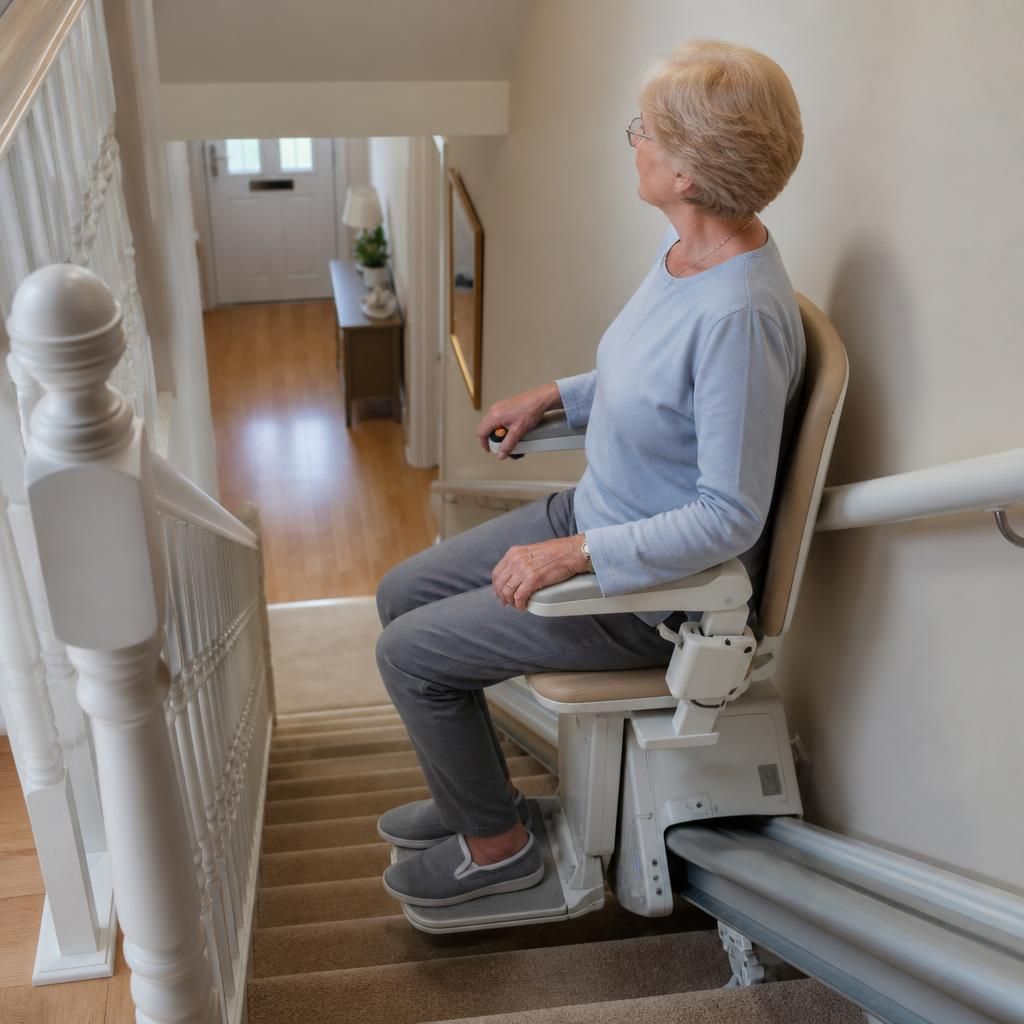
Arrange a Personalised Staircase Assessment
Arrange a personalised staircase assessment with Independent Stairlifts to confirm whether a slimline stairlift is suitable for your staircase and layout. We can discuss the most practical options for safe, comfortable daily use.