
What specific considerations should be made when installing a stairlift on narrow, steep, and curved stairs?
Installing a stairlift on narrow, steep or curved stairs requires an accurate assessment of the staircase, available clearance, landing space and the user’s mobility needs. A bespoke rail, suitable seat and carefully planned installation help provide safe, reliable travel without unnecessarily obstructing the stairs or doorways.
Installing a stairlift on narrow, steep or curved stairs requires more than selecting a suitable chair. The staircase must be measured accurately, the available clearance and landing space assessed, and the lift configured around the user’s mobility, posture and transfer needs. On complex staircases, a bespoke rail and carefully chosen seat and controls are usually needed to provide safe travel without creating avoidable obstructions.
Start with a detailed home assessment
A professional survey should cover the complete staircase rather than relying on a few basic measurements. The surveyor will assess the stair width, tread depth, headroom, gradient, curves, intermediate landings, top and bottom approaches, and the position of nearby doors, radiators, banisters and walls. They should also consider how the lift will be parked when it is not in use and whether it could restrict access to another room or route through the home.
Measurements are particularly important on curved stairs. The rail follows the individual staircase, so its path must be planned around each bend and landing. A survey also identifies suitable fixing points and any features that may need to be worked around before installation.
Check clearance on narrow stairs
On a narrow staircase, the lift must leave enough room for the seated passenger while limiting intrusion into the remaining stairway. The folded width of the chair, armrests, footrest and any projecting controls all affect the usable clearance. A compact seat may be appropriate, but it must still provide adequate support and allow the user to sit down and stand up safely.
The survey should consider the staircase in both positions: with the lift travelling and with it folded away. A swivel seat, folding or powered footrest, retractable arms, or a rail that can park clear of a doorway may improve access. These options are not suitable in every home, so the practical benefit must be checked against the available space and the user’s ability to operate them.
Assess steep gradients carefully
A steep staircase affects the angle of the rail, the seat position and the user’s sense of stability while travelling. The stairlift should keep the seat level as it follows the incline, where the design allows, and the user should be able to transfer onto the seat without leaning excessively or reaching awkwardly.
The installer should check that the seat, armrests, footrest and safety belt are appropriate for the user’s height, balance and leg movement. Controls need to be reachable without twisting. If the user has reduced strength or dexterity, powered options may be preferable to features that require manual operation, provided there is enough space for them to function safely.
Plan the route around curves and landings
Curved stairlifts are made to follow the staircase rather than travelling along a standard straight rail. The rail may pass through bends, changes in direction and intermediate landings, so the design must account for the passenger’s position throughout the journey. The seat should remain stable and correctly aligned, with suitable clearance from walls, banisters and the edge of the stairs.
Parking arrangements are an important part of the design. The lift may need to park at the top, bottom or on a landing, depending on where it causes the least obstruction. A folding or hinged rail can sometimes keep the lower section clear of a doorway or passage, but it must have sufficient room to move and must not interfere with household circulation.
Consider the top and bottom transfers
Many difficulties occur when getting on or off the lift rather than during travel. There should be a stable area at the boarding point, with enough room for the user to turn, sit down and stand up without stepping too close to the stair edge. At the top of the staircase, the user may need to turn towards a landing or doorway, making a swivel seat or a suitable landing layout particularly important.
The survey should also establish whether a door opens towards the lift, whether furniture needs to be moved, and whether the user can approach the seat from the safer side. A stairlift should not be positioned in a way that creates a new trip hazard or prevents essential access through the home.
Match the stairlift to the person, not just the staircase
The user’s condition and daily routine influence the specification. Relevant considerations include:
- ability to bend the knees and sit upright;
- balance when transferring on and off the seat;
- strength and dexterity when using controls, a seat swivel or a manual rail;
- height, weight and leg length in relation to the seat and footrest;
- whether another person will use the stairlift;
- whether the user carries shopping, walking aids or other items; and
- whether a carer needs to accompany or assist the user at either end.
The stairlift’s specified weight capacity must be suitable for the intended user, and the seating position must allow the safety belt and armrests to be used correctly. If needs are changing, this should be discussed before installation rather than treating the current stairlift configuration as permanent.
Review safety features and controls
A suitable installation should include the safety features required for the model and staircase, such as a seat belt, obstruction sensors, controlled starting and stopping, and braking appropriate to the rail design. The footrest and arms should be secure, and the controls should be positioned where the user can operate them comfortably.
On a narrow or curved staircase, obstruction sensors are especially important because walls, skirting boards, doors and objects left on the stairs can be close to the lift’s path. The stairs should be kept clear, and everyone in the household should know that the lift must not be used if an obstruction, unusual noise or fault is present.
Check the structure, power supply and installation route
Most stairlifts are fixed to the stairs rather than the wall, but the installer must confirm that the treads and supporting structure can accept the proposed fixings. The survey should identify loose, damaged or uneven steps and any building work needed before the rail is fitted. Skirting boards, flooring and bannisters may affect the position of the rail and should be discussed in advance.
The installer will also confirm the location of the charging points and electrical supply. The lift needs to charge reliably when parked, including at the end of a journey. Any required electrical work should be completed safely and in accordance with applicable UK requirements.
Allow for testing, handover and future servicing
After installation, the lift should be tested along its complete route, including every bend, stop and parking position. The installer should check clearances, seat rotation, the footrest, belt, controls, sensors and charging. The user should then be shown how to operate the lift, fold it away, respond to a stoppage and use any manual lowering or emergency arrangements provided with the model.
Keep the rail and stairs free from objects, clean the equipment as instructed and report changes such as new flooring, a moved door or difficulty transferring. Regular servicing is particularly useful on bespoke installations because it allows the rail, drive system, batteries and safety features to be checked against the way the lift is being used.
Where space is limited or the staircase has several curves, there may be more than one workable design, but not every configuration will suit every user or landing. An accurate assessment and an honest discussion of the available options are therefore essential before work begins. This approach helps ensure that the finished stairlift fits the staircase, supports the user’s actual abilities and remains practical for everyday access.
For a stairlift on narrow, steep or curved stairs, the most important installation consideration is how safely the user can approach, board and leave the seat. The lift must fit the staircase without creating an obstruction, while providing enough space for the user to transfer without stepping too close to the stair edge.
A professional assessment should check the full route, including bends, landings, doorways, banisters and the areas at the top and bottom. The surveyor can then select suitable features, such as a swivel seat, folding footrest or parking position that keeps the stairway and nearby access routes clear. These features must also match the user’s balance, strength and ability to operate them.
The finished installation should be tested along its complete route, including boarding positions, curves, stops and parking points. The user should be shown how to use the controls, safety belt and folding mechanisms, and what to do if the lift stops or an obstruction is detected.
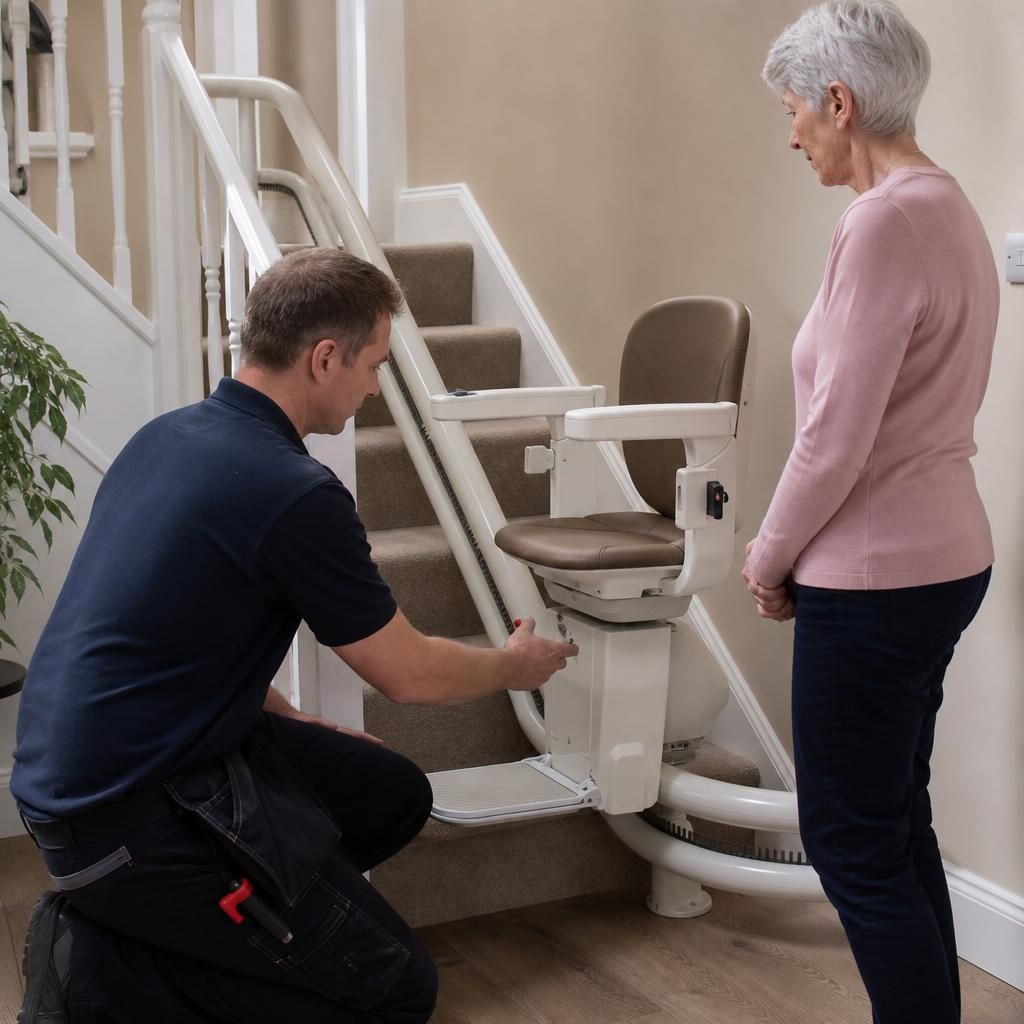
Arrange a tailored assessment for your staircase
Arrange a tailored assessment of your narrow, steep or curved staircase to discuss suitable stairlift options, clearances and safe boarding positions with our team.