
What additional features should a stairlift for narrow steep and curved stairs include to ensure safety and usability?
A stairlift for narrow, steep and curved stairs should include a slim, foldable seat and footrest, adjustable safety features, and a powered swivel seat to make boarding and leaving safer in limited space. Obstacle sensors, a secure seat belt, smooth speed control, reliable battery backup and easy-to-use controls also support safe, comfortable travel around bends and on steep sections.
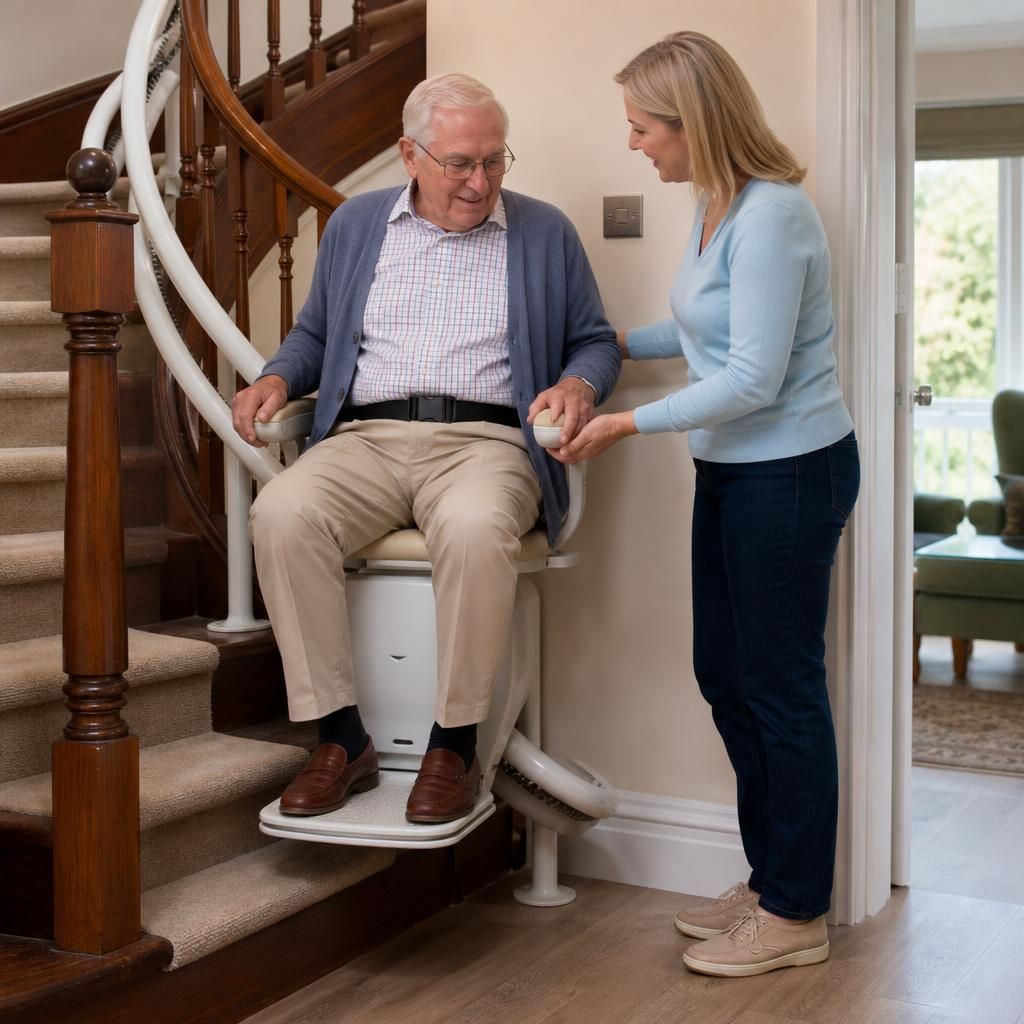
A stairlift for narrow, steep and curved stairs should combine space-saving design with features that keep the user stable, positioned correctly and in control throughout the journey. The most useful additions include a slim folding seat and footrest, a powered swivel seat, adjustable safety equipment, obstacle sensors, controlled speed, dependable battery backup and simple controls. On a curved staircase, the lift should also be engineered to remain level and move smoothly as the track follows each bend or change in gradient.
A slim, foldable design
A narrow stairway leaves limited room for other people to pass, so the stairlift should occupy as little space as practical. A slim seat, narrow carriage and foldable arms, seat and footrest help preserve the available staircase width when the lift is parked. Folding components also reduce the risk of someone catching clothing or tripping against the equipment.
The seat and footrest should lock securely in both their operating and folded positions. Depending on the staircase and the user’s needs, options such as a perch seat or a compact standing-style design may be considered, although these are not suitable for everyone. A proper assessment is needed to confirm which seating position provides adequate support and safe clearance.
Powered swivel or powered pivot seating
Getting on and off can be more difficult than travelling on a steep or curved staircase, particularly where there is little space at the top or bottom. A powered swivel seat turns the user towards the landing before they stand, reducing the need to twist or step sideways near the stairs. A powered hinge or folding footrest can also help where the track finishes close to a doorway or narrow landing.
The swivel mechanism should have a clear locking position so the seat cannot rotate unexpectedly while travelling. The landing position must be checked during the survey, as the safest stopping point may vary according to the direction of travel, available floor space and the user’s mobility.
Adjustable support and restraint features
Seat height, armrest position, footrest height and belt placement should be adjusted to suit the user rather than treated as standard settings. Correct adjustment helps keep the pelvis supported, the feet clear of the steps and the upper body within the seat during movement around bends or on steep sections.
A seat belt should be easy to reach, fasten and release, while still securing the user firmly. Some stairlifts offer different belt arrangements or harness options for people who need additional support. The most suitable arrangement depends on balance, posture, transfer ability and any relevant advice from a healthcare professional.
Automatic levelling and smooth movement
On a curved stairlift, the seat should remain level as the carriage follows changes in direction and gradient. This is particularly important on winding staircases, where an unlevel seat could affect comfort and confidence. Smooth acceleration, deceleration and speed control are also valuable on steep stairs because they reduce sudden movement when starting, stopping or negotiating a bend.
The control system should respond predictably and allow the user to stop safely if required. Controls may be fitted in the armrest and provided through remote controls at the landings, allowing the lift to be called or sent when it is parked at the opposite end of the staircase.
Obstacle detection and protective sensors
Sensors beneath the footrest, carriage and other relevant parts of the lift should detect objects on the stairs or track. If an obstruction is detected, the stairlift should stop rather than continue over it. This helps protect the user, the equipment and items that may have been left on the staircase.
Obstacle sensors do not remove the need to keep the stairs clear. Rugs, shoes, toys, bags and other objects should be removed before use, particularly on narrow stairs where there is little room to move around an obstruction. The sensors and stopping function should be checked as part of routine servicing.
Reliable battery backup
A battery-powered stairlift should continue to operate during a mains electricity failure, provided it has sufficient charge and is correctly maintained. This is important for users who rely on the lift for essential movement between floors. Charging points should be positioned where the stairlift can remain connected when parked, and the user should know how to recognise a low-battery warning.
Battery condition, charging contacts and the charging system should be included in regular servicing. A battery backup is not a substitute for maintenance: an ageing or poorly charged battery may reduce the number of journeys available during a power cut.
Clear controls and emergency operation
Controls should be positioned where the user can operate them without leaning, reaching across the armrest or taking a hand away from a secure position. Large, clearly marked buttons and a straightforward direction control are helpful for users with reduced dexterity or vision. Remote controls at the top and bottom landings should be simple enough for a carer or family member to use when necessary.
The stairlift should also include an emergency stop or equivalent safe stopping control, audible or visual status indicators and a way to report a fault. Users and family members should know what to do if the lift stops away from a landing. Instructions should be kept accessible and explained during handover.
Secure parking and landing access
On a complex staircase, the parking position is part of the safety design. The lift may need to park beyond the top or bottom step, or fold away to leave a doorway, corridor or landing clear. A powered swivel, hinged rail or compatible track arrangement can help where the staircase ends close to an obstruction.
There should be enough clear, level space for the user to sit down and stand up without reaching for the stairs or an unstable surface. If the landing is especially restricted, additional handrails, improved lighting or a change to the parking position may be more appropriate than adding another stairlift feature.
Features for easier everyday use
- A comfortable, supportive seat with surfaces that are easy to clean.
- Armrests that provide stable support during transfers.
- A footrest with a suitable surface and edge protection to help keep the feet positioned securely.
- Safety edges and covers that reduce the chance of contact with moving parts.
- Diagnostic indicators that help identify charging or operating problems.
- Manual release or lowering arrangements where appropriate, explained clearly to the user and their carers.
Not every feature is suitable for every staircase or user. A powered swivel seat, for example, may require additional landing space, while a very compact seat may not provide enough support for someone who needs a broader or more stable seating position. The correct combination should therefore be selected after measuring the staircase, checking clearances around doors and landings, and considering how the user sits, transfers, steers and responds to controls.
During an assessment, discuss any difficulties with balance, knee or hip movement, vision, hand strength, memory or posture. These details help determine whether extra restraint, a different seat style, altered control positions, improved lighting or changes to the surrounding handrails are needed. Once installed, the stairlift should be used as demonstrated, kept clear of obstructions and serviced at appropriate intervals so its safety features continue to operate as intended.
A powered swivel seat helps a stairlift user get on and off safely when a staircase is narrow, steep or ends close to a wall, doorway or landing edge. It turns the seat towards the landing after the lift has stopped, so the user can stand up without twisting across the stairs or reaching for an unstable surface.
The seat should lock securely in the travel position and the turned position. During the assessment, the stopping point and available landing space must be checked together, as a swivel seat still requires enough clear, level space for a safe transfer. If the landing is too restricted, an alternative seat, parking position, hinged rail or other tailored arrangement may be more suitable.
Discuss the right features for your staircase
Speak to our team about the features your narrow, steep or curved staircase and the user require. We can assess the available space, landing access and seating needs before recommending a suitable stairlift configuration.