
What safety features are included in heavy duty bariatric stairlifts to ensure secure use?
Heavy duty bariatric stairlifts include reinforced seating, secure restraints, supportive armrests and reliable braking systems to keep the user stable during travel. Safety sensors, controlled starts and stops, obstruction detection and emergency controls provide additional protection, while a professional assessment ensures the lift is correctly matched to the user and staircase.
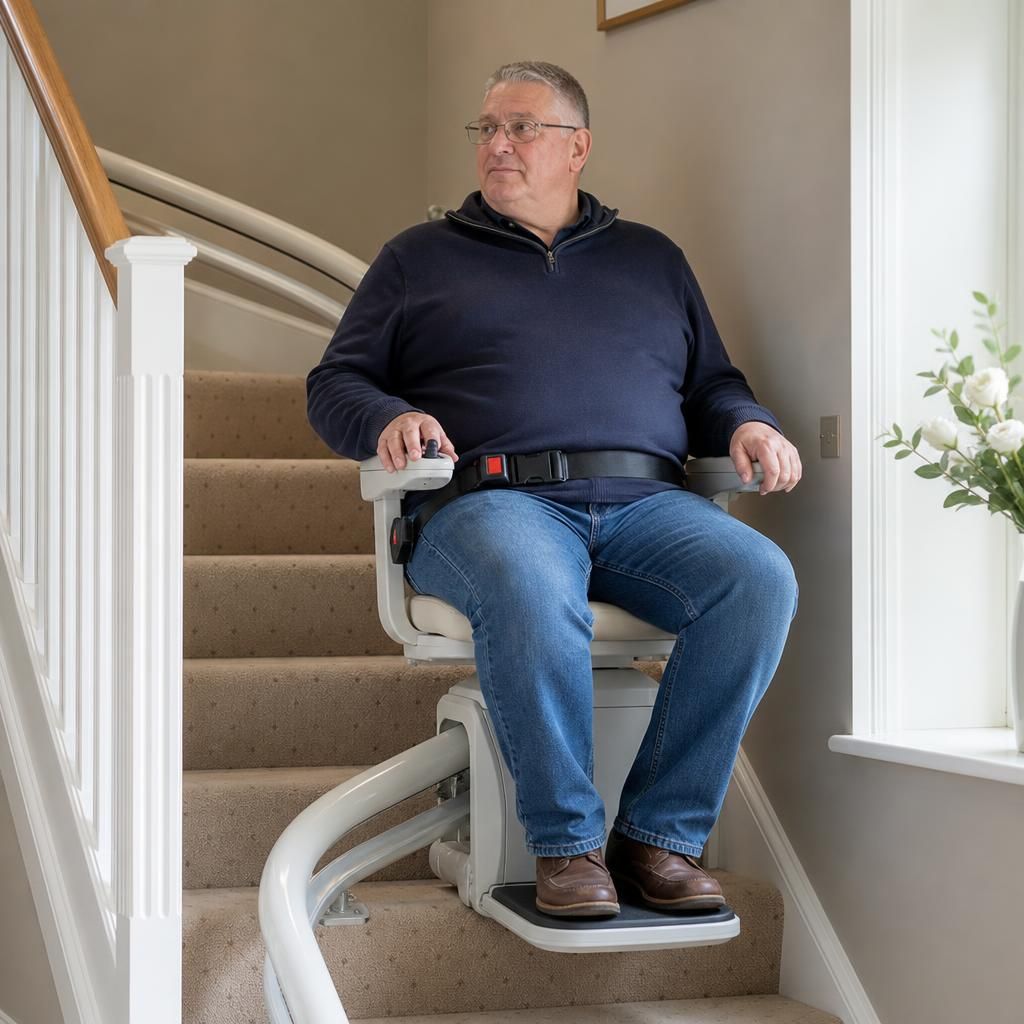
Heavy duty bariatric stairlifts are designed with reinforced seating, higher-capacity drive components and additional occupant support to help the user travel securely between floors. Key safety features usually include a properly positioned seat belt, supportive armrests, a stable footrest, controlled braking, obstruction sensors and emergency controls. The exact specification varies between models, so the stairlift must be assessed and configured for the user, staircase and intended weight capacity.
Reinforced seating and supportive positioning
A bariatric stairlift normally has a wider, stronger seat and a reinforced seat base to provide stable support during travel. The seat should allow the user to sit fully back, with their weight distributed appropriately rather than concentrated at the edge. Firm cushioning and suitable upholstery can also make transfers more controlled and reduce the likelihood of the user shifting position while the lift is moving.
Armrests are important because they provide lateral support and give the user a stable point to hold when sitting down or standing up. On some models, the armrests can be adjusted or specified in different widths to suit the user. The stairlift should not be used if the armrests prevent a safe transfer, restrict the user’s position or do not provide sufficient support.
Seat belts and secure restraint
A seat belt or harness helps keep the user correctly positioned throughout the journey. It is particularly important where the user has reduced trunk control, involuntary movement or difficulty maintaining an upright posture. The restraint should be fastened before movement begins and adjusted so that it is secure without causing discomfort.
Some stairlifts offer different belt arrangements or buckle positions. The appropriate option depends on the user’s mobility, dexterity and ability to release the belt safely at the top and bottom of the stairs. A belt is an important safety aid, but it does not replace correct seating posture or supervision where the user requires assistance.
Swivel seat and transfer safety
A swivel seat can turn towards the landing at the end of the journey, allowing the user to get on and off without twisting across the staircase. A locking mechanism holds the seat in the travel position and prevents it from rotating unintentionally while the lift is moving. The seat should only be swivelled when the stairlift has stopped at the appropriate landing.
Powered swivel or powered lift-up seat options may be useful where the user has limited strength or movement. The suitability of these features depends on the user’s ability to operate the controls and on the available space at each landing.
Stable footrest and foot protection
The footrest supports the user’s feet and helps prevent them from hanging near the steps or contacting the staircase during travel. Bariatric models generally require a robust footrest that is matched to the seat width and the user’s leg position. A suitable design can also reduce pressure on the knees and help maintain a balanced posture.
Footrest sensors can stop the stairlift if an object or part of the user’s clothing is detected in a hazardous position. Users should still keep loose clothing, blankets and other items clear of the mechanism, as sensors are not a substitute for sensible precautions.
Controlled starts, stops and braking
The motor and control system are configured to provide a gradual start and stop, avoiding sudden movement that could affect the user’s balance. A braking system holds the stairlift securely when it stops, including when the user boards or leaves the seat. The drive system, rails and fixings must all be selected for the user’s weight and the staircase layout; a higher-capacity seat alone does not make a standard stairlift suitable for bariatric use.
Where a stairlift includes a powered swivel, footrest or seat adjustment, these functions should also have appropriate interlocks. An interlock prevents travel from starting unless the seat, armrests or other components are in the required position.
Obstacle and obstruction detection
Sensors positioned around the stairlift can detect obstacles on the stairs or near the carriage. If an obstruction is detected, the lift should stop or prevent movement, depending on the design. This helps protect the user and the equipment from items such as toys, footwear, furniture or other objects left on the staircase.
The staircase should nevertheless be kept clear. Sensors have operating limits and may not detect every small, flexible or low-contrast object. Regularly checking the rail, footrest and surrounding steps is part of safe everyday use.
Controls and emergency functions
Controls are usually provided on the armrest and may also be available through remote call and send controls. They should be easy for the user to operate without leaning dangerously or reaching across the staircase. The control direction should be clear, and the user should release it if the stairlift behaves unexpectedly.
Battery-powered stairlifts are designed to continue operating during a mains power interruption, provided the batteries are sufficiently charged. Many systems include an emergency stop control and an alarm or warning facility. Depending on the model, there may also be a manual lowering procedure or other arrangements for dealing with a fault. Users and carers should receive clear instructions for these situations rather than attempting to force the lift or leave it mid-staircase without advice.
Safety features depend on correct assessment and installation
Safe operation depends on more than the visible features. During an assessment, the installer should consider the user’s weight, height, posture, transfer ability, balance, circulation, clothing, foot position and any assistance provided by a carer. The staircase, landings, doorways and nearby furniture must also be checked. This determines the suitable seat configuration, belt arrangement, rail position, footrest design and available clearance.
A professional installation ensures that the rail is securely fixed, the carriage is correctly aligned and the stairlift is tested under the manufacturer’s requirements. The installer should explain the controls, restraint, swivel operation, charging routine and emergency procedure, and should confirm that the user can board and leave the lift safely.
Using a bariatric stairlift safely
- Fasten the seat belt or harness before starting the journey.
- Sit back in the seat, keep the armrests lowered and place both feet securely on the footrest.
- Keep hands, feet, clothing and other objects away from the rail, steps and moving parts.
- Do not exceed the stairlift’s specified user weight or carry another person on the seat.
- Keep the staircase and landing clear, particularly around the footrest and transfer areas.
- Report unusual noise, jerky movement, warning tones, battery problems or repeated sensor stops promptly.
- Arrange servicing at the recommended intervals so that the brakes, batteries, drive system, safety sensors and fixings can be checked.
Independent Stairlifts can review the user’s requirements and staircase to identify which safety features are essential rather than simply selecting the largest available seat. If the user’s condition, weight, transfer ability or home layout changes, the stairlift should be reassessed to confirm that the existing configuration remains appropriate.
Obstruction sensors are a key safety feature in heavy duty bariatric stairlifts. Sensors around the carriage and footrest detect objects on or beside the staircase and stop the lift if movement could cause contact or damage.
They can help identify items such as footwear, toys, furniture or loose clothing, but they are not a replacement for keeping the stairs clear. Sensors may not detect every small, flexible or low-contrast object, so check the staircase before travelling and report repeated sensor stops or unusual behaviour to Independent Stairlifts.
Arrange a safety assessment for your heavy duty bariatric stairlift
Arrange a safety assessment with Independent Stairlifts to confirm that your heavy duty bariatric stairlift, seating, restraint and controls are suitable for your mobility needs and staircase. We can also review any changes in your condition or home layout that may affect safe use.