
What maintenance and servicing does a heavy duty bariatric stairlift require to ensure optimal performance?
A heavy duty bariatric stairlift requires regular cleaning and charging, prompt attention to unusual noises or faults, and scheduled servicing by a qualified stairlift engineer. Servicing should follow the manufacturer’s recommendations and include checks of the drive system, batteries, charging points, seat, safety controls, track and fixings to maintain safe, reliable performance.
A heavy duty bariatric stairlift requires routine cleaning and charging, careful day-to-day use, and scheduled servicing by a qualified stairlift engineer. Because the lift carries a higher working load than a standard model, servicing should pay particular attention to the drive system, batteries, seat and safety controls, rail fixings, charging points and the condition of the staircase. The manufacturer’s servicing schedule should always take priority, as requirements vary between models and installations.
Routine checks and cleaning
Keep the stairlift and its surrounding area clean, dry and free from obstructions. Dust, pet hair and grit can collect around the rail, carriage and footrest, while spills may affect switches or sensors. Wipe accessible surfaces with a slightly damp, non-abrasive cloth and use only cleaning products recommended for the materials. Do not spray liquid directly onto the controls, charging contacts, motor housing or electrical components.
- Check that the rail is clear of furniture, loose items and other obstructions.
- Make sure the seat, armrests, footrest and safety belt are secure and undamaged.
- Check that the swivel or folding mechanisms operate smoothly without excessive force.
- Keep charging contacts clean and free from dirt, but do not scrape or bend them.
- Ensure landing areas and folding sections of rail remain clear when the lift is parked.
Do not apply oil, grease or other lubricant to the rail or moving parts unless the manufacturer specifically instructs you to do so. Incorrect lubrication can attract dirt, affect sensors or interfere with the drive mechanism.
Battery care and charging
Most heavy duty stairlifts use rechargeable batteries and should be returned to a designated charging point whenever they are not in use. Regular charging is important because a bariatric stairlift’s motor may draw more power during operation, particularly on longer or steeper staircases. Leaving the lift away from its charging point for prolonged periods can cause the batteries to discharge and may shorten their service life.
Watch for changes such as reduced travel distance, slower operation, repeated low-battery warnings or the lift stopping before reaching a charging point. These symptoms can indicate ageing batteries, a charging fault or another electrical issue. A service engineer should investigate rather than replacing batteries or electrical parts without a proper diagnosis. Battery performance can also be affected if the stairlift is left unused for an extended period, so ask for advice before a planned absence.
What a professional service should include
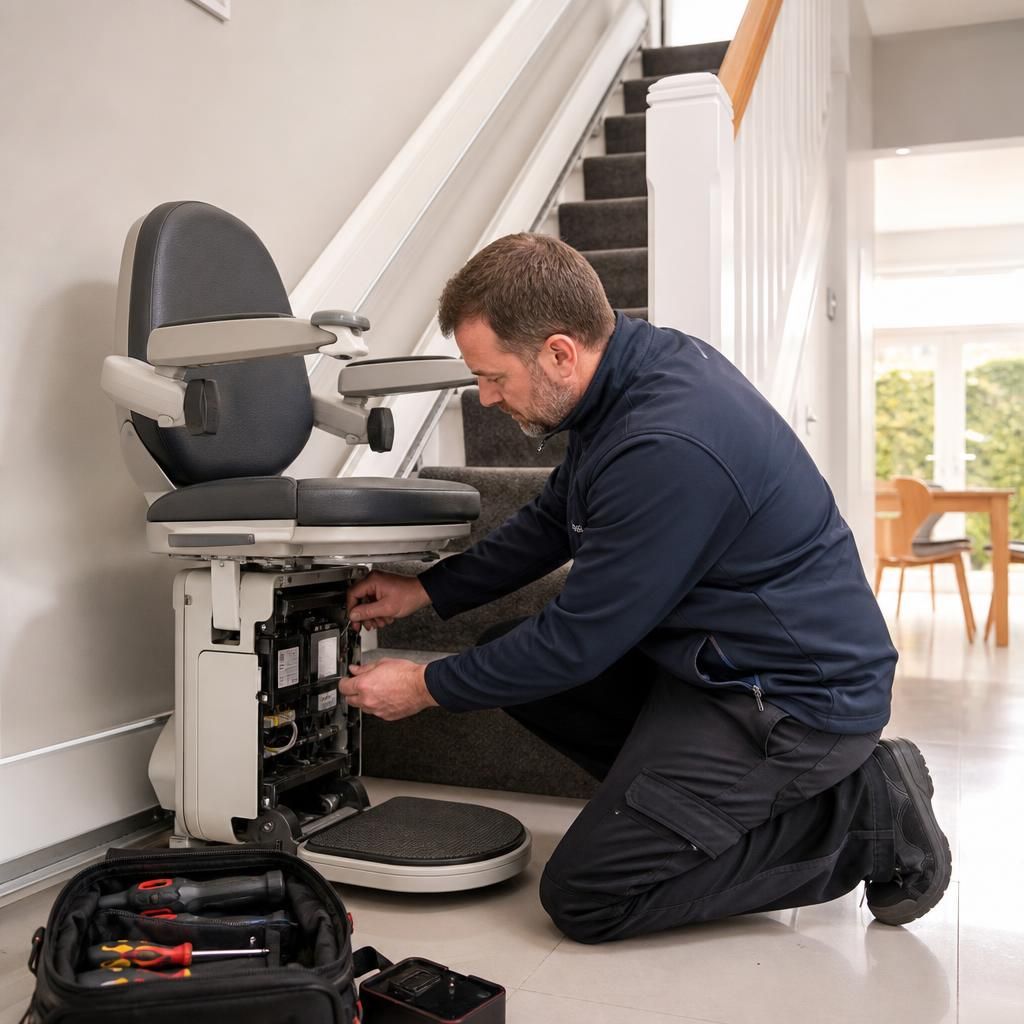
A qualified engineer should inspect, test and, where appropriate, adjust the stairlift in line with the manufacturer’s instructions. A thorough service will normally include the following areas:
- Drive system: inspection of the motor, gearbox, drive mechanism and associated components for wear, unusual noise, vibration or loss of smooth operation.
- Rail and fixings: checks that the track is correctly aligned and securely attached, with particular attention to brackets, joints, bends and any areas subject to higher loading.
- Seat and frame: examination of the seat base, swivel mechanism, armrests, footrest, upholstery, safety belt and structural fixings for looseness, damage or excessive wear.
- Safety controls: testing of the joystick, key switch, emergency stop, sensors, interlocks, obstruction switches and any diagnostic indicators fitted to the model.
- Braking and movement: confirmation that the stairlift starts, travels, slows and stops correctly, including at the upper and lower landings.
- Batteries and charging: testing battery condition, charging output, contacts and the operation of each charging point.
- Electrical connections: inspection for damaged cables, loose connections or signs of overheating, followed by appropriate functional testing.
For a heavy duty installation, the engineer should also confirm that the equipment remains suitable for its intended user and is being operated within the manufacturer’s stated weight limit. Servicing cannot make a stairlift safe to carry a load above its rated capacity.
How often should servicing take place?
Follow the servicing interval stated in the stairlift’s documentation and any advice provided after installation. Many domestic stairlifts are checked at least annually, but the correct interval depends on the model, how frequently it is used, the user’s requirements, the staircase layout and the environment. A lift used several times each day, installed on a demanding staircase or exposed to dust or moisture may need closer monitoring.
An additional inspection may be appropriate if the user’s mobility needs or weight have changed, if the stairlift has been moved or altered, or if it has been unused for a long period. Contact Independent Stairlifts if you are unsure when the next service is due or if service records are unavailable.
Signs that the stairlift needs attention
Do not wait for the next planned service if you notice a change in performance. Arrange an assessment promptly if the stairlift:
- makes a new grinding, clicking, squeaking or scraping noise;
- moves unevenly, jerks, slows unexpectedly or fails to complete the journey;
- stops repeatedly or displays a fault warning;
- does not charge, loses power quickly or gives repeated low-battery alerts;
- has a loose seat, armrest, footrest, belt, rail bracket or other fixing;
- has a safety sensor, control or swivel mechanism that does not operate consistently; or
- shows visible damage, burning smells, overheating or exposed wiring.
If the lift behaves unexpectedly, stop using it where it is safe to do so, switch it off if the instructions advise this, and seek professional assistance. Do not dismantle covers, bypass safety switches or attempt electrical repairs. These actions can create a serious risk and may invalidate the manufacturer’s warranty or service arrangements.
Good practice between services
Use the stairlift only as instructed, with the seat and safety belt positioned correctly and the user facing the intended direction of travel. Do not carry additional people, heavy items or loads that could affect balance or exceed the rated capacity. Keep the stairs and landings clear, and ensure other household members know not to move furniture into the lift’s travel path.
Keep the user manual, installation information and service history available. Recording reported faults, battery changes and completed services helps an engineer identify recurring issues and confirms that important checks have been carried out. After any repair or adjustment, the lift should be function-tested before it is returned to normal use.
Regular user checks do not replace professional servicing. Cleaning, correct charging and early reporting help prevent avoidable faults, while a qualified engineer’s inspection confirms that the mechanical, electrical and safety systems continue to operate together as intended. If your heavy duty bariatric stairlift is due a service or is showing a change in performance, contact Independent Stairlifts for advice and an appropriate inspection.
Professional servicing is essential for a heavy duty bariatric stairlift because its higher working load places particular demands on the drive system, rail fixings, seat frame and batteries. A qualified engineer should inspect these components, test the safety controls and confirm that the lift starts, travels and stops correctly.
Routine cleaning and correct charging support reliable operation between services, but they do not replace an inspection. Arrange professional attention promptly if the stairlift becomes noisy, jerky, slow, difficult to charge or shows any visible damage. Never exceed the manufacturer’s weight limit or attempt to bypass safety switches.
Arrange your heavy duty stairlift service
If your heavy duty bariatric stairlift is due for servicing or showing changes in performance, contact Independent Stairlifts to arrange a professional inspection. Our qualified engineer can check the lift’s mechanical, electrical and safety systems and advise on any required maintenance.