
What are the weight limits and customization options available for heavy duty bariatric stairlifts?
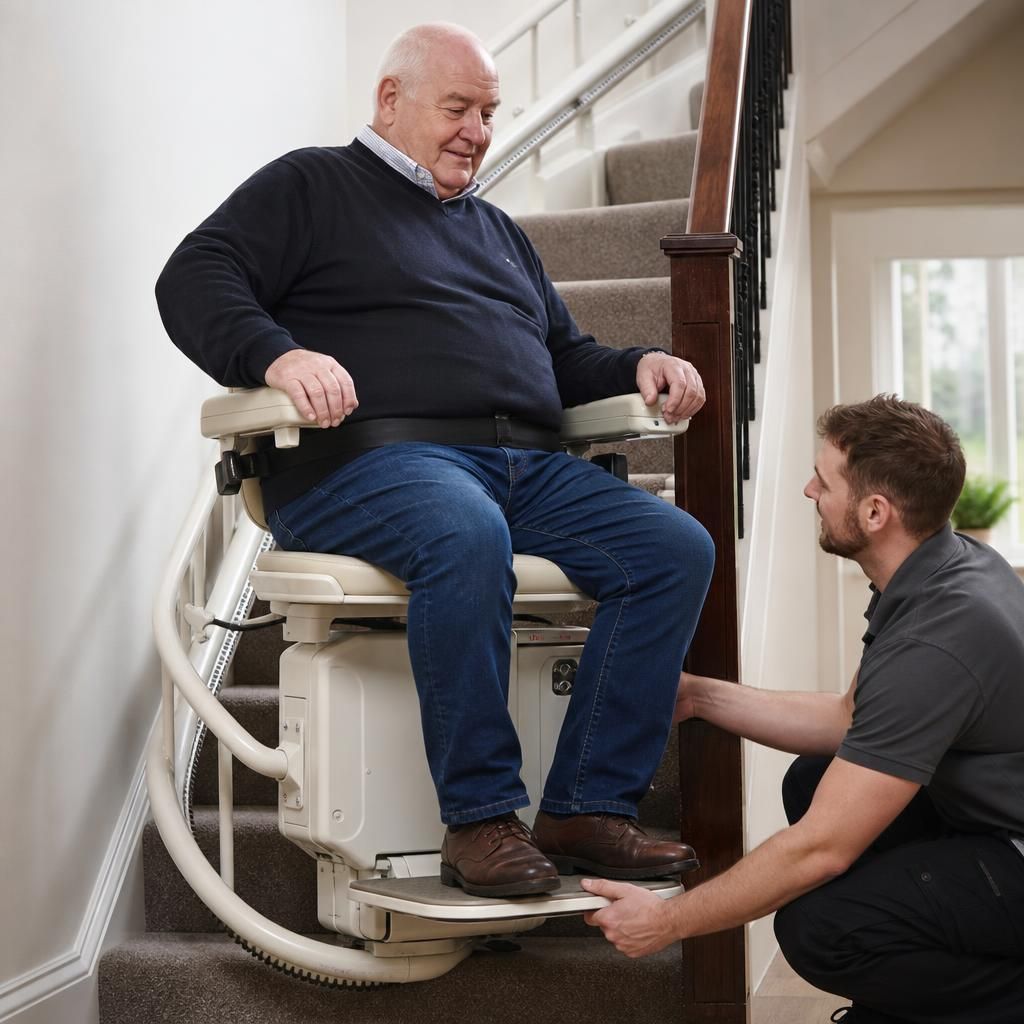
Heavy duty bariatric stairlifts have a higher user weight capacity than standard models, although the exact limit depends on the stairlift model and staircase layout. Customisation can include a wider or reinforced seat, adjustable armrests, a powered swivel or folding seat, alternative controls and tailored finishes, all confirmed during a professional assessment.
Heavy duty bariatric stairlifts are designed for users who exceed the weight capacity of many standard stairlift models. Their maximum safe working load varies between models and must be confirmed against the manufacturer’s specification during a professional assessment. The available capacity is not determined by the user’s weight alone: the staircase design, seat position, track configuration and any accessories must also be considered.
Weight limits and safe working load
A bariatric stairlift normally has a reinforced drive system, stronger seat structure and a wider, more supportive seating platform than a standard model. Some models provide a substantially higher capacity, but there is no single weight limit that applies to every heavy duty stairlift. The safe working load must never be estimated or exceeded, as doing so can affect braking, travel, stability and the long-term reliability of the equipment.
When assessing suitability, Independent Stairlifts will need accurate information about the intended user’s weight, height, mobility and transfer ability. It is sensible to allow for normal clothing, footwear and any items carried while using the stairlift. If the user’s weight may change, this should also be discussed so that the selected model retains an appropriate safety margin.
The staircase itself can affect the available capacity. A straight stairlift may have different operating characteristics from a curved model, while bends, landings, tight turns and changes in gradient can influence the track design and the way the lift travels. A professional survey confirms whether the proposed stairlift can safely carry the intended load throughout its full route, rather than assessing the capacity only at the bottom or top of the stairs.
Seat and support customisation
- Wider or reinforced seat: A broader seat can provide more usable space and improve comfort. The seat must still leave sufficient clearance from the opposite wall, banister and other obstructions.
- Higher-capacity frame and drive system: Heavy duty components are selected to support the specified load during repeated daily use.
- Adjustable armrests: Armrests may be adjusted or configured to provide better support when sitting down, travelling and standing up. They must not make the stairlift too wide for the staircase.
- Seat height and depth: These may be available in different configurations to suit leg length, knee movement and the user’s ability to transfer between the stairlift and the landing.
- Powered swivel seat: A powered swivel can help rotate the seat towards the landing, reducing the need to twist while getting on or off. This can be particularly useful where balance or upper-body strength is limited.
- Powered or assisted footrest: This can make it easier to fold or position the footrest where the user cannot comfortably bend down.
- Seat belt options: A suitable restraint helps keep the user correctly positioned. The design should be selected around the user’s posture, dexterity and ability to release it independently.
Controls and operation
Controls can be tailored to the way the user operates the stairlift. Options may include a control on either armrest, a remote control for calling the lift between floors, and controls positioned to suit limited hand movement or grip strength. Large, clearly marked switches may be preferable where vision or dexterity is reduced. The controls should be reachable without leaning excessively or changing to an unsafe position.
For users who cannot operate a conventional hand control reliably, an alternative control arrangement may be considered. The assessment should establish whether the user can start, stop and control the stairlift independently, or whether a carer will need to operate it. Any person assisting should be able to do so without standing in the path of the moving lift.
Folded dimensions and access
A wider bariatric seat does not necessarily suit every staircase. The folded width of the seat, armrests and footrest must be checked against the usable width of the stairs. This is important in shared hallways, where other people need to pass the stairlift safely, and on narrow staircases where a larger seat may obstruct the route.
Where space is limited, the design may include folding armrests, a folding seat or a powered folding mechanism. These options can reduce obstruction when the stairlift is parked, but they do not remove the need for accurate measurements. The lift also needs adequate space at the top and bottom for the user to turn, stand and transfer safely.
Upholstery, finish and positioning
Upholstery colours and finishes can often be selected to suit the home. These choices do not change the weight capacity, but a firm, supportive cushion and an appropriate seat angle can affect comfort and posture. The seat should support the user without causing pressure behind the knees or requiring them to lean forward during travel.
Parking positions may also be planned around the home. A curved stairlift can sometimes be parked away from a doorway or narrow landing, while a straight installation may be positioned to preserve access at either end of the staircase. The available options depend on the layout, the track route and the clearances required for safe use.
How the correct specification is confirmed
- The user’s weight, size, mobility and transfer needs are discussed confidentially.
- The staircase and surrounding areas are measured, including bends, landings, obstructions and available clearance.
- A suitable heavy duty model is identified with a safe working load that meets the user’s requirements.
- Seat width, armrest position, controls, swivel function, footrest operation and restraint options are considered together rather than separately.
- The proposed specification is checked for safe access at the top and bottom of the stairs, as well as for day-to-day use by other household members.
- The user is shown how to operate the stairlift and advised about its specified capacity, controls and safe-use requirements.
Customisation should improve safe access and ease of use, not simply make the stairlift larger. For example, a wider seat may provide better support but could reduce passage space, while a powered swivel seat may make transfers easier but requires enough landing room to rotate safely. Independent Stairlifts can explain these trade-offs during the survey and confirm which options are compatible with the staircase and the selected model.
If the required capacity or seating dimensions cannot be achieved safely on the existing staircase, the stairlift should not be adapted beyond its approved specification. Alternative layouts, equipment or access arrangements may need to be considered. The final recommendation should always be based on the manufacturer’s stated limits and an assessment of the individual, the property and the way the stairlift will be used.
A heavy duty bariatric stairlift’s weight limit is specific to the model and must be confirmed against the manufacturer’s stated safe working load. It is not safe to estimate capacity from the seat’s appearance or to exceed the limit, as the drive system, braking performance and stability are designed for a defined load.
Customisation should take account of both the user and the staircase. A wider or reinforced seat, adjustable armrests, a powered swivel seat, alternative controls and an assisted footrest may improve comfort and transfers. However, a larger seat can reduce the available space on narrow stairs, while a powered swivel requires enough room at the landing to rotate safely.
During the assessment, the user’s weight, height, posture, mobility and transfer ability are considered alongside the stair width, bends, landings and obstructions. The final specification should provide an appropriate safety margin, preserve safe access for other household members and remain within the approved limits of the selected stairlift.
Book a heavy duty stairlift assessment
Book a heavy duty stairlift assessment to confirm the correct weight capacity, seating configuration and staircase clearances for your needs. Independent Stairlifts can explain the available options and recommend a safe, suitable specification.