
What are the key features that differentiate a bariatric stairlift from a standard stairlift?
A bariatric stairlift is designed for higher user weights than a standard model, with a reinforced drive system, stronger seat and rail components, and usually a wider, more supportive seat. It may also provide enhanced safety features, greater comfort and bespoke installation options to suit the user and staircase.
A bariatric stairlift is purpose-designed to carry a higher user weight than a standard stairlift. The key differences are usually its certified weight capacity, reinforced drive and track components, more supportive seating, and additional space for safer transfers. These features are engineered as a complete system, rather than created by simply increasing the permitted load on a standard model.
Higher, clearly defined weight capacity
The most important distinction is the manufacturer’s stated maximum user weight. A bariatric stairlift is built and tested for a higher load, including the user and any clothing or items carried during normal use. The relevant limit must never be estimated or exceeded. It is also important to consider how the user’s weight is distributed when sitting, standing, turning or transferring, as this can affect the suitability of a particular design.
Weight capacity varies between models, so an assessment should confirm the appropriate specification rather than relying on a general description such as “heavy duty”. The lift should be selected with a suitable safety margin and in line with the manufacturer’s instructions.
Reinforced mechanical components
Bariatric models generally have stronger components to manage the additional load safely and reliably. These may include:
- a reinforced seat frame and swivel mechanism;
- a stronger carriage that travels along the rail;
- heavier-duty drive components, gearbox and motor;
- a rail and fixing arrangement designed for the model’s increased load; and
- more robust armrests, footrest and seat supports.
The staircase and the wall or steps used for fixing the rail must also be capable of supporting the installation forces. This is why a bariatric stairlift cannot always be fitted by using the same rail configuration as a standard lift, particularly on a curved staircase or where the stairs have unusual construction.
More supportive seating and increased space
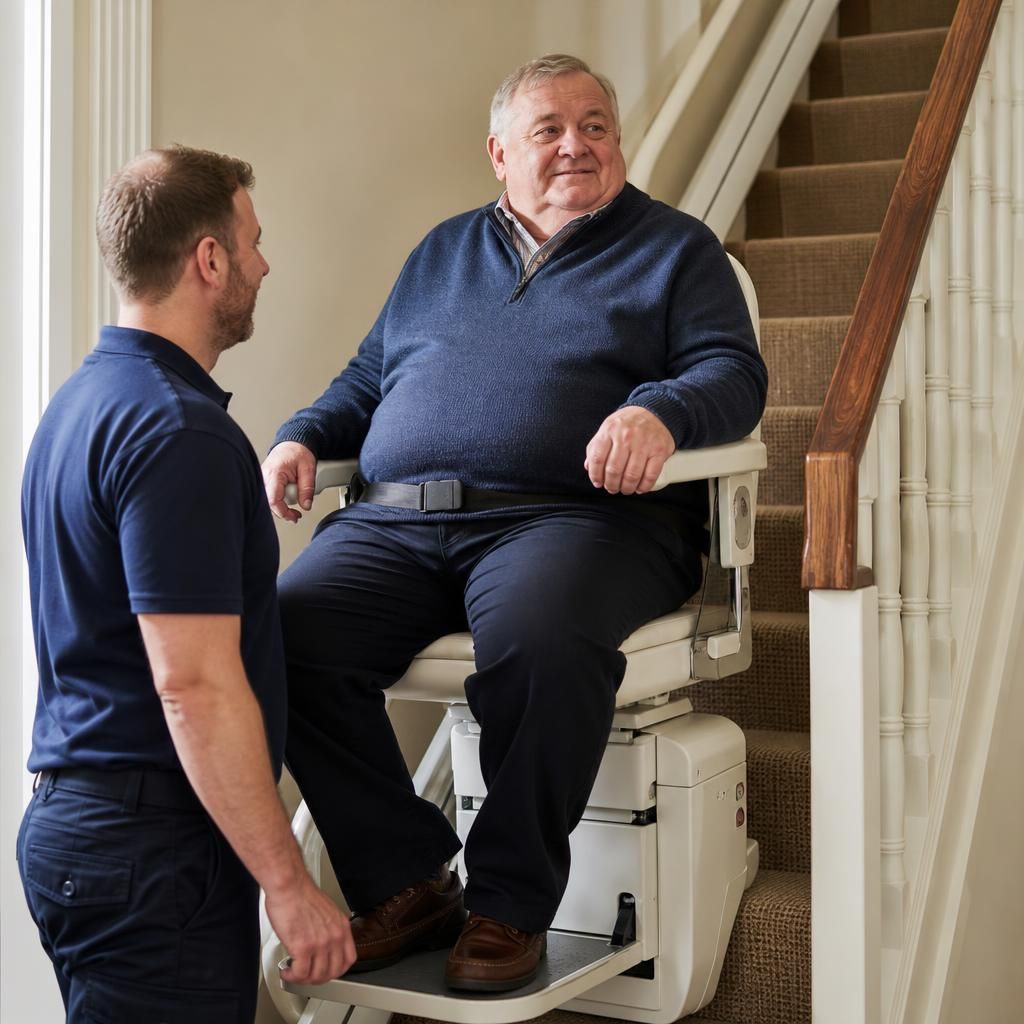
A standard stairlift is often designed around the space requirements of an average seated user. A bariatric stairlift normally provides a wider, deeper or more heavily supported seat, helping the user sit squarely and remain stable while travelling. Depending on the model, it may also include:
- stronger or adjustable armrests;
- a longer or reinforced seat base;
- additional padding and improved postural support;
- a wider or more substantial footrest; and
- a seat belt or harness suited to the user’s body shape and transfer needs.
More seat width can improve comfort, but it also affects the amount of stairway space available when the lift is in use or folded away. A wider footrest may have a similar effect. The assessment should therefore consider not only the user’s comfort while seated, but also whether other household members can pass safely and whether doors, landings and adjacent furniture remain accessible.
Enhanced stability and safety features
Both standard and bariatric stairlifts should include essential safety systems, but a bariatric model may need components with a higher load rating and additional adjustment to support the user securely. Depending on the design, safety features can include a seat belt, swivel-seat locking mechanism, obstruction sensors, controlled starting and stopping, speed regulation, braking systems and battery backup.
Some users may benefit from a powered swivel seat, powered footrest or powered arms if moving into position is difficult. These options are not automatically included because the correct configuration depends on the user’s strength, balance, joint movement and transfer technique. A stairlift should not be used as a substitute for professional advice about transfers where the user has a significant risk of falling.
Greater power and load management
The motor and drive system of a bariatric lift are selected to move the increased load consistently along the staircase. This can be particularly important on a long, steep or curved flight, where the lift may encounter greater resistance than it would on a short, straight stairway. Batteries, charging arrangements and control systems must also be compatible with the model’s power requirements.
Performance depends on the complete installation. A correctly specified bariatric stairlift should not be overloaded with extra passengers or used to carry bulky items that interfere with the controls, seat belt, sensors or footrest.
More demanding installation requirements
A standard stairlift may fit a wider range of domestic staircases with relatively little alteration. Bariatric installations require closer attention to the available width, turning areas, landing space, stair construction and fixing points. On a curved staircase, the rail must be designed around the user’s required seating position and the available clearance at bends and landings.
In a narrow staircase, the extra seat width may restrict passage when the stairlift is parked or folded. Possible approaches can include a compact seat configuration, a different parking position, a hinged or slide-away rail, or another mobility solution if the clearances cannot be maintained. These options must be confirmed during a site assessment; a model that is suitable in one property may not be suitable in another.
Customisation for the user and property
Bariatric stairlifts are often available with more choices around seat dimensions, armrest position, belt arrangement, footrest size, controls and parking locations. The aim is to match the equipment to the user’s body shape and mobility needs while preserving safe access on the stairs.
Customisation may also be needed for the home. Examples include choosing where the lift parks, allowing for a doorway at the top or bottom of the stairs, accommodating a narrow hallway, or positioning controls for a user with limited hand movement. A bespoke solution does not mean every feature can be added to every model, so the available options should be checked against the manufacturer’s specifications.
Maintenance and servicing
The heavier loads placed on the seat, carriage, rail and drive system make regular checks especially important. Servicing should follow the manufacturer’s recommendations and include inspection of fixings, belts, sensors, batteries, charging points, moving parts and the condition of the rail. Any unusual noise, hesitation, loss of power or movement in the seat should be reported promptly rather than ignored.
Keeping the stairway clear, using the seat belt correctly and avoiding the carriage or footrest as a place to transport heavy objects will also help protect the equipment. The exact maintenance requirements depend on the model and how frequently it is used.
How a standard stairlift compares
A standard stairlift is generally lighter, narrower and intended for a lower certified user weight. It may be appropriate where the user can sit comfortably within its seat dimensions, transfer safely, and use the controls without difficulty. A bariatric model is more suitable where the standard lift’s weight rating, seat width, support or structural specification would not provide an adequate margin of safety.
The correct choice should be based on more than weight alone. Seat height, hip and thigh support, balance, knee position, transfer ability, staircase width, landing clearance and the needs of other people in the home all matter. During an assessment, Independent Stairlifts can consider these factors together and confirm whether a bariatric stairlift, a customised configuration or an alternative arrangement is the safest practical option.
A bariatric stairlift differs from a standard model primarily through its higher certified weight capacity and reinforced construction. The seat, carriage, drive system, rail fixings and supporting components are selected and tested as one system to manage the additional load safely; a standard stairlift must never be used beyond its stated limit.
The larger, more supportive seat can improve stability and comfort, but it also requires careful planning. Seat width, armrest position and footrest size may reduce the clearance available to other stair users, particularly on a narrow staircase. During an assessment, Independent Stairlifts checks the user’s posture and transfer needs alongside the staircase width, landings and fixing points, helping to confirm whether a bariatric model can be installed safely in the available space.
Arrange a bariatric stairlift assessment
Arrange a bariatric stairlift assessment with Independent Stairlifts to review your weight capacity, seating, transfer and staircase requirements. We can confirm which specification and installation options are suitable for your home.