
What are the installation and maintenance considerations for heavy duty bariatric stairlifts?
Installing a heavy duty bariatric stairlift requires a thorough assessment of the staircase, fixing points, available space, user’s weight and transfer needs, while maintenance should cover the drive system, batteries, seat, safety sensors and track. Professional installation, regular servicing and prompt attention to unusual noises, reduced performance or warning signals help keep the lift safe and reliable.
Heavy duty bariatric stairlifts need a more detailed installation assessment and a maintenance routine suited to their higher working load. The installer must confirm that the stairlift, track, stair structure, charging arrangement and user supports are appropriate for the person and the staircase; ongoing servicing should then check the drive system, batteries, seat, safety controls and fixings.
Installation starts with a proper site and user assessment. A survey should consider the full staircase rather than only its length. This includes the width of the stairs, the shape and gradient, bends, intermediate landings, the available space at the top and bottom, doorways, handrails and any obstructions. On a curved staircase, the track is usually made to follow the individual route, so measurements and clearance checks are particularly important.
The assessment should also cover the construction of the stairs. Heavy duty equipment places greater loads on its track and fixing points, especially when starting, stopping or travelling around a bend. The installer needs to identify suitable fixing locations and check the condition and material of the treads, risers or other supporting structure. Fixings must be installed in accordance with the stairlift manufacturer’s requirements; they should not be assumed to be suitable simply because a standard stairlift has previously been fitted.
The lift must be selected for the user, not just their current weight. The stated capacity of the particular model must accommodate the user safely and must never be exceeded. The assessment should allow for changes in mobility, clothing or equipment where relevant. Seat width and depth, armrest position, footrest size, swivel operation and the height of the seat can all affect comfort, balance and the ability to transfer safely.
Transfers are an important part of the installation decision. The user may need to move from a wheelchair, walking aid or chair onto the stairlift, so the installer should consider where that transfer will take place and whether the seat, armrests and controls can be used confidently. A powered or manual swivel seat, a suitable seatbelt and adjusted footrest may help, but these features must be appropriate to the individual rather than treated as substitutes for a safe transfer assessment.
Clearance and access need checking before installation. A bariatric stairlift can have a wider seat, larger armrests or a more substantial footrest than a standard model. The lift must leave enough usable space for other people to pass where this is required and must avoid contact with walls, doors, bannisters and other fixtures. If space is restricted, options may include a different seat configuration, a hinged or powered rail section, a folded seat arrangement or another suitable model. These options depend on the staircase and should be confirmed during the survey.
The electrical supply and charging points should also be assessed. Most stairlifts charge at designated points on the track, allowing the batteries to recharge when the lift is parked correctly. The installation should make clear where those points are and how the user can leave the stairlift when it is not in use. Battery-backed operation can help during a power cut, but it does not remove the need to keep the stairlift charged and to follow the manufacturer’s instructions.
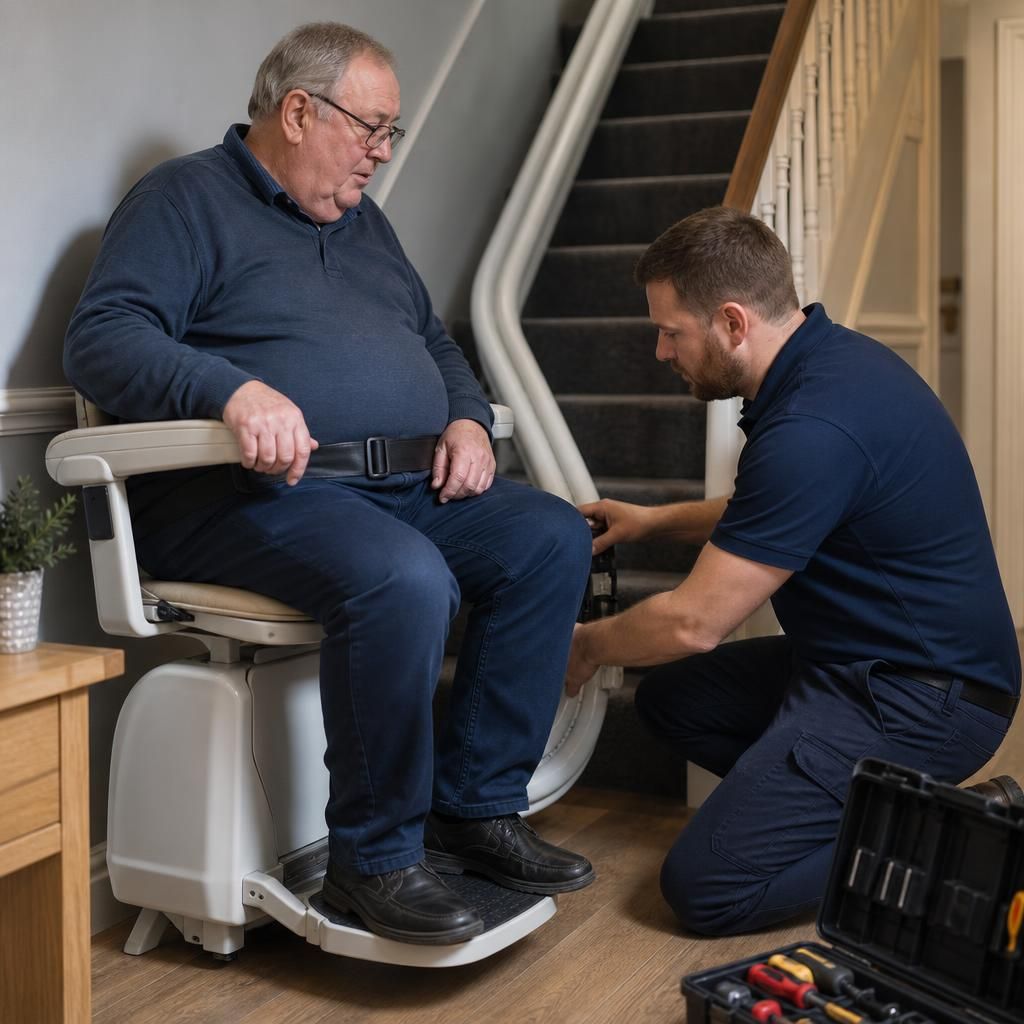
Professional installation is essential for a heavy duty stairlift. The engineer should secure the track correctly, set the seat and controls to suit the user, test the safety edges and sensors, and confirm that the lift travels smoothly through every part of the route. They should also explain safe operation, charging, seatbelt use, swivel-seat operation, parking and what to do if the lift stops. The user or their carer should have an opportunity to operate the stairlift and ask questions before the installation is completed.
Maintenance should follow the manufacturer’s servicing requirements and the amount of use. A service normally includes checks of:
- the track, brackets, fixings and joints for movement, wear or damage;
- the motor, gearbox, drive mechanism and braking function;
- the batteries, charging contacts and charging performance;
- the seat swivel, seatbelt, armrests, footrest and any powered adjustments;
- safety sensors, obstruction edges, limit switches and controls;
- the wiring, connectors and visible electrical components; and
- the smoothness, speed and stopping position of the lift under normal operation.
Cleaning is also useful between professional services. Keep the track and charging contacts free from dust, pet hair and objects, and wipe the seat and controls with suitable products. Do not apply oils or other lubricant unless the manufacturer or servicing engineer specifically recommends it, as the wrong product can attract dirt or affect the drive system. Do not remove covers, alter settings or attempt to repair electrical or mechanical parts yourself.
Arrange an inspection promptly if the stairlift develops unusual noise, juddering, slower travel, inconsistent charging, unexpected stopping, difficulty swivelling or a warning indicator. A worn battery or dirty charging contact can affect reliability, while changes in the user’s posture or mobility may mean that the seat position or transfer method needs reviewing. Continuing to use the lift when a safety feature is not working can increase risk, so follow the instructions for isolating the equipment and contact the service team.
Keep the stairlift’s service information and report any recurring fault, even if it clears temporarily. When a stairlift is used frequently, by more than one person or in a demanding environment, the servicing engineer may recommend closer monitoring. Regular professional checks, correct charging and careful day-to-day use help preserve the lift’s performance, but they should always be based on the specific model, installation and user rather than on a generic schedule.
A heavy duty bariatric stairlift requires installation checks that account for its greater load, larger seating area and the user’s transfer needs. The survey should confirm the staircase structure, track fixing points, available clearance, seat position and charging arrangement before any equipment is fitted.
Professional servicing should then check the track and fixings, drive system, batteries, charging contacts, seatbelt, swivel seat, controls and safety sensors. Contact the service team promptly if you notice unusual noise, slower movement, juddering, charging problems or unexpected stops. Do not attempt to adjust or repair the lift yourself, as this could affect its safety and warranty.
Arrange a heavy duty stairlift assessment
Arrange a heavy duty stairlift assessment with Independent Stairlifts to review your staircase, access requirements and suitable equipment. Our specialist team can also explain installation, servicing and ongoing care for your proposed stairlift.