
How does Independent Stairlifts ensure the durability and reliability of heavy duty stairlifts?
Independent Stairlifts supports the durability and reliability of heavy duty stairlifts through a detailed home assessment, careful product selection, professional installation and ongoing servicing. We check that the lift, track and supporting components are suitable for the user and staircase, then provide maintenance and aftercare to help keep the equipment operating safely and consistently.
Independent Stairlifts ensures the durability and reliability of a heavy duty stairlift by matching the equipment to the user and staircase, checking the installation thoroughly and providing appropriate servicing after fitting. A bariatric stairlift must support the user safely while coping with regular operation, so reliability depends on more than the lift’s stated weight capacity. The track, brackets, drive system, seat, controls, electrical supply and staircase all need to be suitable as a complete system.
Detailed assessment before installation
We begin with an assessment of the staircase, the intended user and how the stairlift will be used. This includes considering the user’s weight, posture, transfer ability, mobility, balance and whether a carer may need to assist. We also consider the width and shape of the staircase, the position of doors and landings, available parking space and any bends, tight turns or changes in gradient.
These details help establish whether a heavy duty model is appropriate and which configuration will provide adequate support. The assessment also identifies potential installation issues, such as weak or unsuitable fixing points, obstructions, limited clearance or a staircase that requires a bespoke track. Addressing these matters before fitting reduces strain on the equipment and helps prevent avoidable operating problems.
Suitable equipment and load capacity
A heavy duty stairlift is selected according to the manufacturer’s stated capacity and operating requirements, rather than simply choosing the largest available model. The seat, armrests, footrest, track and drive mechanism must all work together to accommodate the user securely. We also consider the expected frequency of use, as a lift used repeatedly throughout the day may have different practical requirements from one used occasionally.
Where additional support is needed, options may include a wider or reinforced seat, a suitable seatbelt arrangement, powered swivel or powered footrest functions and controls that are easier to operate. Features are recommended for a clear mobility or safety reason, not added without considering whether they suit the user’s abilities and the space available.
Correct installation and structural fixing
Professional installation is essential to the long-term performance of a heavy duty stairlift. The track must follow the staircase accurately, with brackets positioned to provide stable support and appropriate clearance. Fixings are selected and installed according to the staircase construction and the equipment manufacturer’s requirements. On a curved or unusually shaped staircase, accurate measurement and track manufacture are particularly important because small fitting errors can affect smooth travel, parking and clearance.
During installation, the engineer checks that the stairlift travels correctly without contacting walls, doors, handrails or other obstacles. The seat, arms, footrest and belt are checked for secure operation, and the controls are positioned so that the user can operate the lift without unnecessary reaching or twisting. The charging points and power supply are also checked so that the stairlift can recharge reliably when parked.
Testing and commissioning
Once fitted, the stairlift is tested through its normal route and stopping positions. Checks include starting and stopping, travel over bends where applicable, operation of safety sensors, seat swivel or folding functions, the seatbelt, controls, batteries and charging system. The engineer also checks for unusual noise, vibration, hesitation or other signs that the lift is not operating as intended.
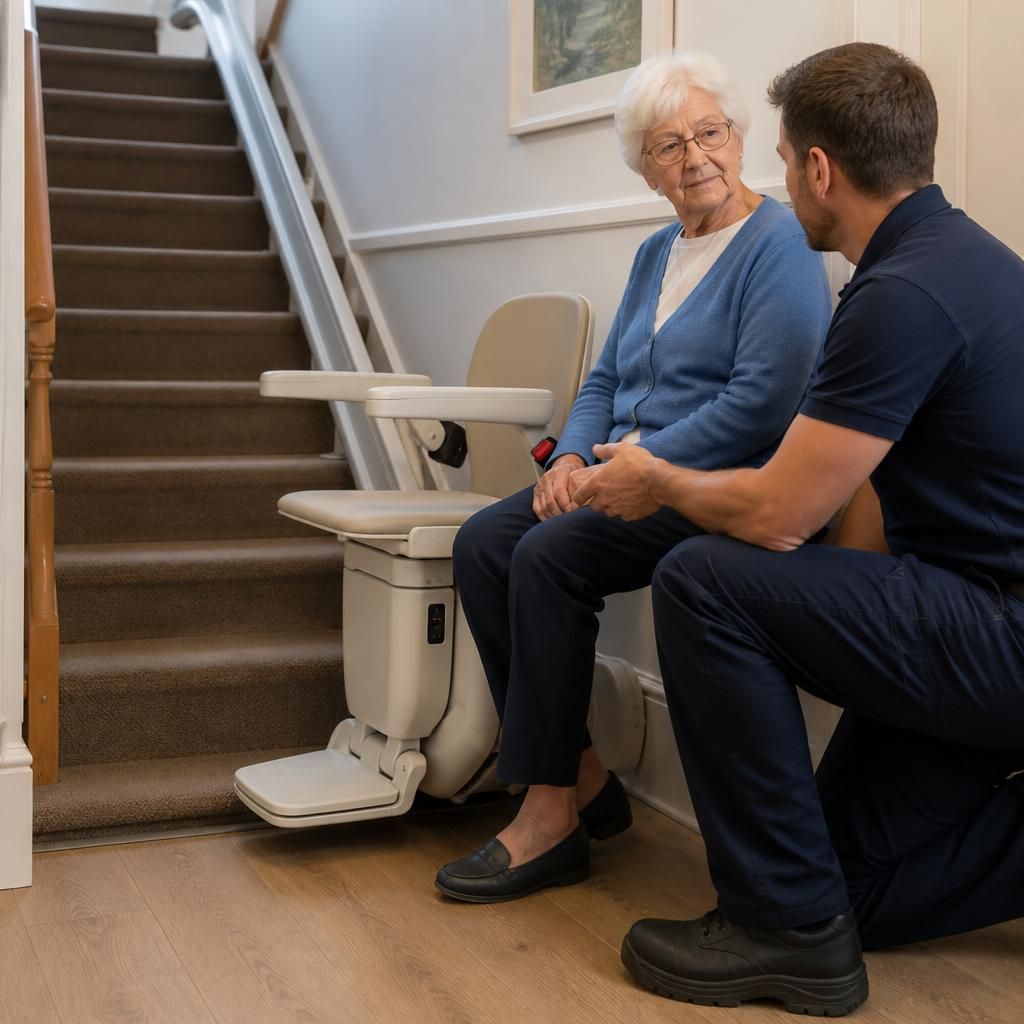
The user is shown how to use the stairlift safely, including how to position themselves, fasten the belt, use the controls, park the lift and respond if it stops. Clear instruction helps avoid misuse, overloading or actions that could place unnecessary stress on the equipment. If another person regularly assists the user, they should understand the basic operating and safety procedures as well.
Routine maintenance and aftercare
Regular servicing helps preserve the reliability of a heavy duty stairlift. During a service, the engineer can inspect the track, brackets, drive components, seat, safety systems, batteries, charging contacts and controls. Moving and electrical parts may require cleaning, adjustment or replacement as they wear. The exact service requirements depend on the model, the installation and how frequently the stairlift is used.
Customers should report changes such as juddering, unusual sounds, slower travel, difficulty charging, intermittent controls or unexpected stopping. Continuing to use equipment that is showing a fault can increase wear and may make a minor issue more difficult to resolve. Keeping the track clear, parking the stairlift where it can charge and following the operating guidance also support dependable performance.
Consideration of the home environment
Durability can be affected by the environment around the stairlift. Indoor equipment should be protected from spills, excessive moisture and impact. If the lift is installed outdoors or in an exposed area, the model and electrical arrangements must be suitable for those conditions, with additional attention to weather protection and maintenance. The staircase should also remain clear so that the lift is not struck by furniture, walking aids or other objects.
Reconditioned heavy duty stairlifts
Where a reconditioned stairlift is considered, suitability and condition must be assessed carefully. The equipment needs to be appropriate for the user and staircase, professionally checked and fitted with any necessary replacement or consumable parts. A reconditioned option is not suitable simply because it has the required weight rating; its age, condition, available support and compatibility with the proposed installation also matter.
By combining a proper assessment, suitable equipment, accurate fitting, commissioning checks and planned aftercare, Independent Stairlifts helps ensure that a heavy duty stairlift performs consistently within its intended operating conditions. If the user’s weight, mobility, staircase or frequency of use changes, contact us so that the installation can be reviewed rather than assuming the existing configuration remains suitable.
The durability of a heavy duty stairlift depends on the complete installation, not just its stated weight capacity. Independent Stairlifts assesses the user, staircase and expected frequency of use before recommending a suitable model. The track, brackets, seat, drive system and controls must work together securely and remain appropriate for the staircase layout.
Professional fitting and commissioning then confirm that the lift travels smoothly, the fixings are secure, the safety features operate correctly and the batteries charge reliably. Regular servicing helps identify wear or faults early, while keeping the track clear and reporting changes such as unusual noise, juddering or slower travel supports continued reliable use.
Arrange a heavy duty stairlift assessment
Arrange a heavy duty stairlift assessment with Independent Stairlifts to review your staircase, mobility requirements and the most suitable equipment. Contact us to discuss your needs and arrange a convenient home assessment.