
Are heavy duty stairlifts suitable for narrow or steep staircases, and what solutions are available if they aren't?
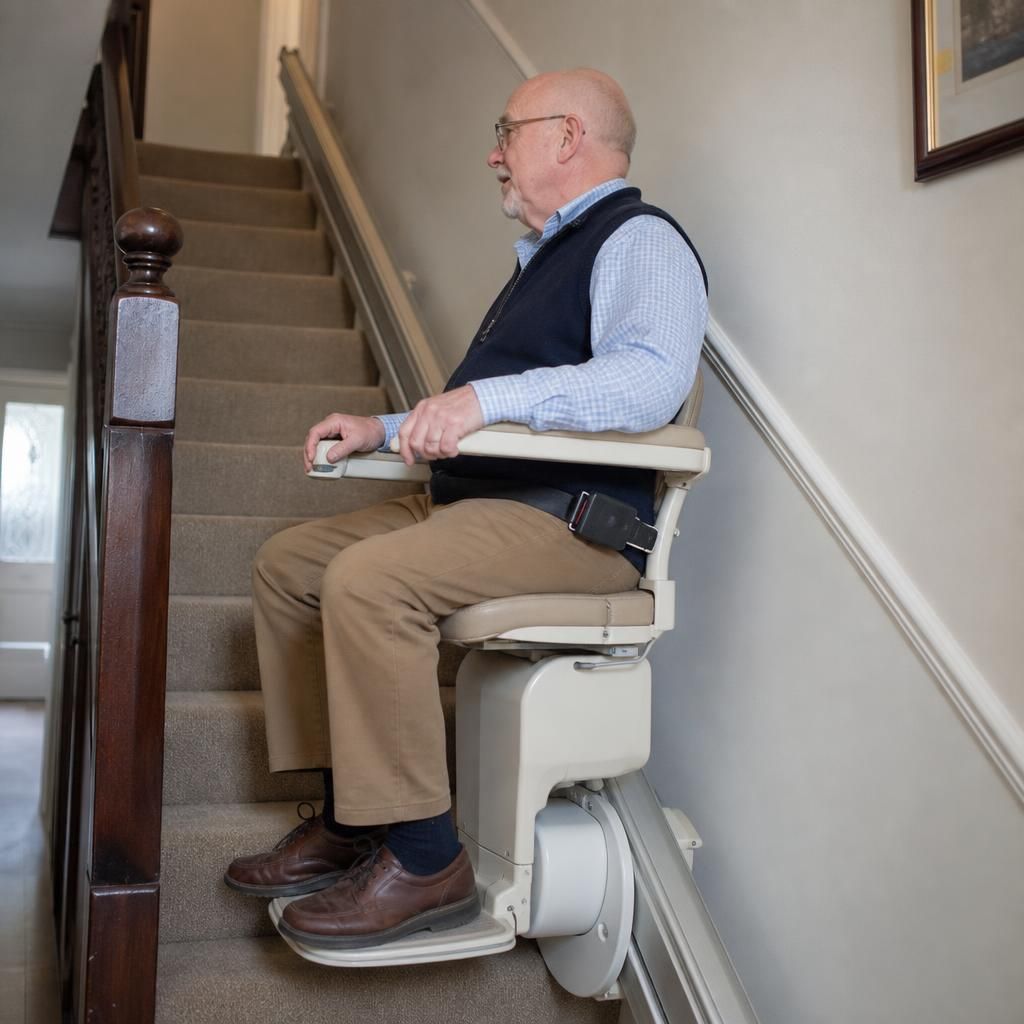
Heavy duty stairlifts can be suitable for some narrow or steep staircases, but the available space, staircase shape, gradient, user’s weight and transfer needs must be assessed before confirming a safe installation. If a conventional heavy duty model cannot be fitted, possible solutions include a more compact or customised stairlift, a perch or standing stairlift where appropriate, or alternative access equipment following an expert home assessment.
Heavy duty stairlifts can be suitable for some narrow or steep staircases, but suitability depends on more than the user’s weight. The staircase width, available clearance, gradient, bends, landings, obstructions and the user’s ability to transfer safely must all be assessed together. A larger-capacity stairlift may require a wider seat, stronger carriage and additional space, so a model that works on a standard staircase may not be appropriate in a restricted installation.
A home assessment is therefore essential before a heavy duty stairlift is selected. An installer will measure the staircase and inspect the top and bottom landings, doorways, radiators, newel posts, handrails and other features that could affect the lift’s travel or parking position. The assessment should also consider how the user approaches the lift, sits down, fastens the safety belt, operates the controls and transfers at the destination. These practical details are particularly important where the user has limited balance, joint movement or upper-body strength.
Narrow staircases
On a narrow staircase, the main issue is usually the combined space occupied by the user, seat and folded stairlift. The lift must leave enough room for the rider to sit securely without their knees, feet or shoulders being placed too close to the wall, banister or stair edge. It must also be possible for other household members to use the stairs safely when the lift is parked, where this is required.
Potential solutions for a restricted staircase may include:
- A compact heavy duty configuration: Some stairlift designs have a narrower folded profile or a seat arrangement that reduces the space needed when the lift is not in use. This does not mean that every compact design is suitable for every heavier user, so the safe weight capacity and seating position must be confirmed.
- A customised seat or carriage: Adjustments to the seat, arms, footrest or controls may improve comfort and positioning. Customisation can help with a particular transfer problem, although it cannot overcome every physical limitation of the staircase.
- A powered or manually operated swivel seat: Turning the seat at the landing can reduce the need to twist while getting on or off. The available landing space must still allow the seat to swivel and the user to transfer without obstruction.
- A perch or standing stairlift: A perch design can occupy less space in some installations because the user travels in a semi-standing position. It may be considered where sitting is difficult and the user has sufficient leg strength, balance and control. It is not automatically suitable for someone who needs the full support of a seated heavy duty stairlift.
Extra care is needed where the staircase is narrow at only one point, such as beside a newel post or at a bend. A lift may pass the narrow section but still fail to provide a safe boarding or exit position. The measurements should therefore cover the complete route rather than the straightest or widest part of the stairs alone.
Steep staircases
A steep staircase presents different challenges. The stairlift must be able to follow the gradient while maintaining a stable seat angle, keeping the user’s centre of gravity in a safe position and providing adequate foot and side support. A standard heavy duty model may not be suitable if its operating range does not match the staircase gradient.
Possible approaches include a stairlift designed for a steeper gradient or a bespoke rail that follows the actual staircase. On a curved staircase, a made-to-measure rail may be needed to negotiate bends, intermediate landings or changes in direction. The installer will also check whether the rail, carriage and footrest can travel without striking walls, doors or other fittings.
Steep stairs can make boarding and exiting more demanding, particularly if the user has weak knees, poor balance or difficulty standing from a low seat. A powered swivel seat, a suitable seat height, supportive arms and correctly positioned controls may make transfers more manageable. These features should be chosen around the user’s abilities rather than added without considering the available landing space.
When a conventional heavy duty stairlift is not suitable
If the staircase cannot safely accommodate a conventional heavy duty model, the assessment should identify the reason rather than simply treating the installation as impossible. In some cases, the problem can be resolved through a different seat configuration, a perch design, a customised rail or changes to where the lift parks. In other cases, the available space, gradient or landing arrangement may prevent a stairlift from meeting the required safety conditions.
Depending on the property and the user’s mobility needs, alternatives may include:
- A through-floor lift: This can provide access between floors without occupying the staircase. It requires suitable floor and ceiling space, structural assessment and an appropriate location on both levels.
- A wheelchair or platform lift: Where the user needs to remain in a wheelchair, a platform solution may be more practical than transferring into a stairlift seat. It generally needs more room and may require building alterations.
- A step lift or vertical access lift: In some layouts, a lift serving a short change of level or a suitable vertical route may provide an alternative. The correct equipment depends on the height, available footprint and whether the user is walking or using a wheelchair.
- Changes to the living arrangement: If permanent access between floors cannot be achieved safely, adapting the main living, sleeping and washing facilities to one level may be considered. This should be planned with appropriate occupational therapy or accessibility advice where necessary.
Portable ramps are generally relevant only to small changes in level and are not a solution for a full flight of steep domestic stairs. Similarly, a standard stairlift should not be used as a substitute for a heavy duty model if the user’s weight, body shape or transfer requirements exceed its safe operating limits.
What the assessment should establish
A suitable recommendation should take account of the user’s current needs and likely progression, not just whether the carriage can physically travel from one floor to another. Important points include the user’s weight and dimensions, posture, ability to sit upright, transfer method, foot position, balance, hand strength and ability to operate the controls. The assessment should also consider whether a carer needs to assist, whether other people must continue using the stairs and where the lift can park without blocking a doorway or landing.
Independent Stairlifts can assess straight, curved and outdoor access arrangements across the UK and explain when a heavy duty stairlift is appropriate, when a different configuration is safer, and when another form of access equipment should be considered. Do not rely on a catalogue measurement or assume that a narrow or steep staircase rules out every option. An in-home assessment is the reliable way to establish the available solutions and ensure that the final recommendation supports safe transfers, comfortable travel and practical everyday use.
Whether a heavy duty stairlift can be installed on a narrow or steep staircase depends on the complete route, not simply the staircase width or gradient. The user’s weight, seating position, transfer ability, landing space and required clearance must all be assessed together to confirm that the lift can be used safely.
A restricted staircase may still accommodate a compact heavy duty configuration, customised seating or a bespoke rail. In some cases, a perch stairlift can reduce the space required, but it is suitable only where the user has sufficient balance and leg strength. If these options cannot provide safe boarding, travel and exit, a through-floor lift, platform lift or single-level living arrangement may be more appropriate. An in-home assessment establishes which solution is practical before any equipment is recommended.
Arrange an assessment for your staircase
Arrange an in-home assessment with Independent Stairlifts to establish whether a heavy duty stairlift can be fitted safely to your narrow or steep staircase. We can also explain suitable alternatives if a conventional installation is not appropriate.