
What types of stairlifts are available for disabled users, and how do you choose the right option?
Stairlifts for disabled users include straight, curved, outdoor, standing and heavy-duty models, as well as reconditioned options. The right choice depends on your staircase layout, mobility, weight, transfer ability, seating needs and whether the lift will be used indoors or outside, so a professional assessment is essential.
Stairlifts for disabled users are available in several designs, including straight, curved, outdoor, standing or perch, heavy-duty and reconditioned models. The right option is determined by the staircase layout, the user’s mobility and transfer ability, the available space, weight capacity, seating requirements and whether the lift will be used indoors or outside. A professional assessment is important because the most suitable model is not always apparent from photographs or measurements alone.
Straight stairlifts travel along a single, uninterrupted flight of stairs. They are generally suitable where the staircase runs directly from one level to another without a bend, landing or change of direction. Straight models can often be fitted with limited alteration to the staircase and may be suitable for users who can sit safely and transfer on and off the seat at the top and bottom.
The space available at the top and bottom of the stairs still needs to be checked. A swivel seat, powered swivel, hinged rail or folding footrest may be needed to keep the transfer area clear and reduce the risk of overreaching. If a doorway, radiator or narrow hallway is close to the stairs, the rail design and parking position will need careful consideration.
Curved stairlifts are made to follow staircases with bends, intermediate landings, multiple flights or changes in direction. The rail is measured and manufactured to suit the individual staircase, so the lift can usually be parked in a position that preserves access to landings and doorways. Curved solutions can also be used on more complex layouts where a straight lift on each flight would create additional transfers.
A curved stairlift may be appropriate for a staircase with a half landing, quarter landing, spiral section or unusual alignment. The assessment should consider where the user will board and leave the lift, whether the seat can turn safely at landings, and how much clearance is available for other people using the stairs.
Outdoor stairlifts are designed for external steps, such as access to a garden, driveway, entrance or split-level path. They use materials and protective features intended for exposure to changing weather, but the installation site still needs suitable drainage and a practical power supply. The seat, controls and charging points should be protected as far as possible from rain, frost and direct exposure.
Outdoor use may require a weatherproof cover and a parking position that does not obstruct a path or doorway. The assessment should also consider the condition of the steps, lighting, handrails, surface grip and how safely the user can approach the lift in wet or icy conditions. An outdoor stairlift is not a substitute for repairing unsafe steps or improving access around the property.
Standing or perch stairlifts allow the user to travel in a supported semi-standing or perched position rather than sitting fully back in a conventional seat. They can be useful where bending the knees or sitting down is difficult, or where the staircase is narrow and a more compact design is needed. However, the user must have sufficient standing balance, leg strength and ability to remain supported throughout the journey.
A perch model is not suitable for everyone with difficulty sitting. The assessment should check whether the user can transfer to the perch seat, maintain the required posture, operate the controls and use the safety belt correctly. If there is uncertainty about balance, pain, fatigue or involuntary movement, a seated model or another access solution may be safer.
Heavy-duty stairlifts are designed for users who need a wider or more supportive seat and a higher specified weight capacity than a standard model provides. They may include stronger seating, reinforced components, a larger footrest and additional support features. The relevant capacity is the complete safe operating limit for the model, not simply an estimate based on the user’s weight.
The assessment should include the user’s weight, height, body shape, posture, ability to transfer and the space needed to sit comfortably without contacting the wall or stair edge. The user must remain within the manufacturer’s operating limits, and belongings should not be carried in a way that affects balance, visibility or the lift’s safe operation.
Reconditioned stairlifts can provide a suitable option where the required model is available and the budget is an important consideration. A reconditioned lift should be inspected, tested and prepared by a competent installer, with its suitability checked against the staircase and the user’s needs. Availability can be more limited than with a new bespoke installation, particularly for complex curved staircases or less common specifications.
When considering a reconditioned stairlift, ask what preparation and safety checks have been completed, what warranty or servicing arrangements apply, whether the model has the required features and whether replacement parts remain available. The decision should be based on the condition and suitability of the individual lift, rather than price alone.
Choosing the right stairlift involves assessing several practical factors:
- Staircase design: establish whether the stairs are straight, curved, narrow, steep, external or interrupted by landings. Doorways, radiators, furniture and available parking space can affect the rail design.
- Transfer ability: consider whether the user can safely stand, turn and sit down, and whether they can get off the lift without twisting or reaching. A powered swivel seat or other transfer aid may be appropriate.
- Posture and movement: conditions affecting balance, strength, joint movement, grip, coordination or fatigue can influence the choice between a standard seated, perch or more supportive model.
- Seat and support: check the seat width, height, cushioning, armrests, footrest, seat belt and swivel action. The user should be able to maintain a stable position throughout the journey.
- Controls: controls should be reachable and simple to operate with the user’s available hand strength and dexterity. Remote controls can allow the lift to be called to another floor, while alternative control arrangements may help where one hand is weaker.
- Weight and dimensions: confirm the manufacturer’s operating limit and make sure the lift provides sufficient room without reducing safe clearance for people walking on the stairs.
- Transfer and evacuation arrangements: a stairlift should not be used to carry another person or as an emergency evacuation device. The household should retain a separate plan for power cuts, fire or a medical emergency.
- Future needs: consider whether the user’s mobility is likely to change. A feature that is manageable now, such as a manual swivel or perch position, may become difficult later, while powered functions can reduce the physical effort required.
The assessment should involve the person who will use the stairlift wherever possible. It should cover how they approach the stairs, transfer onto the seat, operate the controls, travel around landings and get off at the destination. If an adult child, carer or occupational therapist is involved, their observations can help identify practical risks that may not be obvious during a short demonstration.
It is also important to discuss the needs of other household members. The stairlift should be parked so that it does not block a doorway or landing, and a folding seat, footrest or rail may help preserve access for people walking up and down the stairs. Where the stairway is particularly narrow or regularly used by several people, clearance should be checked carefully before choosing the model.
Features such as powered swivel seats, powered footrests, hinged or drop-down rails, foldable arms, diagnostic displays and remote controls can improve usability, but they should be selected for a clear functional reason. Extra features do not make an unsuitable stairlift safe. The priority is a secure transfer, comfortable travel, accessible controls and reliable stopping at each end of the route.
A professional assessment will confirm the appropriate stairlift type, check the staircase and surrounding areas, discuss available features and identify any access issues before installation. The installer should explain how to use the lift, charge it, respond to an alert and report a fault. If the assessment indicates that a stairlift cannot provide safe access, other options may need to be discussed rather than proceeding with an unsuitable installation.
In practical terms, the best stairlift is the one that matches both the building and the person. A straight lift may be appropriate for a simple staircase, while a curved model may avoid repeated transfers on a complex layout. A perch, heavy-duty or outdoor design may solve a specific mobility or environmental problem, and a properly prepared reconditioned lift may be suitable when its condition and specification meet the user’s needs.
The right stairlift depends on both the staircase and the person using it. A straight model may suit a single uninterrupted flight, while a curved stairlift can follow bends, landings or changes in direction without requiring the user to transfer between separate lifts. Outdoor, perch and heavy-duty models address specific access, posture and support requirements.
During the assessment, the user’s transfer ability, balance, posture, weight, hand strength and preferred seating position should be considered alongside stair width, clearance and parking space. Features such as a powered swivel seat, powered footrest or hinged rail should be recommended only where they solve a particular safety or access issue. The most suitable option is the one that allows a secure transfer, comfortable journey and straightforward operation now and as needs change.
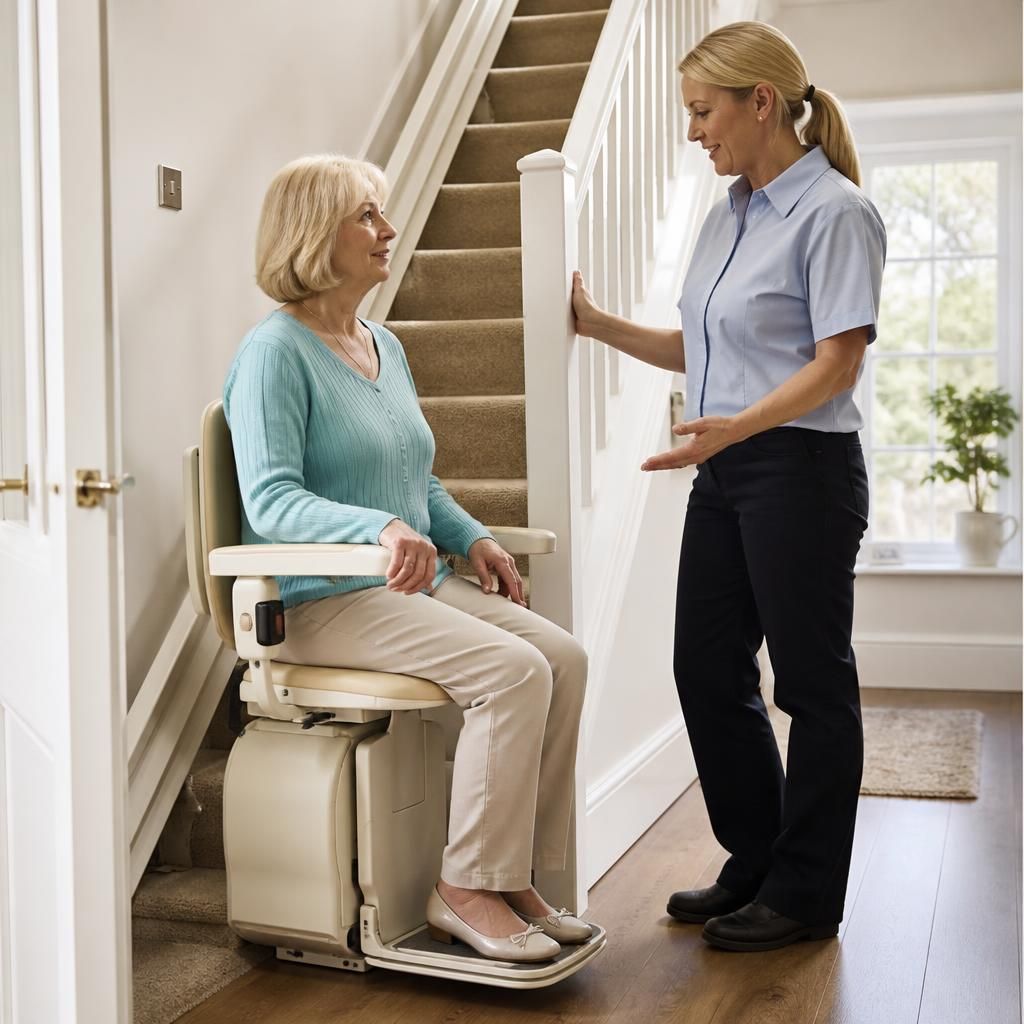
Arrange Your Disabled Stairlift Assessment
Arrange your disabled stairlift assessment so we can assess your staircase, transfer needs and preferred features. We will help you identify a suitable solution and explain the installation and aftercare options.