
What should I consider when deciding between a new and a reconditioned stairlift?
Choosing between a new and reconditioned stairlift depends on your budget, stairway layout, required features, warranty and expected level of use. A new stairlift offers the widest choice of options, while a professionally reconditioned model can provide a reliable, more affordable solution when a suitable model is available.
The choice between a new and a reconditioned stairlift usually comes down to the balance between budget, availability, stairway layout, required features, warranty cover and expected use. A new stairlift provides the widest choice of models and specifications, whereas a professionally reconditioned stairlift can offer a reliable and more affordable solution when a suitable model is available for your staircase and needs.
Start with the assessment rather than the price. The stairlift must suit the shape and dimensions of the staircase, the user’s mobility, and the way the property is used. A home assessment considers the available space at the top and bottom of the stairs, the position of doors and corridors, access to controls, seating and transfer requirements, and whether other household members need to use the stairs. This helps establish whether a standard straight model is appropriate or whether a curved, outdoor or more specialised solution is required.
A new stairlift may be the better option when:
- you need a particular seat, control arrangement, rail design or set of safety features;
- the staircase is unusual and requires a made-to-measure curved rail;
- the stairlift will be used frequently or by more than one person;
- you want the widest choice of current models and available accessories;
- you want the reassurance of new equipment and the applicable manufacturer warranty; or
- you expect your mobility needs to change and want to discuss features that may remain useful in the future.
New equipment is not automatically the right answer for every home. It may cost more initially, and some features may not be necessary for the intended user. The important point is to pay for the specification that improves safe, practical use rather than selecting features that have no clear benefit.
A reconditioned stairlift may be suitable when:
- the staircase has a conventional layout or a compatible curved rail is available;
- the required controls and seating arrangement are straightforward;
- keeping the initial cost lower is an important consideration;
- the stairlift is intended for temporary, occasional or shorter-term use; or
- a professionally prepared model meets the same safety and accessibility requirements as a new alternative.
A reconditioned stairlift should not simply be a used unit removed from another property and installed without proper checks. Ask how it has been inspected, cleaned, tested and prepared, and whether worn components such as batteries, drive parts, rollers or safety edges have been replaced where necessary. The installation should include checks of the controls, seat belt, sensors, charging system, stopping mechanism and movement along the full staircase.
Compare warranty and aftercare as well as the purchase price. Warranty terms can differ between new and reconditioned equipment and may cover parts, labour, or both for different periods. Before agreeing to an installation, confirm what is included, who provides the support, how repairs are arranged and whether routine servicing or call-outs are charged separately. A lower initial price may not represent better value if the equipment has limited support or if important items are excluded.
Also consider the total cost of ownership. This can include installation, removal of an existing stairlift, replacement batteries, servicing, repairs and eventual removal. For a reconditioned model, check whether the rail is already available or must be adapted for your staircase. For a new curved stairlift, a bespoke rail is normally made for the individual staircase, so the design and installation requirements can affect the price.
Safety and usability should take priority over age. A well-maintained reconditioned stairlift can be appropriate if it is correctly matched to the user and installed by a competent specialist. Conversely, a new stairlift will not be suitable if its seat, controls or access arrangements do not work for the person using it. The user should be able to transfer on and off the seat as safely as possible, operate the controls, use the seat belt where fitted, and understand what to do if the stairlift stops.
Discuss any relevant conditions or limitations during the assessment, including difficulty bending the knees, reduced grip, visual impairment, balance problems, pain when turning, or a need to carry essential items between floors. These details can affect the choice of seat swivel, armrest controls, footrest design, powered options and other accessories. If more than one person will use the stairlift, the solution must be safe and manageable for each regular user.
Availability is another practical difference. A suitable reconditioned stairlift depends on the stock available and may not match every staircase or feature requirement. New equipment generally gives more flexibility, but some bespoke installations require additional design and manufacturing time. The assessment should explain the realistic options for your home rather than assuming that a particular model will fit.
Before making a decision, ask for a clear comparison covering:
- the exact model and whether it is new or reconditioned;
- compatibility with your staircase and the user’s weight, height and mobility requirements;
- included safety and comfort features;
- the condition and expected serviceability of a reconditioned unit;
- warranty length, exclusions and aftercare arrangements;
- installation, delivery, removal and any other included costs; and
- what happens if the user’s needs change or the stairlift is no longer required.
In practical terms, choose a new stairlift when you need a particular specification, a bespoke curved solution, the latest available options or the broadest choice of warranty and support. Choose a reconditioned stairlift when a suitable model is available, its condition and preparation are clearly explained, and it meets the user’s safety and accessibility needs without unnecessary features. An individual assessment is the most reliable way to confirm which option provides the right combination of fit, usability, support and overall value.
A reconditioned stairlift is a previously used unit that has been removed, inspected, cleaned, tested and prepared for another installation. Its suitability depends on its condition, compatibility with the staircase and the user’s needs—not simply on its age or lower purchase price.
Before choosing one, ask what checks and replacement work have been carried out. The controls, seat belt, sensors, charging system, batteries, rollers, drive mechanism and stopping function should all be assessed. Confirm the warranty, what it covers, how repairs are arranged and whether installation or future servicing costs are included. If the model meets the user’s safety and accessibility requirements and is supported by appropriate aftercare, it can provide a practical alternative to new equipment.
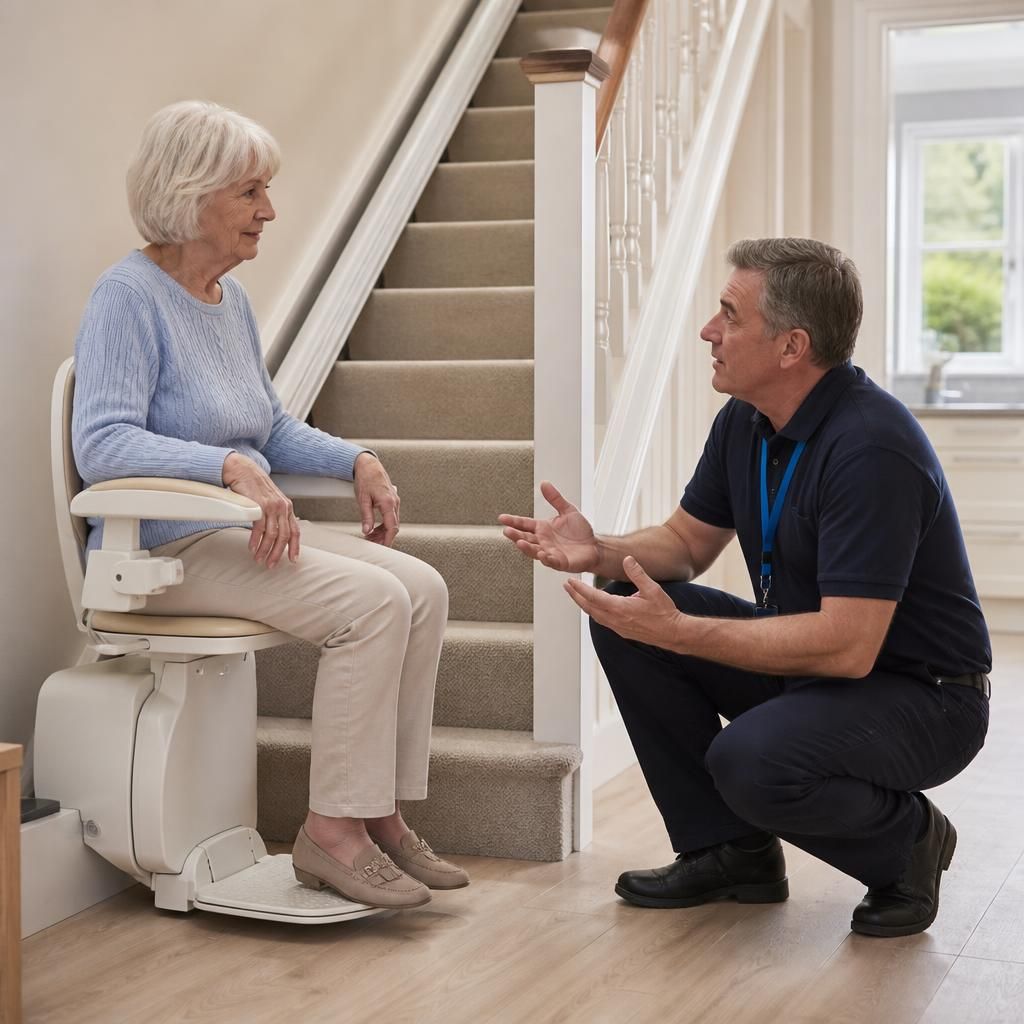
Arrange your stairlift assessment
Arrange your stairlift assessment to compare suitable new and reconditioned options for your staircase, mobility needs and budget. We can explain the differences in specification, warranty and aftercare before you decide.