
What happens if my stairlift needs repairs or maintenance, and how quickly can these issues be addressed?
If your stairlift needs repair or maintenance, contact Independent Stairlifts so the issue can be assessed and the appropriate support arranged. Safety-related faults are prioritised, while less urgent repairs are scheduled with an engineer as soon as practical, depending on the fault, parts required and your location.
When your stairlift needs repair or maintenance, contact Independent Stairlifts as soon as you notice a fault so it can be assessed and the right support arranged. Safety-related problems are prioritised, while less urgent repairs are scheduled with an engineer as soon as practical. The time required depends on the fault, whether replacement parts are needed, the stairlift model and your location.
If the stairlift stops working, stop using it and report the problem rather than attempting to force the controls, move the carriage manually or remove covers. If it has stopped on the stairs, use the safest available route away from the lift if you can do so without risk. If someone is stranded, injured or in immediate danger, contact the appropriate emergency service as well as notifying Independent Stairlifts.
When you contact us, provide the user’s details, the stairlift location, the make or model if known, what happened and any message or warning light shown on the controls. It is also helpful to explain whether the lift has stopped completely, is moving unusually slowly, is making an unfamiliar noise or is failing to charge. These details help us judge urgency and prepare for the visit.
Urgent faults may include a stairlift that will not stop or operate safely, a damaged seat or safety arm, a problem with the seat belt, smoke or a burning smell, exposed wiring, significant fluid leakage or a fault that leaves the user unable to move safely between floors. Do not continue using the lift in these circumstances. An engineer will assess the issue and advise whether the stairlift should remain out of service until it has been repaired.
Some problems have simple causes and can be checked during the initial call. For example, the stairlift may not operate if it is not fully parked on its charging point, the key switch is turned off, an arm or seat is not in its travelling position, the batteries are depleted or an obstruction is affecting the track or safety sensors. Only carry out checks that you can complete safely and that you have been advised to perform. Do not bypass a safety device.
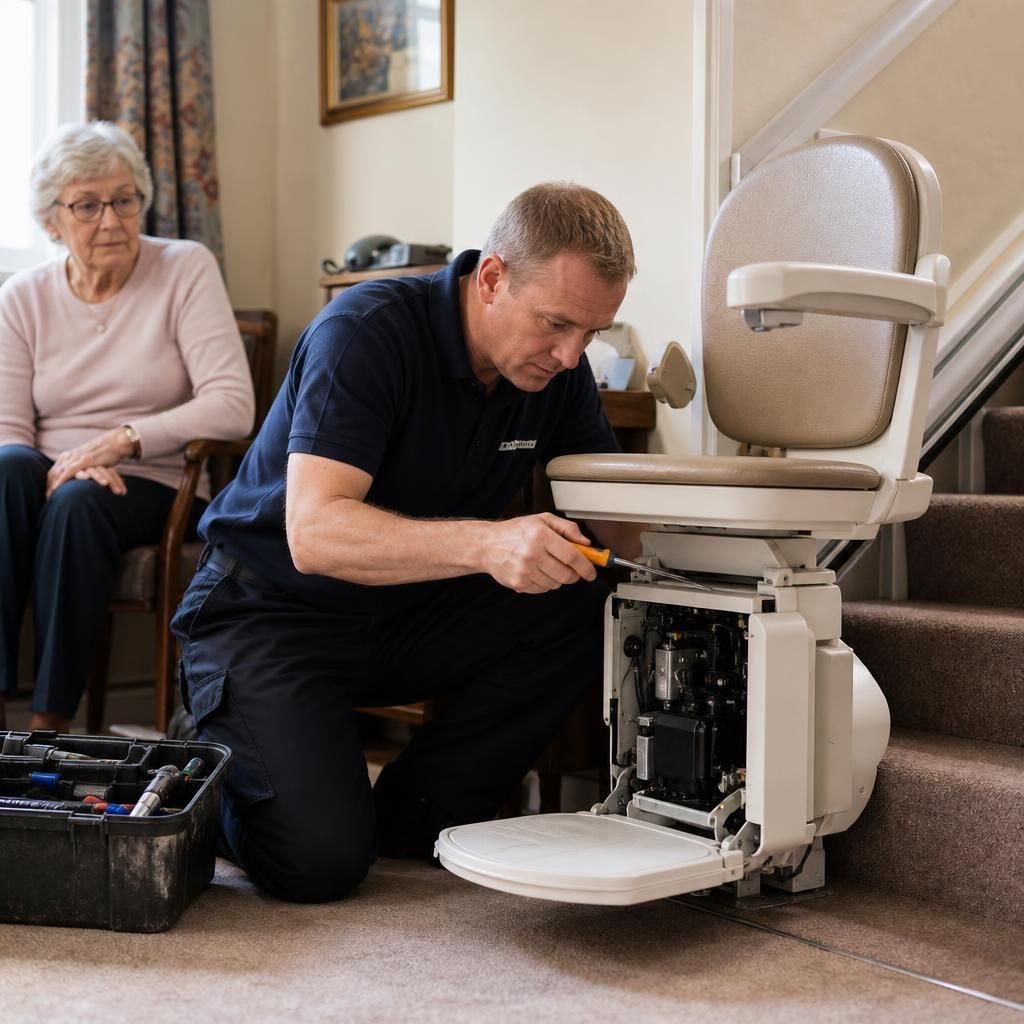
During a repair visit, the engineer will inspect the stairlift, identify the cause of the fault and test the relevant electrical, mechanical and safety components. Depending on the problem, the repair may involve adjusting the track or seat, checking charging points, replacing batteries, resolving a control fault or fitting another compatible component. The stairlift should be tested before it is returned to normal use.
How quickly can it be fixed? If the fault can be diagnosed and the necessary part is available, it may be possible to complete the repair during the arranged visit. If a specialist or model-specific part is required, a further visit may be necessary. Availability can also be affected by the age and condition of the stairlift, discontinued components and the engineer’s travel requirements. We will explain the expected timescale and any additional work once the fault has been assessed, rather than promising a fixed completion time before the cause is known.
Routine maintenance is different from an urgent repair. A maintenance visit checks the stairlift’s operation and condition before a fault develops. It can include inspecting the track, drive system, batteries, charging points, controls, seat, armrests, footrest, sensors and safety belt, followed by operational testing. The appropriate maintenance interval depends on the stairlift, how frequently it is used and the manufacturer’s guidance.
Regular servicing does not prevent every fault, and batteries and other wear components eventually need replacement. Report changes such as reduced travel distance, repeated low-battery warnings, unusual noises, jerky movement, intermittent controls or difficulty docking. Early attention can help identify a developing issue and reduce the risk of the lift becoming unavailable.
Keep the stairlift clear of household items, avoid spilling liquid near its controls or charging points and do not allow anyone to tamper with the track or electrical components. If your stairlift is covered by a warranty or service arrangement, check its terms when reporting the fault so that the repair is handled under the correct cover. Independent Stairlifts can confirm the next step, the likely urgency and whether a charge applies once the details of the problem are known.
Stairlift repair times depend on the type of fault, the model, the parts required and your location. If the problem affects safe operation, stop using the lift and contact Independent Stairlifts promptly so its urgency can be assessed and suitable support arranged.
When reporting the fault, explain what happened, whether the stairlift is working at all, and any warning message, unusual noise or charging problem. This information helps the team prioritise the call and allows the engineer to prepare for the visit. Some repairs can be completed during the first appointment when the cause is clear and the required part is available; model-specific or discontinued components may require further time.
Contact Independent Stairlifts About Repairs or Maintenance
Contact Independent Stairlifts to report a stairlift fault or arrange routine maintenance. We can assess the issue, prioritise any safety concerns and explain the next steps, likely timescale and whether a charge applies.