
How does the stairlift assessment process ensure that the chosen solution will meet specific safety and accessibility needs?
The stairlift assessment process reviews your staircase, home layout, mobility needs and safety requirements before a solution is recommended. This helps ensure the chosen stairlift is suitable for the available space, comfortable to use and accessible for your individual circumstances.
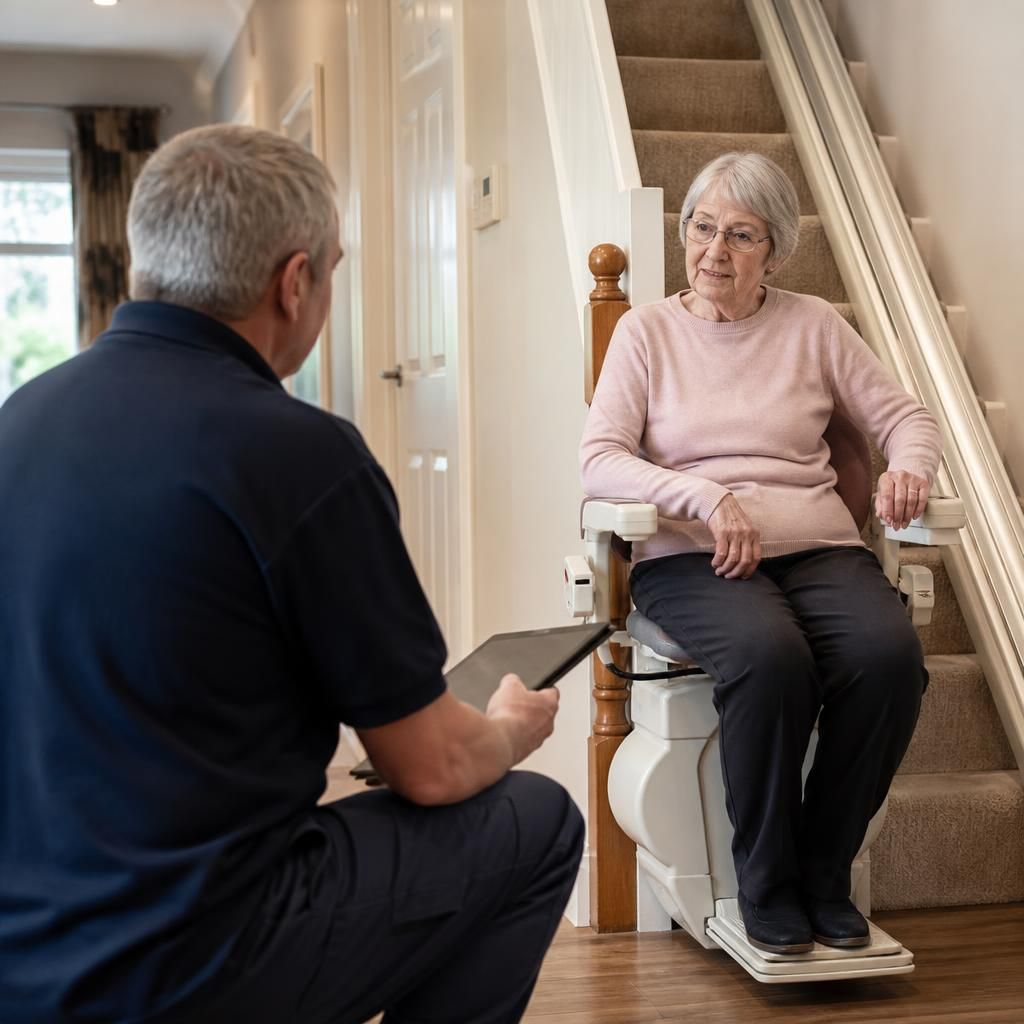
The stairlift assessment ensures that the recommended solution is safe for your staircase, suitable for your mobility needs and practical for everyday use. It combines a review of the property with an assessment of how you sit, stand, transfer and operate the lift, so the equipment is selected for your circumstances rather than simply the shape of the stairs.
Understanding your mobility and daily routine
The assessment begins by discussing how you currently use the stairs and what you find difficult or unsafe. This may include reduced strength, balance problems, pain, limited movement, difficulty bending your knees, or the need to use a walking aid. The assessor will also consider whether you will need help getting on or off the stairlift, whether another person may use it, and whether your condition is likely to change.
These details influence important features such as the seat style, seat height, swivel mechanism, armrest position, footrest design, safety belt and control layout. If sitting down or standing up is difficult, for example, a powered swivel seat or a perch-style lift may be considered. If you use a wheelchair, the assessment will also look at where it can be left at the top and bottom of the stairs, as stairlifts do not usually carry a wheelchair with the passenger.
Checking the staircase and surrounding space
The assessor examines the full route, not just the steps themselves. This normally includes:
- the width, length, gradient and shape of the staircase;
- straight sections, bends, intermediate landings and changes in direction;
- the available space at the top and bottom for safe transfers;
- doorways, radiators, handrails, furniture and other possible obstructions;
- headroom, particularly where the stairs pass beneath a landing or low ceiling;
- the position of switches, sockets and suitable power supplies; and
- any outdoor exposure, damp or uneven access if an external stairlift is required.
Measurements and photographs or digital measurements may be taken to confirm whether a standard rail is appropriate or whether a bespoke curved rail is needed. The assessment also identifies whether the rail, seat or footrest could restrict access to a doorway, hallway or landing when the lift is parked.
Matching the lift to the staircase
A straight stairlift may be suitable where the staircase runs in one continuous line. A curved stairlift is generally considered where there are bends, landings or multiple flights and the lift needs to follow the stair profile. The assessor will explain the practical differences, including where the lift can park and how much space remains available for other users.
Where appropriate, alternative arrangements may be discussed. These could include different parking positions, a hinged or powered rail where a doorway or circulation route is close to the stairs, a compact seat, or equipment designed for outdoor conditions. The recommendation should take account of access for everyone in the household, not only the person using the stairlift.
Reviewing safety controls and accessibility
The assessment checks that the proposed configuration supports controlled, predictable use. Features may include a seat belt, swivel seat lock, armrest controls, obstruction sensors and a footrest that provides stable support. Controls should be reachable and understandable for the user, with a remote control available where it is useful for calling or sending the lift between floors.
The assessor will also consider transfer risks. The lift must stop in a position that allows you to sit down or stand up without twisting into an obstruction or stepping into an unsafe area. At the top landing, for example, the seat may need to swivel before you leave the lift. At the bottom, there must be sufficient room to dismount and move clear of the staircase.
A stairlift is a mobility aid for travelling between levels; it is not an emergency escape device. The assessment should therefore take account of your wider home access and any evacuation arrangements relevant to your circumstances. If you rely on carers or other household members, their ability to use the stairs and move around the lift should also be considered.
Considering the home environment
Fixings are normally attached to the stair treads rather than the wall, but the assessor checks the condition and construction of the stairs before installation. They will identify issues such as damaged treads, loose flooring, unusual surfaces or restricted access for the installation team. Any work needed before fitting should be explained in advance.
For an outdoor installation, the assessment additionally considers rain, frost, drainage, surface condition, lighting and safe access at the top and bottom. Outdoor equipment requires suitable positioning and maintenance to remain reliable in changing weather conditions.
Explaining the recommendation and costs
Once the assessment is complete, you should receive a clear explanation of why a particular type and configuration has been recommended. This should cover the proposed route, seat and control options, parking position, any adaptations or preparatory work, installation requirements and aftercare. If more than one solution is practical, the differences in accessibility, convenience and cost should be explained so you can make an informed choice.
Ask about anything that could affect your use of the lift, including the position of the charging points, what happens during a power cut, how the lift is operated manually if necessary, and whether the proposed arrangement leaves enough room for other people to use the staircase. It is also useful to mention changes you expect in your mobility, because a solution that works today may need different features as your needs develop.
Final checks after fitting
The assessment process continues through installation and handover. After the stairlift has been fitted, the installer should test its travel, stopping points, safety sensors, swivel mechanism, belt, controls and charging. You should be shown how to start and stop the lift, use the controls, park and charge it, respond to an obstruction and report a fault.
You should then try the lift yourself, ideally using the walking aid or footwear you normally use. This gives the installer an opportunity to adjust the seat position, controls or other settings and to answer questions before the installation is completed. If your circumstances change later, contact the service team for advice rather than altering the equipment or its fixings yourself.
A stairlift assessment checks whether you can transfer on and off the lift safely, not just whether the rail will fit the staircase. The assessor considers your balance, leg strength, flexibility, walking aid and the space available at each end of the stairs.
This may affect the recommended seat height, swivel seat, armrests, footrest and belt. The lift must stop where you can sit down and stand up without twisting into an obstruction or stepping into an unsafe area. During handover, you should try the stairlift yourself so the installer can check your posture, reach and control of the equipment, and make any appropriate adjustments.
Arrange Your Stairlift Assessment
Arrange your stairlift assessment with Independent Stairlifts so your staircase, mobility needs and everyday access requirements can be reviewed before a solution is recommended. Contact the team to discuss your circumstances and agree a convenient assessment.