
What are the key considerations for ensuring the electrical compatibility of a stairlift with my home's power supply?
A stairlift must be matched to your home’s mains voltage, wiring, earthing and available socket or circuit, with the charger connected in accordance with the manufacturer’s instructions. During the assessment, the installer should check the supply, identify any electrical work required and confirm that the installation can be completed safely by a qualified professional.
Electrical compatibility means confirming that the stairlift’s charger and control system can operate safely from your home’s mains supply. In most UK homes, a stairlift is powered by rechargeable batteries, while a charging point or charger remains connected to the domestic supply. The installer should check the voltage, frequency, earthing, wiring, protective devices and socket arrangement before installation, rather than relying only on the presence of a nearby socket.
Checks that should be completed during the assessment include:
- Mains voltage and frequency: The stairlift and its charger must be designed for the UK domestic supply, normally 230V AC at 50Hz. The installer should confirm that the equipment’s rating is suitable and that the manufacturer’s instructions are being followed.
- Earthing and bonding: Effective earthing is essential for reducing the risk of electric shock if a fault occurs. An installer or qualified electrician may need to check the condition of the protective conductor and the property’s bonding arrangements, particularly in an older home.
- Condition of the wiring: Old, damaged or overloaded wiring can make a supply unsuitable even when a socket appears to work normally. Signs such as heat, scorch marks, buzzing, loose fittings or frequently tripping protection should be investigated before the stairlift is connected.
- Socket position and accessibility: The charger needs a suitable connection at the location specified by the manufacturer. Depending on the stairlift design, this may be near the top or bottom of the rail, or at a designated charging point. The socket must remain accessible for inspection and isolation without creating a trip hazard.
- Circuit capacity: The installer should establish whether the existing circuit can safely supply the charger and whether other high-load appliances share it. A dedicated circuit may be appropriate in some homes, particularly for a platform lift or a system with higher electrical demands.
- Protective devices: The consumer unit, fuse or circuit breaker and residual current protection should be suitable for the installation. Any additional protection must be selected and fitted correctly rather than added as a temporary measure.
Most domestic stairlifts have relatively modest charging requirements and do not normally need a special high-power supply. However, the exact requirement depends on the model, the length and configuration of the rail, the type of lift and whether the equipment is intended for indoor or outdoor use. Platform stairlifts and larger wheelchair-access systems can have different electrical requirements from a conventional seated stairlift, so their supply should be assessed separately.
The battery and charger are important parts of compatibility. A battery-powered stairlift should charge using the supplied or approved charger, with the correct charging voltage and current. Do not substitute a charger, battery or connector from another model, even if it appears to fit. The batteries should normally charge while the lift is parked at an appropriate charging point, allowing the stairlift to remain available during a short power interruption. Batteries do not remove the need for a safe mains connection: they depend on the charger and the home’s supply to remain in good condition.
Where the stairlift is being installed for a wheelchair user, check how the equipment behaves if the power fails. The installer should explain the expected battery backup, any limitations on travel during an outage and how to use the manual release, emergency lowering or other manufacturer-approved procedure where applicable. The precise arrangements vary between stairlift and platform-lift designs, so they should be demonstrated at handover rather than assumed.
Extension leads, trailing cables and multi-way adapters should not be used as a permanent solution. They can be damaged by foot traffic, become a trip hazard or be overloaded by other equipment. If the nearest suitable socket is inconveniently placed, a new socket or a dedicated supply should be installed by a competent electrician. Cable routes should be protected from mechanical damage and should not interfere with the rail, carriage, seat, platform or wheelchair access.
Outdoor installations require additional checks. The socket, charger and any external wiring must be suitable for the environment and protected against moisture, temperature changes and accidental damage. Indoor equipment should not simply be used outside, and an external extension lead should not be treated as an equivalent alternative to a properly installed weather-resistant supply.
An older property may need electrical remedial work before installation. This does not necessarily mean that the whole electrical system must be replaced, but faults affecting safety or the proposed circuit should be addressed first. Where work changes the fixed wiring, it should be completed and tested by an appropriately qualified electrician in accordance with current UK electrical requirements, including BS 7671 where applicable. The installer should make clear which work is included in the stairlift installation and which work must be completed separately.
Before installation, tell the surveyor about any known electrical issues, recent fuse or breaker trips, planned building work, solar or battery-storage systems, generator supplies and any reliance on backup power. Keep the consumer unit and the stairlift’s isolating point accessible. After installation, check that the charger indicator operates as expected, the lift charges at its designated points and the isolation procedure has been explained. Any burning smell, unusual heat, repeated tripping, damaged cable or charger warning should be reported promptly, and the stairlift should not be used until it has been inspected.
A proper electrical assessment should be recorded alongside the installation details, with any required work identified before fitting begins. This confirms that the stairlift is compatible with the home’s supply and helps ensure safe, dependable operation for everyday use.
Electrical compatibility depends on more than having a socket near the stairs. The stairlift charger must be connected to a suitable, safely earthed supply that can support the equipment without overloading the circuit.
During the assessment, the installer should check the socket’s condition and position, the wiring, circuit protection and access to the isolation point. The charger may need to be located at a designated charging position, such as the top or bottom of the rail, and the socket must remain accessible without creating a trip hazard. Extension leads and multi-way adapters should not be used as a permanent solution. If the existing arrangement is unsuitable, any new socket or fixed wiring should be installed and tested by a qualified electrician.
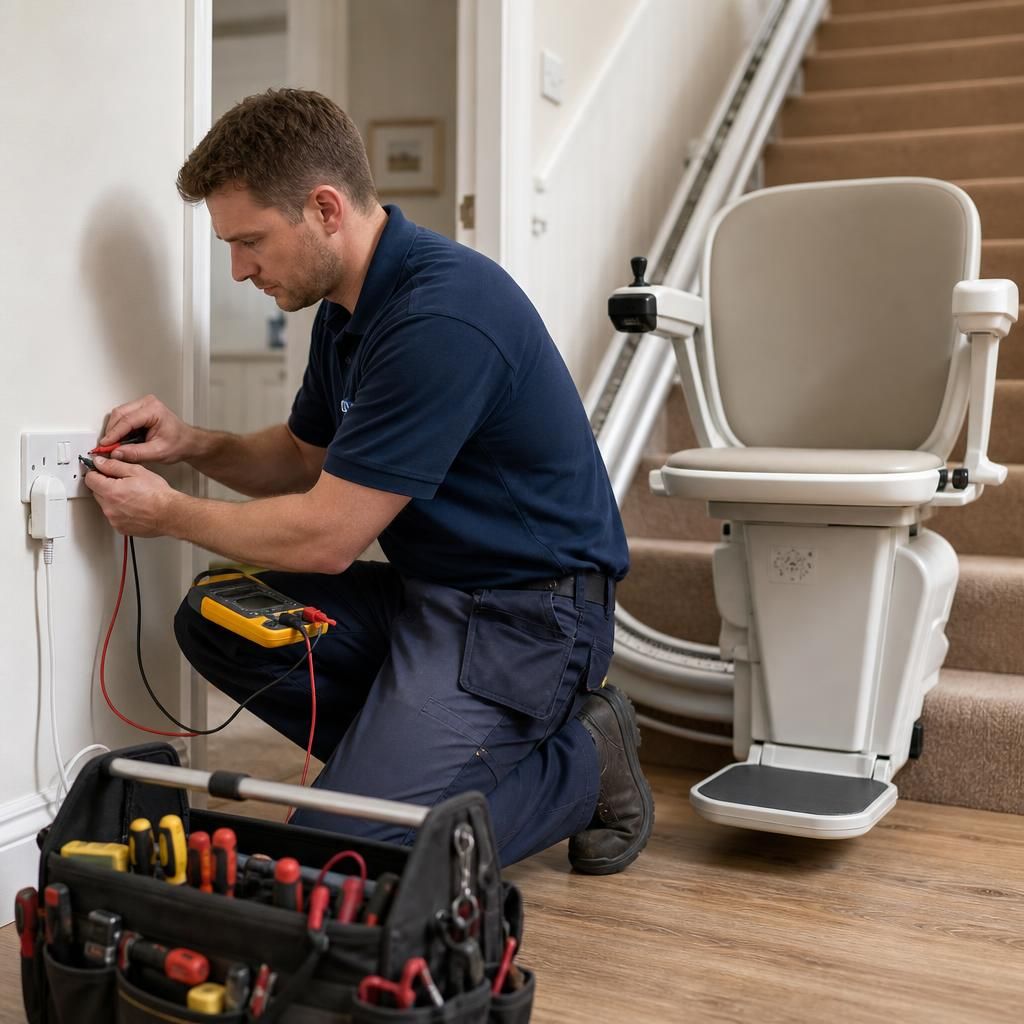
Book your stairlift electrical compatibility assessment
Contact Independent Stairlifts to arrange a stairlift electrical compatibility assessment. We will check your home’s power supply, socket position and circuit requirements, and explain any electrical work needed before installation.