
What maintenance is required for outdoor wheelchair stairlifts?
Outdoor wheelchair stairlifts require regular cleaning, checks for debris or corrosion, inspection of the track, seat or platform, safety features and charging equipment, plus protection from prolonged exposure to harsh weather. Arrange professional servicing at the manufacturer’s recommended intervals, and report unusual noises, movement, charging faults or damaged components rather than continuing to use the lift.
Outdoor wheelchair stairlifts need routine cleaning, visual checks, weather protection and professional servicing to remain safe and reliable. Maintenance applies to the track, platform, drive system, controls, batteries, charging equipment and safety features. Follow the maintenance instructions supplied with your particular lift, as servicing requirements vary by model and installation.
Keep the platform and track clear. Remove leaves, mud, grit, snow and other debris from the steps, platform and landing areas before using the lift. Check that the track is not obstructed and that drainage channels or gaps around the installation have not become blocked. Do not pour water directly over electrical or drive components, and avoid pressure washing the lift.
Clean the platform, handrails, seat or wheelchair clamps and control surfaces with a soft cloth and a suitable mild cleaning product. Rinse or wipe away salt and road grit promptly if the lift is near a road or exposed to coastal air, as these can accelerate corrosion. Do not use abrasive products, solvents or unapproved lubricants, since they may damage finishes, seals or moving parts.
Inspect for corrosion and weather damage. Regularly look for rust, flaking paint, cracked covers, loose fixings, damaged seals or water collecting around the base of the lift. Pay particular attention to exposed brackets, charging contacts, ramps, safety arms and fixings. Surface dirt can hide early corrosion, so cleaning is part of the inspection rather than only a cosmetic task. Report any significant rust, movement or damage instead of attempting to repair it yourself.
Check the platform and restraints before use. The platform should fold, unfold and travel smoothly, with ramps, safety barriers, armrests and wheelchair restraints operating as intended. Check that the wheelchair is positioned within the marked area and that any clamps or straps engage correctly. Never use the lift if a barrier does not lock, a restraint is damaged, the platform is unstable or the load cannot be secured according to the manufacturer’s instructions.
Keep controls and safety devices operational. Test the call controls, platform controls, emergency stop, key switch, sensors and audible or visual indicators as described in the user instructions. A lift should stop or prevent movement when a relevant safety edge, barrier or obstruction sensor is activated. Do not bypass, tape down or modify a safety device. If a control is intermittent or a sensor behaves unexpectedly, isolate the lift if it is safe to do so and contact the service team.
Look after the batteries and charger. Keep charging points clean, dry and free from corrosion. Park the lift in its designated charging position after use, where applicable, and check that charging indicators show the expected status. Avoid storing items against the charger or covering ventilation openings. Battery performance can reduce in cold weather or when the lift is left unused, so arrange a check if it struggles to complete its normal journey, moves more slowly than usual or repeatedly reports a low charge.
Do not disconnect batteries, open electrical covers or use an alternative charger unless this is specifically authorised for the lift. Battery replacement and electrical work should be carried out by a suitably qualified technician. If the stairlift will be unused for an extended period, ask for advice on the correct isolation and charging procedure rather than simply switching it off.
Protect the lift during severe weather. Use the supplied cover or weather protection when the lift is not in use, provided it is designed for that model and does not obstruct ventilation or charging. Remove accumulated snow and ice before operation, and never force a frozen platform, control or safety mechanism. After storms or high winds, check for branches, flooding, displaced covers and visible damage. An outdoor lift may be weather-resistant, but it is not designed to operate with waterlogged electrical parts or an obstructed track.
Arrange planned professional servicing. A trained engineer should service the lift at the intervals recommended for its model and level of use. A service normally includes checks of the drive mechanism, track, fixings, bearings, electrical connections, batteries, charging system, safety circuits and emergency features, together with adjustments or replacement of worn parts where necessary. Outdoor installations may need closer attention if they are heavily used or exposed to salt, persistent moisture, dirt or severe weather.
Keep a record of services, reported faults, repairs and any battery or component replacements. This helps identify gradual changes in performance and provides useful information when arranging future maintenance. Follow any inspection or testing requirements included with the installation, particularly where the lift is used by more than one person or forms part of a managed property.
Stop using the lift and report faults promptly if you notice unusual noise, jolting, vibration, uneven travel, a burning smell, a charging fault, repeated stoppages, water ingress or a damaged cable, cover, restraint or fixing. Do not continue using the lift to see whether the problem clears, and do not dismantle it. If someone is stranded, use the agreed emergency procedure and contact the appropriate support service. Regular user checks combined with manufacturer-recommended servicing will help maintain safe operation without replacing the need for professional inspection.
Professional servicing is an essential part of maintaining an outdoor wheelchair stairlift. A trained engineer can inspect the drive system, track, fixings, electrical connections, batteries, charger and safety circuits for wear, corrosion or weather-related damage that may not be obvious during routine cleaning.
Arrange servicing at the intervals recommended for your particular model, or sooner if the lift is heavily used or exposed to coastal air, persistent moisture, dirt or severe weather. Keep a record of servicing and report unusual noise, jolting, uneven movement, charging problems or repeated stoppages promptly. Do not dismantle the lift or attempt electrical repairs yourself.
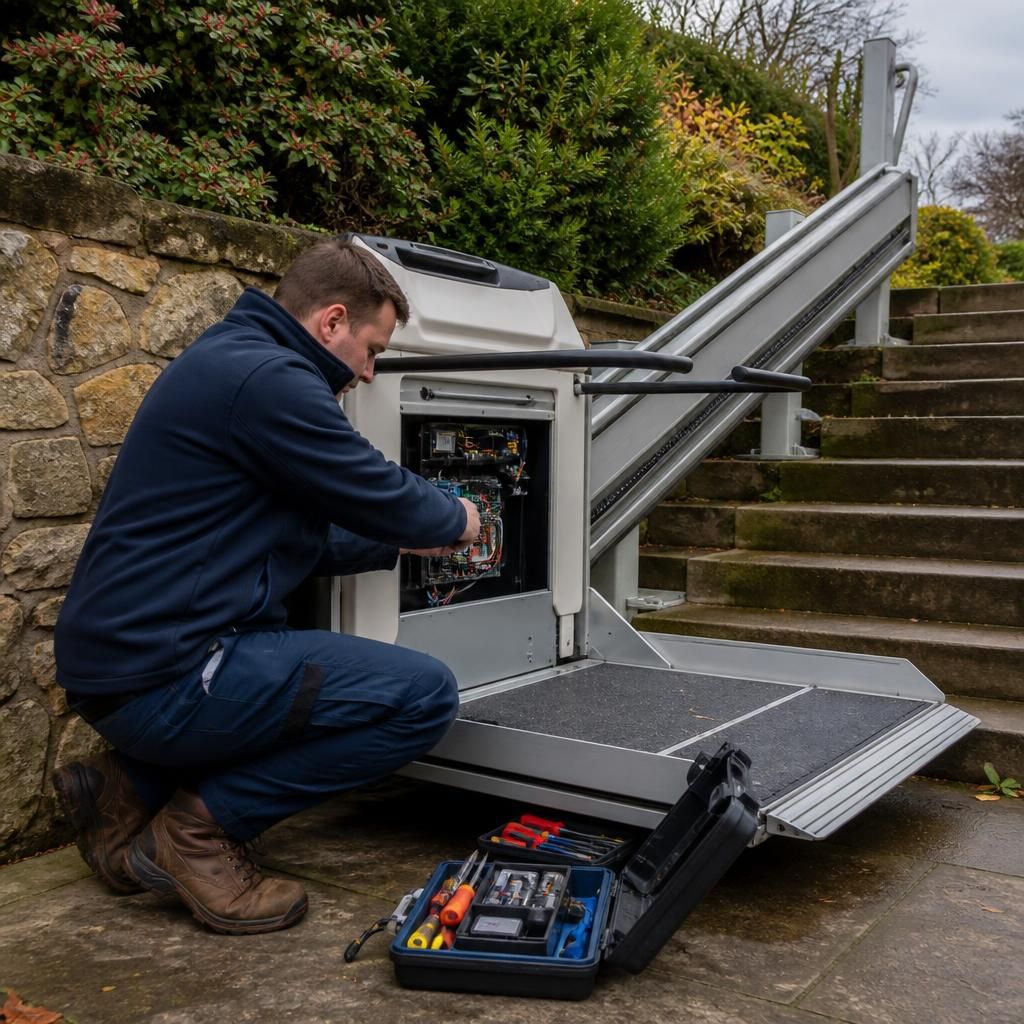
Arrange professional maintenance for your outdoor wheelchair stairlift
Contact Independent Stairlifts to arrange professional maintenance for your outdoor wheelchair stairlift at the manufacturer’s recommended intervals. Report any unusual noise, uneven movement, charging fault or visible damage promptly so an engineer can assess it.