
What are the installation requirements for outdoor wheelchair stairlifts?
Outdoor wheelchair stairlift installation requires a site assessment to check the staircase, load-bearing surfaces, available space, access at the top and bottom, and safe clearance for the wheelchair. The installation also needs a suitable power supply, weather-resistant equipment and controls, secure drainage and protection from standing water, with any required planning or property permissions arranged before work begins.
Outdoor wheelchair stairlift installation requires a detailed site assessment to confirm that the staircase, surrounding structure, access areas, power supply and drainage are suitable. The installer must also allow enough space for the wheelchair, provide safe clearances at the top and bottom of the stairs, and specify equipment and controls designed for exposed outdoor use. Any necessary planning, landlord or property permissions should be addressed before installation begins.
Site and staircase assessment
The staircase is checked for its length, angle, width, layout and condition. This includes straight flights, intermediate landings, bends, changes in direction and any unusual features that could affect the rail or platform path. A curved or complex staircase may require a bespoke rail and more detailed measurements than a straight installation.
The steps, wall, parapet or supporting framework must be capable of carrying the equipment and the expected user load. Installers look for cracked masonry, loose paving, corrosion, unstable handrails and movement in the structure. If the staircase is not strong or level enough, remedial work or an alternative support arrangement may be needed before the stairlift can be fitted.
Space for the wheelchair and safe movement
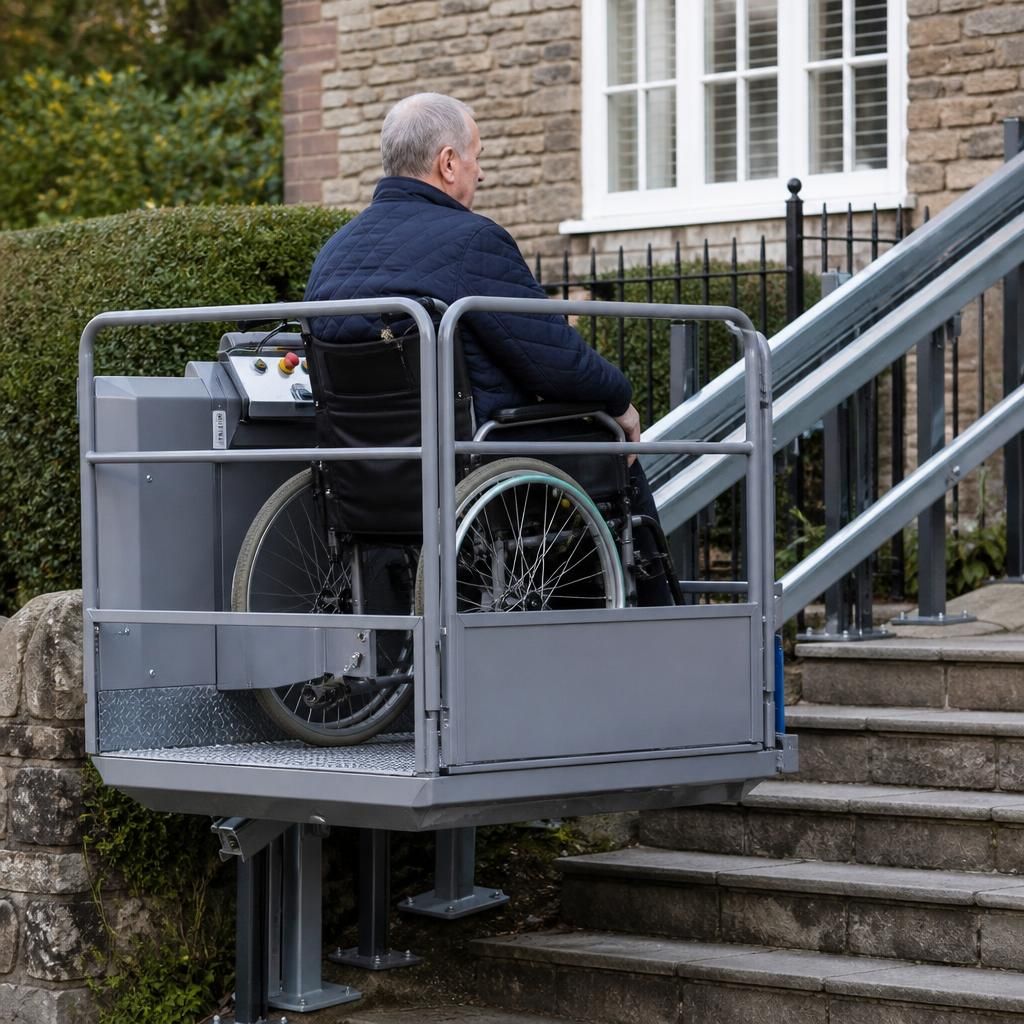
An outdoor wheelchair stairlift normally uses a platform or carriage that must accommodate the user and wheelchair without obstructing the route. The required platform size and weight capacity depend on the wheelchair, its turning radius, footrests, controls and any additional equipment being carried. Measurements should therefore be taken with the wheelchair that will be used regularly, rather than relying only on a standard chair size.
There must be sufficient clearance beside the platform and along the staircase for safe travel. The top and bottom landing areas need particular attention: the user should be able to approach, board and leave the platform without being forced into a sharp turn, a drop, a narrow doorway or an obstruction. Where space is limited, a folding platform, access ramp, altered gate or different parking position may be considered, subject to the manufacturer’s design and the site’s safety requirements.
Suitable foundations and fixing points
Outdoor equipment needs secure fixing points that remain stable in changing weather. Depending on the design, the rail or support structure may be fixed to the steps, a wall, a landing, or an independent framework. The installer will consider the construction materials, edge distances, slope, surface levels and the possibility of water entering fixing points.
Loose, uneven or deteriorated surfaces should not be used as the sole support. In some situations, a concrete base, steel support, retaining structure or other preparation work is required. This should be agreed before the installation date because structural preparation may involve a separate trade or additional permissions.
Electrical supply and controls
The stairlift needs a suitable electrical supply positioned where it can be installed safely and protected from outdoor conditions. The supply must be correctly rated for the equipment and installed in accordance with applicable electrical requirements. A qualified person should assess cable routes, earthing, isolation and protection against moisture; the final arrangement will depend on the equipment and the property.
Controls should be reachable from the wheelchair and from the boarding and disembarking positions. Wireless or remote controls may be useful where the user needs to call the platform from either end of the stairs. Batteries and charging points must be located as specified by the manufacturer, with no risk of standing water, accidental damage or blocked access.
Weather protection and drainage
Outdoor wheelchair stairlifts use weather-resistant materials, seals, covers and electrical components suitable for their intended environment. Weather resistance does not mean that every part can be left exposed to flooding or persistent standing water. The installation area should have effective drainage, with water directed away from the rail, motor, controls, charging equipment and fixing points.
Where the site is particularly exposed, a canopy, shelter or protective enclosure may be appropriate. It must not reduce the platform’s clearance, obstruct the travel path or create a hazard in strong winds. The installer will also consider coastal exposure, frost, snow, falling leaves, salt, direct sunlight and nearby trees when recommending the equipment and its position.
Safety arrangements
The completed installation should include the safety features specified for the selected model and the site. These can include platform guardrails, safety arms, non-slip surfaces, interlocked access ramps or gates, obstruction sensors, emergency stop controls, secure wheelchair restraints and controls that prevent travel unless the platform is correctly positioned.
There should be a safe way to use the stairlift if the mains supply fails. Depending on the model, this may involve battery operation or a controlled return procedure. The user and anyone who regularly assists them should know how to stop the equipment, report a fault, release restraints and obtain assistance. The installation must not narrow an essential access route or create an unsafe alternative route for other people using the staircase.
Planning and property permissions
Permission may be relevant where the staircase is shared, the property is rented, the installation affects a boundary or communal area, or the equipment changes the external appearance of a building. Listed buildings, conservation areas and leasehold properties may have additional requirements. Planning rules and building-control considerations depend on the location and the nature of the work, so these should be checked locally rather than assumed.
If the installation involves a public path, shared accessway or neighbouring land, the route must also remain safe and unobstructed for other users. The installer can identify issues during the survey, but the property owner or occupier may need to obtain formal consent before work starts.
What happens during the installation
After the survey, the proposed route, parking positions, platform dimensions, fixing method, power arrangements and any preparatory work should be confirmed. The installation team then fits the rail or support structure, connects the platform and controls, completes the electrical work, checks drainage and tests the equipment under operating conditions.
Before handover, the stairlift should be tested for smooth travel, braking, ramp or gate operation, emergency controls, sensors, charging and safe boarding at both ends. The installer should explain normal use, cleaning, charging, weather precautions and what to do if the lift stops or displays a fault. You should also receive the relevant operating and maintenance information.
Every outdoor staircase is different, so an online description or photograph cannot confirm suitability. A proper assessment is especially important where the route is narrow, curved, steep, exposed, shared with vehicles or pedestrians, or built on older masonry. A site survey will establish whether the existing staircase can support a wheelchair stairlift and identify any work or permissions needed before a safe installation can be specified.
A professional site survey is the essential first step when installing an outdoor wheelchair stairlift. It confirms whether the staircase, landings, fixing surfaces and surrounding access areas can safely accommodate the platform and the wheelchair it will carry.
The assessment should use the wheelchair regularly used by the customer, including its width, footrests and turning requirements. The installer will also check boarding space at both ends, clearances along the route, drainage, weather exposure and the position of the power supply. If the existing structure needs strengthening or the landing is too restricted, these issues can be resolved or accounted for before equipment is ordered and installation begins.
Book Your Outdoor Wheelchair Stairlift Assessment
Arrange your outdoor wheelchair stairlift assessment so we can check the staircase, access space, power supply and weather protection requirements at your property. Contact Independent Stairlifts to discuss your needs and request a free, no-obligation quote.