
How do I choose the right outdoor wheelchair stairlift for my needs?
Choose an outdoor wheelchair stairlift by assessing the staircase, wheelchair dimensions, user’s mobility, weight requirements and how the lift will be used in different weather conditions. A professional survey can then confirm the safest configuration, access features, power supply, weather protection and installation requirements for your home.
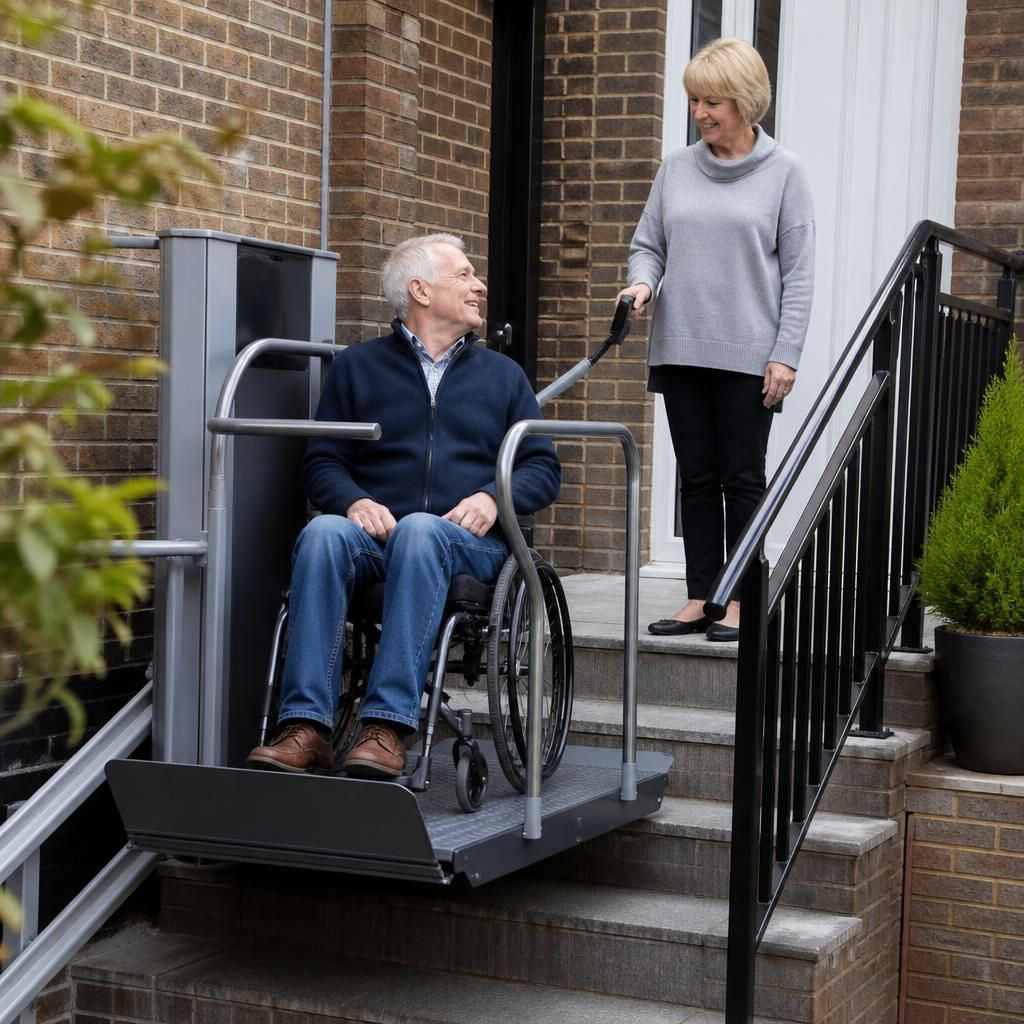
The right outdoor wheelchair stairlift is the one that safely carries the user and their wheelchair over the specific staircase, while providing reliable access in the weather conditions at your property. Choosing it requires an assessment of the staircase, wheelchair, user’s needs, available landing space, power supply and how frequently the lift will be used. A professional site survey should confirm the suitable platform, rail configuration and installation requirements before a decision is made.
Start with the staircase and access route
Outdoor wheelchair stairlifts can be suitable for straight or curved staircases, but the design of the route affects the type of system required. The survey should consider the width, gradient, length and surface of the steps, as well as bends, intermediate landings, gates, walls, railings and changes in level. The installer will also assess the space at the top and bottom, because the platform may need room to unfold, park and allow the wheelchair user to leave safely.
Consider the full journey rather than the staircase alone. The approach to the lift should be firm, level where possible and free from obstructions. At the upper landing, the user needs enough space to disembark without reversing into a hazard. If the staircase leads to a driveway, garden, entrance or raised patio, the position of doors, paths, lighting and drainage can influence the safest layout.
Check that the platform suits the wheelchair
Wheelchairs vary considerably in width, length, turning radius and weight. Powered wheelchairs and mobility scooters may also require more platform space and a higher load capacity than a compact manual wheelchair. Before choosing a lift, check:
- the overall width and length of the wheelchair, including footrests and controls;
- the combined weight of the user and wheelchair;
- whether the wheelchair can be driven straight onto the platform;
- whether the user needs space to turn or reposition on the platform; and
- whether the chair has features such as a high back, ventilator, oxygen equipment or extended controls that affect clearances.
The platform must not be selected by its advertised size alone. Usable space, entry direction, safety edges and the position of the controls all matter. Provide accurate details of the wheelchair during the assessment and, where practical, have the actual wheelchair available for testing.
Consider the user’s mobility and confidence
A platform stairlift is normally operated from a seated or standing wheelchair position, depending on the user and the system. The user may need to drive onto the platform, position the wheelchair accurately, apply the brakes and operate controls. If they have limited hand strength, reduced reach, poor balance, visual impairment or difficulty judging distances, the controls and access arrangement must be chosen accordingly.
Useful features may include easy-to-operate constant-pressure controls, remote controls for calling the platform, automatic or assisted ramps, secure side arms, non-slip platform surfaces and clear visual indicators. A carer may also need to operate the lift, so discuss who will use it and whether the controls are accessible from both ends of the staircase.
Where the user cannot safely position the wheelchair independently, a different transfer arrangement or additional assistance may be necessary. The safest solution is not always the one with the largest platform; it is the configuration that allows the user to board, travel and leave the lift with the least risk.
Choose the appropriate rail configuration
A straight outdoor wheelchair stairlift generally follows a single flight, while a curved system can be designed around bends, landings and changes in direction. Curved installations are individually measured and manufactured to follow the staircase, so the survey must account for the platform’s movement and parking position.
For a staircase with unusual geometry, ask the installer to explain where the platform will park when it is not in use, how it will be kept clear of other users and whether it will obstruct doors, paths or neighbouring access. Folding or vertical parking arrangements may help where space is restricted, but they must still leave a safe route for pedestrians and allow the platform to be deployed without obstruction.
Assess exposure to outdoor conditions
Outdoor equipment needs protection from rain, frost, sunlight, wind, dirt and coastal or polluted air. Ask which components are designed for external use and how exposed parts are protected. Important considerations include weather-resistant controls, corrosion-resistant materials, sealed electrical components, drainage from the platform and a suitable cover or storage position when the lift is parked.
A sheltered location can reduce exposure, but it does not remove the need for an outdoor-rated system. Avoid choosing a lift based solely on a claim that it is weatherproof. Confirm the manufacturer’s operating and storage guidance, including any restrictions during severe weather, and discuss whether a protective cover is recommended for your staircase.
Confirm the power supply and emergency arrangements
The installation survey should identify how the lift will be powered and where the charging or electrical equipment can be safely positioned. Some systems use rechargeable batteries, allowing limited operation during a mains power cut, while others have different requirements. Ask how often charging is needed, what happens if the batteries are low and whether the lift can be returned safely to a designated position during a power interruption.
Safety does not depend on power alone. The system should include suitable braking, obstruction detection, secure platform barriers or arms, non-slip surfaces and an emergency stop or alarm arrangement appropriate to the model. Make sure you understand the manual release or emergency procedure and who to contact if the lift stops away from a landing.
Check the installation requirements
Outdoor wheelchair stairlifts are usually fixed to the steps or an appropriate supporting structure. The survey must establish whether the steps, walls and landings can support the proposed installation without compromising their condition. The installer should also check drainage, surface stability, access for installation and the route of any electrical supply.
Planning or building requirements can vary according to the property and the nature of the work. If the staircase is shared, forms part of a communal area or affects a boundary, permission from the relevant owner or managing party may be needed. Ask for these points to be confirmed before work begins, particularly where the installation changes gates, railings or access routes.
Compare day-to-day practicality
Think about how the lift will be used in normal conditions. If the wheelchair will remain on the platform between journeys, there must be a suitable parked position that does not block the staircase. If other people use the steps, the folded or parked lift should leave a safe passage. Consider whether the user will travel alone, whether a carer will accompany them and whether shopping, walking aids or other equipment will need to be carried separately.
Ask to see the operating process, including boarding, securing the wheelchair, travelling, disembarking, folding the platform and calling it from another level. A demonstration can reveal whether the controls are reachable and whether the user can manage the process confidently in wet or low-light conditions.
Include servicing and long-term support
Outdoor stairlifts need regular checks because moisture, dirt and temperature changes can affect moving and electrical parts. Before choosing a system, confirm the recommended servicing schedule, what is included in the maintenance arrangement and how faults are reported. Ask specifically about battery replacement, corrosion checks, platform and rail inspection, safety-device testing and support if the lift becomes unusable.
Keep the steps, platform and approach clear of leaves, ice, standing water and other debris, but do not use cleaning products or make adjustments unless they are approved for the equipment. Follow the operating and care instructions supplied after installation, and report unusual noises, reduced travel speed, intermittent controls or visible damage promptly.
Use a professional survey to make the final choice
The most suitable outdoor wheelchair stairlift should be selected after measuring the staircase and checking the actual wheelchair, rather than from a general product description. During the survey, provide details of the user’s mobility, the people who will operate the lift, the intended frequency of use and any future changes that may affect access. Ask for the proposed platform dimensions, weight capacity, parking position, weather protection, power arrangements, safety features and ongoing support to be explained clearly.
A tailored recommendation should balance safe access, ease of use, protection from the elements and the practical limitations of the property. If the staircase, wheelchair or user’s needs change, request a reassessment rather than assuming the original configuration will remain suitable.
Choosing the right outdoor wheelchair stairlift means matching the platform and rail system to the user’s wheelchair, the staircase and the way the lift will be used. The wheelchair must fit comfortably within the usable platform area, with sufficient capacity for the combined weight of the user and chair.
During the assessment, provide the wheelchair’s overall dimensions, including footrests, controls and any additional equipment. The installer should also check whether the user can drive or be assisted onto the platform, apply the brakes, operate the controls and leave safely at the other end. A professional survey should confirm:
- the platform’s usable width, length and entry direction;
- the combined weight capacity required;
- space for safe boarding and disembarking;
- the best parking position when the lift is not in use; and
- weather protection, power and emergency arrangements.
Where the staircase has bends, landings or limited space, the rail and platform may need to be individually configured. Testing the actual wheelchair on the proposed arrangement, where possible, is the most reliable way to confirm that the chosen lift will be practical for everyday use.
Book your outdoor wheelchair stairlift assessment
Book an outdoor wheelchair stairlift assessment so we can measure your staircase, check your wheelchair and recommend a safe, practical configuration for your home.