
Can outdoor wheelchair stairlifts be customised to fit curved or unusual staircase designs?
Yes. Outdoor wheelchair stairlifts can be designed with bespoke rail systems to follow many curved, angled or unusual staircases, subject to a site assessment confirming the available space, gradients, landings and safe access points.
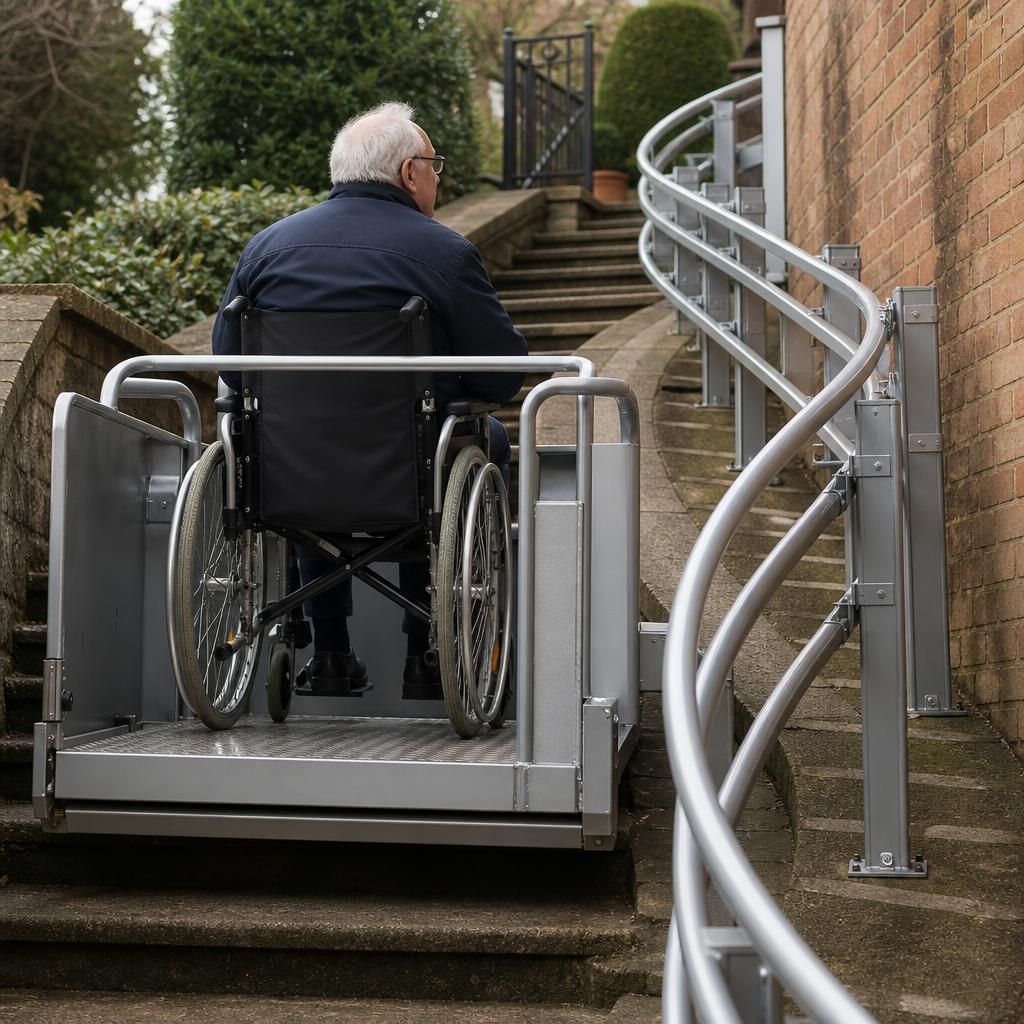
Yes. Outdoor wheelchair stairlifts can be customised for many curved, angled or unusual staircases by using a bespoke rail or track system. The track is measured and manufactured to follow the route of the stairs, rather than relying on a standard straight section. Whether a suitable installation is possible depends on the staircase layout, available clearances, the platform’s operating space and the proposed access points.
A curved outdoor wheelchair stairlift may be appropriate where the staircase includes bends, intermediate landings, changes in direction or more than one flight. Bespoke systems can often be designed to follow the inside or outside edge of the staircase, depending on which position provides the safest and most practical route. The platform normally travels with the user’s wheelchair, avoiding the need to transfer to a separate seat.
What can be adapted?
- Rail shape: The rail can be made to follow curves, corners, gradients and changes in direction identified during the survey.
- Platform position: The platform may be configured to suit the available width and the way the user approaches the lift at the lower and upper landings.
- Folding components: Where space is limited, a platform or safety barrier may fold when the lift is not in use, helping to preserve access to the stairs.
- Access arrangements: The lift can be assessed for straight-on, side or angled approaches, subject to the equipment’s safe operating requirements.
- Outdoor protection: Weather-resistant finishes, covers and suitable drainage arrangements can be considered for the location and exposure of the installation.
The most important part of the process is a detailed site assessment. An installer will examine the staircase’s width, surface, gradient, landings, bends, headroom and the space available at both ends. They will also consider whether doors, gates, walls, railings or nearby paths could obstruct the platform or its users. Measurements are taken along the intended travel route so that the rail can be designed accurately for the individual staircase.
Outdoor conditions create additional design considerations. The supporting structure must be suitable for the ground and the method of fixing, while the installation should allow rainwater to drain away rather than collect around the rail, platform or electrical components. The assessment should also consider exposure to wind, salt air, frost and debris, particularly on open external staircases. A suitable power supply and a safe location for controls and charging equipment will need to be confirmed.
Not every unusual staircase can accommodate a wheelchair platform lift. Very narrow steps, restricted headroom, unstable surfaces, sharp changes in gradient or insufficient space at a landing may prevent a safe design. In some cases, a different rail position, a small alteration to the surrounding area or a revised landing arrangement may provide a solution. If the staircase itself cannot safely support the equipment, an alternative access route or mobility solution may need to be considered.
Curved outdoor installations are usually more involved than straight stairlift installations because the rail and platform must negotiate each change in direction while maintaining safe clearance for the wheelchair. The design must also ensure that the platform remains stable during travel, that safety edges and restraints operate correctly, and that the user can board and leave it without entering an unsafe area.
Before installation, you should receive a clear explanation of the proposed route, platform dimensions, access requirements, fixing method, electrical work and any preparation needed around the staircase. Ask the installer to identify where the platform will park when not in use and how other people will continue to use the stairs. It is also sensible to confirm how the system will be operated in wet or cold conditions and what servicing access is required.
Independent Stairlifts can assess the staircase and surrounding property to establish whether a bespoke outdoor wheelchair stairlift is suitable. A tailored recommendation should be based on the user’s wheelchair, the physical environment and the way the lift will be used every day, rather than on the staircase shape alone.
Customisation is achieved through a bespoke rail designed to follow the staircase’s measured route, including curves, corners, changes in gradient and intermediate landings. The platform must maintain safe clearance throughout its journey and provide suitable space for the wheelchair user to board and leave at each access point.
A detailed site assessment is therefore essential. The installer will check:
- the staircase width, surface, gradient and headroom;
- the wheelchair’s dimensions and turning space;
- available room at the top and bottom of the stairs;
- obstructions such as doors, gates, walls and railings;
- how the rail and its supports can be fixed securely outdoors; and
- exposure to rain, wind, frost and debris.
If the staircase cannot provide safe clearance or stable fixing points, an outdoor wheelchair stairlift may not be suitable in its existing form. The assessment should identify whether a different rail position, alteration to the surrounding area or an alternative access arrangement is more appropriate.
Arrange a bespoke outdoor wheelchair stairlift assessment
Arrange a bespoke outdoor wheelchair stairlift assessment with Independent Stairlifts to establish whether your curved or unusual staircase can accommodate a safe, practical installation. We will assess the staircase, surrounding access and your wheelchair’s requirements before recommending a suitable solution.