
How do I maintain and service my wheelchair stairlift to ensure its longevity?
Maintain your wheelchair stairlift by keeping the platform, rails and safety controls clean and unobstructed, carrying out routine visual checks, and arranging professional servicing at the manufacturer’s recommended intervals. Do not attempt repairs yourself: report unusual noises, movement, battery issues or safety faults promptly so a qualified engineer can inspect and rectify them.
Regular cleaning, sensible daily checks and professional servicing are the main ways to extend the life of a wheelchair stairlift. Keep the platform, rails, sensors and controls clear, use the lift as instructed, allow the batteries to charge fully, and report changes in performance promptly. Do not attempt electrical or mechanical repairs yourself, as a wheelchair stairlift contains moving parts and safety systems that require inspection by a qualified engineer.
Carry out simple checks before use. Look over the stairlift and its route for anything that could interfere with movement. In particular, check that:
- The track or rail is free from objects, dust build-up and anything that could obstruct the platform or carriage.
- The platform, ramps, armrests and guards are secure and move as intended.
- The seat, wheelchair restraints or other user supports, where fitted, are undamaged and correctly positioned.
- The call and send controls respond normally.
- Safety edges, sensors and the emergency stop control are not covered, damaged or obstructed.
- There are no unusual noises, jerky movements, burning smells, fluid leaks or signs of loose fixings.
These checks should be visual and functional only. Never remove covers or place your hands near the drive mechanism while the lift is switched on. If a safety feature does not operate as expected, stop using the stairlift and contact the service provider.
Keep the stairlift clean and dry. Wipe the platform, controls, handrails and accessible surfaces with a soft, slightly damp cloth and a suitable mild cleaner. Follow the cleaning instructions supplied with the lift, particularly around switches, charging contacts and control panels. Do not spray liquid directly onto electrical components, immerse controls or use abrasive products. For an outdoor wheelchair stairlift, remove leaves, grit, standing water and other debris from the platform and rail, while taking care not to force water into the motor, controls or charging equipment.
Do not apply oil, grease or general-purpose lubricant to the rail unless the manufacturer’s instructions specifically allow it. Some systems use particular lubricants or require servicing by an engineer; the wrong product can attract dirt, affect sensors or interfere with the drive system. If the rail appears dry, corroded or damaged, arrange an inspection rather than treating it yourself.
Use the charging system correctly. Most wheelchair stairlifts use rechargeable batteries and should be returned to their designated charging position after use, particularly when the lift will not be used for a period. Keep the charger and power supply connected as instructed, and check that the charging indicator behaves normally. Repeated low-battery warnings, a noticeably shorter operating range or failure to charge can indicate ageing batteries, a charging fault or an electrical problem. Arrange a service rather than repeatedly operating the lift until it stops.
Power cuts and long periods without use can affect battery condition. If you are going away or the stairlift will be unused, follow the manufacturer’s storage guidance and ask for advice if the lift has an external charging arrangement. Never substitute a battery or charger unless it has been approved for that specific model.
Arrange servicing at the interval specified for your model. The service schedule can vary according to the manufacturer, design, age, usage and whether the lift is installed indoors or outdoors. A qualified engineer will normally examine the drive system, rail, batteries, charging equipment, fixings, platform, restraints, controls and safety sensors. They may also test the lift under load and check that it stops correctly at the top and bottom of the stairs.
Servicing is different from repairing an obvious fault. A stairlift can continue to move while a battery, sensor, cable or mechanical component is beginning to deteriorate. Planned inspections help identify wear before it affects reliability or safety. Keep service records and note any repairs, battery replacements or recurring warnings, as this information can help an engineer diagnose problems efficiently.
Report faults promptly and stop when necessary. Stop using the wheelchair stairlift and seek professional advice if it:
- Stops unexpectedly, moves unevenly or fails to complete its travel.
- Makes a new grinding, clicking, squealing or knocking noise.
- Shows an error code or warning light that does not clear in the normal way.
- Has damaged restraints, platform edges, controls, wiring or protective covers.
- Fails to stop when a safety control or emergency stop is used.
- Has been affected by water, impact, a power surge or another unusual event.
Do not repeatedly reset a fault, bypass a sensor, wedge down a safety switch or continue carrying a passenger if the platform or restraints are not secure. If the lift has stopped on the stairs, follow the emergency procedure provided at installation and contact the appropriate service team. Do not try to push or manually move the platform unless the manufacturer’s instructions specifically describe how to do so safely.
Keep the route and surrounding area suitable for operation. Avoid storing household items on the stairs or beside the rail, and make sure doors, furniture and other fixtures cannot obstruct the platform. Tell the service provider about building work, changes to flooring, damp, repeated water exposure or alterations to the electrical supply, as these can affect clearances and safe operation. For outdoor installations, regular removal of weather-related debris and prompt attention to corrosion or damaged covers are particularly important.
Everyone who uses or assists with the stairlift should know the basic operating procedure, the weight and wheelchair dimensions specified for the model, the location of the isolator or emergency stop, and how to summon help. Do not exceed the stated capacity, carry unsecured items or allow a second person to travel unless the stairlift is specifically designed and approved for that use.
A maintenance routine cannot prevent every fault, and batteries and other wear components will eventually need replacement. However, careful use, correct charging, clean operating surfaces, prompt fault reporting and scheduled servicing will reduce avoidable wear and help the wheelchair stairlift remain safe and dependable for longer.
Professional servicing is essential for maintaining a wheelchair stairlift because it checks internal drive components, batteries, charging equipment and safety systems that cannot be assessed safely through routine cleaning. Arrange servicing at the interval recommended for your specific model, taking account of its age, usage and whether it is installed indoors or outdoors.
A qualified engineer can inspect the rail, platform, restraints, controls, fixings and sensors, then test smooth travel, stopping performance and operation under load. Keep a record of each service and report changes such as reduced battery performance, jerky movement, unusual noises, warning lights or repeated charging faults rather than waiting for the next appointment.
Do not remove covers, lubricate the mechanism or bypass a safety sensor yourself. If the stairlift has been exposed to water, impact or an electrical fault, stop using it and request an inspection before carrying a passenger.
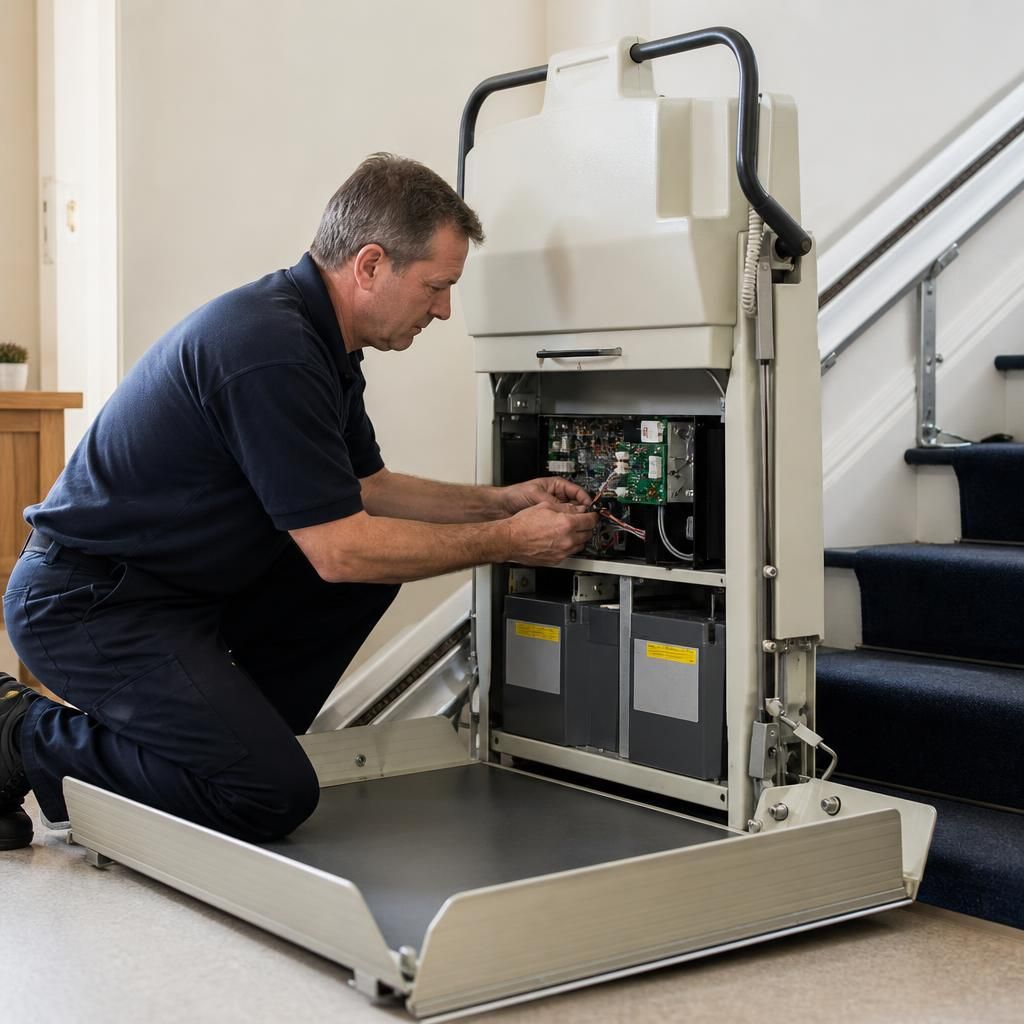
Arrange a Professional Wheelchair Stairlift Service
Arrange a professional service for your wheelchair stairlift to check its batteries, drive system, safety controls and charging equipment. Contact Independent Stairlifts to book an inspection or discuss any changes in performance.