
What should I consider when selecting a straight stairlift to accommodate future mobility needs and potential changes in physical condition?
When selecting a straight stairlift for future mobility needs, consider a suitable weight capacity, supportive seating, easy-to-use controls, adjustable safety features and options such as powered swivel, folding or lift-up footrests. Ask for an assessment that considers how changes in strength, balance, flexibility or transfer ability could affect use, and choose a model that can be adjusted or upgraded where possible rather than relying only on your current needs.
When selecting a straight stairlift for future mobility needs, choose a model that can accommodate changes in strength, balance, flexibility, pain, vision or transfer ability rather than one based only on how you manage today. The assessment should consider your likely day-to-day use, the staircase and available space, while the stairlift itself should provide appropriate weight capacity, supportive seating, simple controls and safety features that remain practical if your mobility changes.
Start with a forward-looking assessment
A proper assessment is more than measuring the length of the staircase. It should consider how you approach the stairs, sit down, stand up, transfer on and off the seat, operate the controls and move around at the top and bottom. If you currently manage these actions with difficulty, or expect your condition to affect them in the future, discuss this openly during the assessment. It may influence the most suitable seat height, armrest design, swivel arrangement, footrest and control position.
It is also useful to consider possible changes in the home. You may eventually spend more time on one floor, need to carry essential items between floors or require additional space when transferring. A straight stairlift should be positioned and configured so that it does not create unnecessary obstacles at the landing or foot of the stairs.
Check the weight capacity and seating support
The stairlift must be suitable for the user’s current weight and any foreseeable change, while also allowing comfortable use with ordinary clothing or small personal items. Do not select a model solely because it meets today’s requirement. Ask the assessor to explain the manufacturer’s stated capacity and whether it is affected by the seat position, track arrangement or any particular option.
Supportive seating can become more important if sitting upright, bending the knees or maintaining balance becomes harder. Consider:
- the seat width and depth;
- the height of the seat when transferring;
- the shape and support of the backrest;
- the position and height of the armrests;
- the security and adjustment of the seat belt; and
- whether the seat can swivel safely at the landing.
A seat that is comfortable for a short trial should also remain practical for repeated daily journeys. If pain, stiffness or reduced balance is likely to affect transfers, a powered swivel seat may be worth considering. It turns the seat towards the landing, reducing the need to twist while getting on or off, although the landing must have enough clear space for safe use.
Consider how controls may need to work in future
Controls should be easy to see, reach and operate without excessive grip strength or finger movement. A joystick or compact control may suit one person, while a larger, clearly marked control or a remote handset may be more suitable for someone with reduced dexterity, tremor or limited movement in one hand. The control should be positioned on the most useful armrest and should not require the user to lean forward.
Ask whether the stairlift includes controls at both ends of the staircase and whether remote controls can be used to call or send the lift when appropriate. If more than one person may use the stairlift, the controls must be accessible and understandable to all users. Keep in mind that a control arrangement which works now may become less suitable if hand strength, coordination or vision changes.
Choose safety features that support changing abilities
Safety features should reduce the physical demands of using the lift, not simply provide reassurance. A seat belt that is easy to fasten, sensors that stop the stairlift if an obstruction is detected, and a controlled start and stop can all be important. Swivel and locking mechanisms should be straightforward to operate and should prevent the seat from being turned or used in an unsafe position while travelling.
Depending on the assessment, useful options may include powered swivelling, powered folding of the footrest or seat, a powered hinged track where a doorway or walkway is affected, and a comfortable, adjustable seat belt. A powered feature can reduce the need to bend, reach or use force, but it also introduces additional controls and components. The best choice is the one the user can operate consistently and safely.
Reduced vision or hearing should also be discussed. Clear controls, visible indicators and suitable audible warnings may help, but they should not be relied on as the only safeguard. The user should be able to understand when the stairlift is ready, moving, stopped or unable to operate.
Allow for changing transfer and walking ability
A straight stairlift does not remove the need to transfer at the top and bottom of the stairs. If walking becomes more limited, the approach areas and landing may need to accommodate a walking frame, stick or another mobility aid. Check where these items can be placed without blocking the staircase, a doorway or an escape route.
If you may eventually need assistance from another person, consider whether there is enough room for the helper to stand safely and whether the controls can be reached without obstructing the transfer. A carer should not have to pull, lift or steady the user while the stairlift is moving. Any assistance plan should follow the equipment instructions and the advice given during the assessment.
Look at the footrest and lower landing arrangement
Reduced hip, knee or ankle flexibility can make it difficult to place both feet securely on a standard footrest. A larger or powered footrest may reduce the need to bend down, while a suitable footrest height can help prevent the feet from slipping or catching. Ask whether the footrest position can be adjusted and whether the stairlift has sensors to detect an obstruction.
At the bottom of the stairs, consider whether the footrest, seat or track could affect a hallway, door or frequently used route. A folding seat or folding footrest may help preserve access when the stairlift is parked. If the track needs to extend beyond the bottom step, a powered or manual hinged section may be considered where the building layout permits it. The installation team should assess the finished clearance rather than relying only on measurements taken away from the staircase.
Ask about charging, power cuts and regular use
Battery-powered stairlifts normally charge through points on the track, allowing them to be used without a trailing cable. Ask where the stairlift should be parked to charge and whether the user will be able to reach that position comfortably. Consistently parking the lift at an appropriate charging point helps maintain availability.
You should also understand what happens during a power cut, how far the stairlift can travel if mains power is unavailable and what warning indicates a low battery. These details matter more if the user may become dependent on the stairlift for access between floors. Keep the operating and emergency instructions where the user or carer can find them.
Consider adjustability, servicing and future support
Some stairlift elements can be adjusted during installation or servicing, but not every change can be made after the lift is fitted. Ask which parts can be altered, whether a different seat or control arrangement can be added later, and whether any upgrade would require a replacement component or a new assessment. Do not assume that every option is compatible with every model or track.
Reliable servicing is particularly important if mobility changes and the stairlift becomes essential for everyday access. Check how to report a fault, what routine maintenance is recommended and whether replacement batteries or other parts remain available for the selected model. Keep the stairlift clean and follow the operating guidance, but do not attempt electrical or mechanical repairs yourself.
Balance future-proofing with simple operation
Choosing every available option is not necessarily the best approach. Extra powered functions may be helpful for one user but confusing or unnecessary for another. Prioritise features that address an identified difficulty, such as limited knee movement, poor grip, reduced balance or difficulty rotating in the seat. The controls should remain simple enough for the user to operate without assistance whenever possible.
A practical decision should take account of the user’s current needs, possible changes in physical condition, the staircase layout, the needs of anyone else using the stairs and the support available from family or carers. An in-home assessment with Independent Stairlifts can help compare suitable configurations and identify which features are genuinely likely to remain useful as mobility changes.
A future-focused straight stairlift assessment considers how changes in strength, balance, flexibility, vision or hand control could affect everyday use. The assessor should look at transfers, seating position, controls, footrest access and the space available at both landings, rather than measuring the staircase alone.
Features such as a powered swivel seat, easy-to-operate controls, supportive armrests and a powered footrest may reduce physical effort if mobility changes. Choose only options the user can operate safely, and ask which components can be adjusted or upgraded later. This helps the stairlift remain practical without making it unnecessarily complicated.
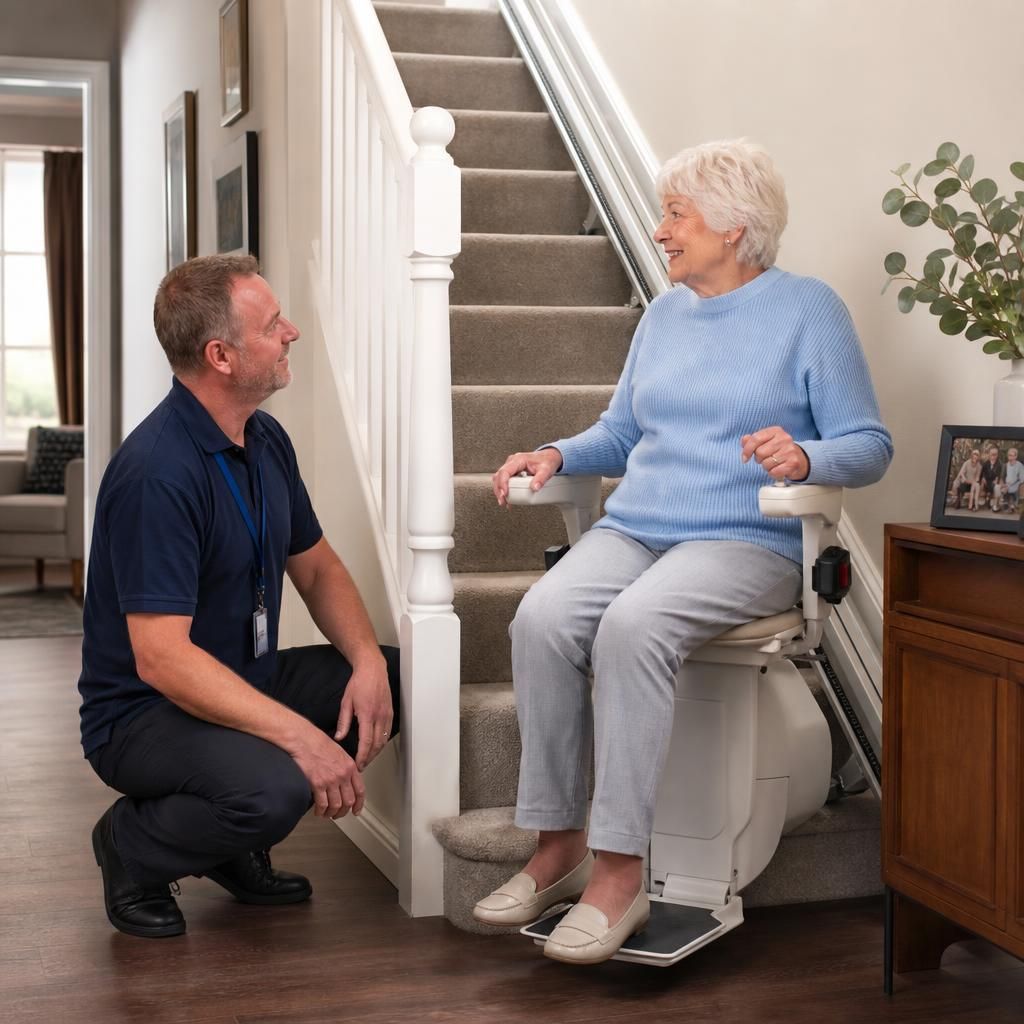
Book a future-focused straight stairlift assessment
Arrange a future-focused straight stairlift assessment with Independent Stairlifts to review your current needs, likely changes in mobility and the features that could support safe, comfortable use over time.