
What maintenance is required to ensure a straight stairlift remains in optimal condition?
A straight stairlift should be kept in optimal condition through regular cleaning, simple safety checks and servicing by a qualified technician at the recommended intervals. Keep the track and seat area clear, check that the seat belt and controls work correctly, and arrange professional inspection if you notice unusual noise, movement or warning lights.
A straight stairlift remains in optimal condition with regular cleaning, simple user checks and professional servicing at the intervals recommended by the manufacturer. Keep the rail and seat area clear, maintain the charging position, check the safety controls and seat belt, and arrange an inspection promptly if the lift becomes noisy, jerky, slow or displays a warning.
Keep the stairlift clean and unobstructed. Dust and debris can collect on the rail, footplate and around the seat swivel mechanism. Wipe accessible surfaces with a soft, slightly damp cloth and a mild household cleaner, following the cleaning instructions supplied with your model. Do not pour or spray liquid directly onto the stairlift, controls, charging contacts or motor housing. Keep the track clear of clothing, bags, toys and other objects that could interfere with the carriage or safety sensors.
The rail usually requires very little attention from the user. Do not apply oil, grease or other lubricant unless the manufacturer or a qualified technician specifically instructs you to do so. The wrong product can attract dirt, affect the carriage or interfere with the lift’s operation. Any lubrication, adjustment or removal of covers should be carried out by a trained technician.
Carry out basic safety checks regularly. Before using the stairlift, check that:
- the seat belt fastens securely and releases correctly;
- the armrests, seat and footplate are secure, with no loose or damaged parts;
- the joystick, remote controls and other operating controls respond as expected;
- the seat swivels and locks into its normal travelling position correctly;
- the footplate and sensors are free from obstructions;
- the lift stops when the control is released or when a safety edge encounters an obstruction; and
- the charging indicator and any display or warning lights show normal operation.
Test safety functions only in the way described in the user manual. Never deliberately obstruct the stairlift while it is travelling or bypass a safety switch. If a safety feature does not work as expected, stop using the lift and contact Independent Stairlifts or an appropriately qualified service technician.
Maintain the batteries through correct charging. Most straight stairlifts use rechargeable batteries and are designed to charge when parked at a designated charging point. Leave the lift in its recommended charging position when it is not being used, rather than routinely allowing the batteries to become completely flat. If the stairlift is rarely used, occasional charging may still be necessary. Keep the charging contacts clean and make sure the power supply has not been switched off accidentally.
Battery performance naturally reduces over time. Slow travel, repeated low-battery warnings, failure to complete a journey or the need to recharge unusually often can indicate that the batteries need testing or replacement. Do not attempt to replace batteries unless the model’s instructions specifically allow safe user replacement. A technician should check the batteries, charger and electrical connections together, as a charging fault can produce symptoms similar to battery failure.
Arrange professional servicing at the recommended interval. A qualified technician can inspect components that are not accessible during normal cleaning, including the drive system, rail fixings, carriage, batteries, charging points, wiring, safety sensors, limit switches and braking components. They can also check that the stairlift is travelling smoothly, stopping accurately and operating within the manufacturer’s specifications. Keep the service records and report any change in performance, even if the stairlift still completes the journey.
The correct service interval depends on the model, how often it is used and the conditions in the home. Follow the maintenance schedule provided with the stairlift and any advice given after installation or a previous service. A service is particularly important if the stairlift is used heavily, has been unused for a prolonged period, has been exposed to damp or has been moved or altered during building work.
Respond promptly to warning signs. Stop and seek advice if you notice:
- unusual grinding, clicking, squeaking or electrical smells;
- jerky, uneven or slower-than-usual movement;
- the stairlift stopping unexpectedly or failing to start;
- the seat, armrest, footplate or rail appearing loose;
- warning lights, error messages or repeated low-battery alerts;
- the lift failing to charge or not stopping at its normal positions; or
- damage caused by an impact, liquid spill or power-related incident.
Do not continue using a stairlift that is behaving unpredictably, and do not remove covers or attempt electrical repairs. Switch it off only if the user manual or technician advises this, keep the stairs clear, and contact the service team for guidance. In a power cut or breakdown, follow the supplied emergency procedure rather than trying to push the chair or move it manually.
Good maintenance also includes keeping the surrounding staircase suitable for safe use. Ensure lighting is adequate, the landing and steps are free from trip hazards, and household items are not stored near the rail or charging points. If the home is redecorated, inform anyone carrying out the work that the stairlift must not be painted, covered with dust or used to carry materials. After building work, arrange a check if the rail, power supply or stairlift has been disturbed.
These user checks help identify problems early, but they do not replace a professional service. Following the manufacturer’s instructions, keeping the stairlift charged and clean, and reporting faults without delay will help preserve reliable operation and ensure that safety systems continue to work as intended.
Regular professional servicing is essential because important straight stairlift components cannot be safely checked through routine cleaning. A qualified technician can inspect the drive system, rail fixings, carriage, batteries, charging points, wiring, safety sensors and stopping mechanisms, then confirm that the lift is travelling and stopping correctly.
Arrange servicing at the interval recommended for your model, taking account of how often the stairlift is used and the conditions in the home. Contact Independent Stairlifts sooner if you notice slower or jerky movement, unusual sounds, repeated low-battery warnings, charging problems or unexpected stops. Keep service records and never remove covers or attempt electrical repairs yourself.
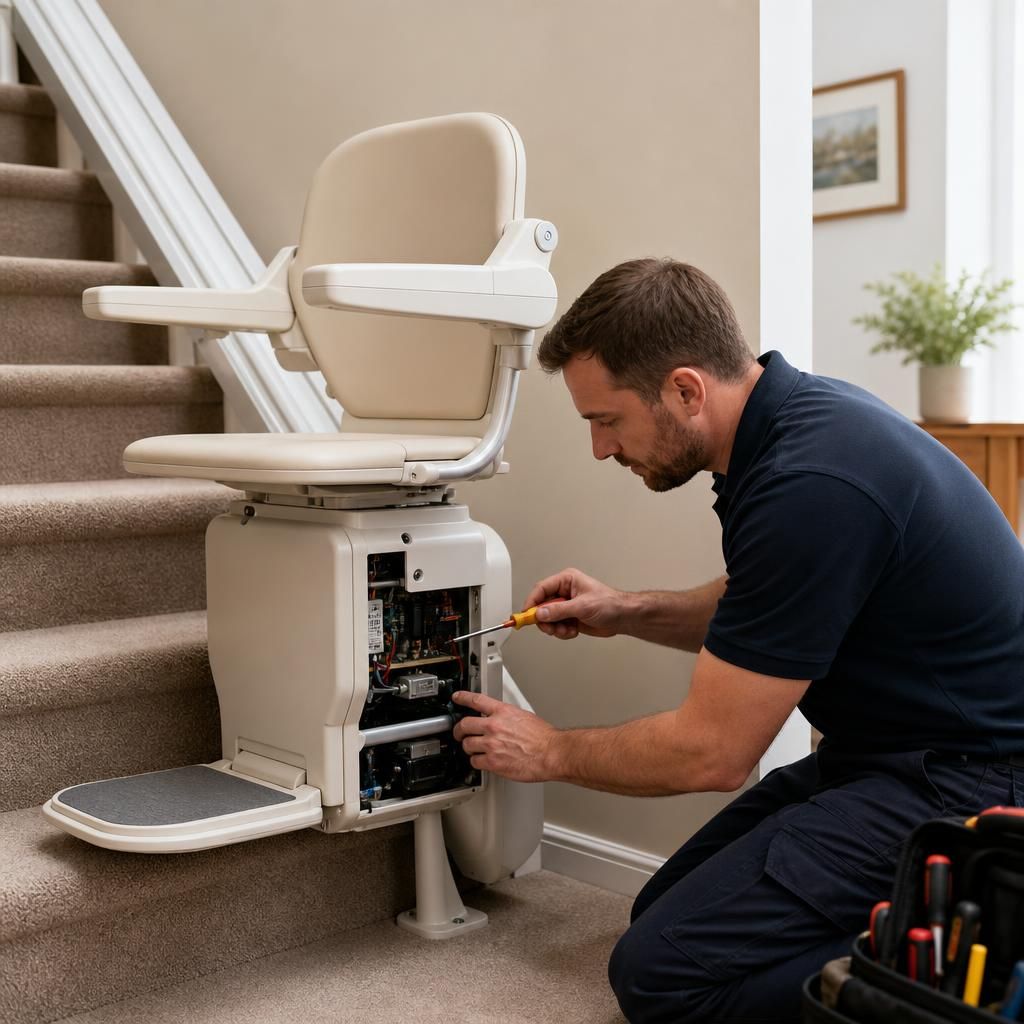
Book your straight stairlift maintenance check
Book a professional straight stairlift maintenance check with Independent Stairlifts to confirm that the lift, batteries, safety systems and charging points are operating correctly. Contact our team to arrange a service at the interval recommended for your model or sooner if you have noticed any changes in performance.