
What customisation options are available for straight stairlifts to suit specific user needs?
Straight stairlifts can be customised with different seats, upholstery, controls, armrests, footrests, safety features and rail configurations to suit the user and staircase. During an assessment, Independent Stairlifts can recommend suitable options for comfort, mobility, transfer needs and the available space in your home.
Straight stairlifts can be adapted in several ways to suit the user’s mobility, transfer ability, comfort preferences and staircase layout. Customisation may include the seat style, upholstery, controls, armrests, footrest, safety equipment, rail arrangement and charging position. The most suitable combination is confirmed during a home assessment, because an option that improves comfort for one person may be unsuitable for another.
Seat styles and transfer support
The seat is one of the most important customisation choices. A standard seat may be suitable for someone who can sit down and stand up without significant difficulty, while a powered swivel seat can rotate towards the landing to make getting on and off easier. This can be particularly useful where the user has reduced balance, limited hip movement or difficulty turning at the top of the stairs.
Some models can be supplied with a perch or semi-perch seat. These allow the user to travel in a more upright position and may help where bending the knees fully is uncomfortable or where the staircase is too narrow for a conventional seat. However, a perch seat still requires the user to maintain an appropriate level of standing balance and control. It is not automatically the safest choice for someone who is unable to stand securely.
Seat height, seat width and the position of the seat relative to the staircase can also affect safe transfers. The installation team should consider the height of the user’s chairs, the landing surface and whether the person transfers from a wheelchair or walking aid.
Upholstery, colour and appearance
Upholstery can usually be selected from a range of practical materials and colours, depending on the model. A wipe-clean finish may be preferable where regular cleaning is important, while a softer finish may provide a more comfortable feel. Colour choices can help the stairlift blend with the existing décor, although appearance should not take priority over a safe seat position, suitable support and clear access to the stairs.
Fold-up seats, armrests and footrests are available on many straight stairlifts. These features reduce the space taken up when the lift is parked and can help other household members use the staircase. Whether they provide enough clearance depends on the width and shape of the stairs, so this should be checked in person.
Controls for different levels of dexterity
Most straight stairlifts are operated using a control on one of the armrests. The control can often be positioned on the left or right side to suit the user’s stronger hand. A simple joystick or paddle-style control may be easier to use than a small button for someone with reduced finger strength or limited dexterity.
Wireless remote controls can be placed at the top and bottom of the stairs. They allow a household member or carer to send the stairlift to the required landing when the user is not sitting on it. Controls should remain easy to reach without encouraging the user to lean, twist or stand on the stairs.
Some users may benefit from controls with clear tactile features or straightforward directional operation. The control method should be demonstrated during the assessment, particularly if the user has arthritis, tremors, impaired vision or difficulty remembering multi-step instructions.
Armrests, footrests and positioning
Armrests provide lateral support and help the user maintain a stable seated position. Their width and shape can affect how easily the user transfers into the seat, particularly where the staircase is close to a wall or banister. The armrests must also leave enough room for the user’s shoulders and clothing without restricting the controls.
A folding footrest supports the feet during travel and helps keep them clear of the stairs. Depending on the model, the footrest may include an automatic folding function or additional support for users who have difficulty lifting their legs. Foot placement is important: the user should not need to reach down while the stairlift is moving.
Safety features matched to the user and home
Safety equipment is normally included as standard, but the most appropriate specification depends on the user’s needs and the staircase. Common features include a seat belt, swivel-seat locking mechanism, obstruction sensors, safety edges, a braking system and controls that require continuous operation. Sensors can stop the lift if an object is detected in its path, while a correctly adjusted seat belt helps keep the user secure during travel.
A retractable or adjustable seat belt may be easier for some people to fasten than a fixed design. If the user has limited reach or reduced hand function, the belt position and release mechanism should be tested rather than selected solely from a brochure. A powered swivel seat may also need to be considered where the user cannot safely rotate the seat manually.
These features support safe use but do not replace suitable supervision, clear stairs and correct operation. The user should receive practical instruction and be able to demonstrate how to start, stop, secure and dismount from the stairlift.
Rail and parking configurations
A straight stairlift rail is made to follow the staircase, but its position can be adjusted to work with the available space. It may be installed close to the wall or on the open side of the stairs, subject to the layout, handrail position and access requirements. The assessment should check clearance at the top and bottom, doorways, radiators, newel posts and nearby furniture.
Where the rail would obstruct a doorway, hallway or narrow landing, a hinged rail may allow the lower section to be folded out of the way when the stairlift is not in use. A manual hinge may be appropriate for a user who can operate it safely, while a powered hinge can reduce the physical effort required. Alternative parking positions, including parking away from a doorway or at the top landing, may also be possible.
Charging points are usually positioned where the stairlift can be parked safely and remain available for charging. If there is limited space at one end of the stairs, the charging arrangement should be discussed before installation. A straight stairlift can only follow a genuinely straight flight; intermediate landings, bends or changes of direction may require a different design.
Power, transfers and future needs
Battery-powered straight stairlifts are designed to continue operating for a limited period during a mains power interruption, provided the batteries are maintained and the lift is used as instructed. Charging points and the condition of the household electrical supply should be considered as part of the installation. If the staircase is outdoors or exposed to the weather, an outdoor-rated solution is required rather than an internal model with cosmetic changes.
Customisation should take account of likely changes in mobility. For example, a user who currently manages a manual swivel may later need powered operation, or someone using a walking stick may later require a more supportive transfer arrangement. Not every option can be added to every model after installation, so it is sensible to discuss foreseeable changes before choosing the initial specification.
How the options are selected
During an assessment, the installer should observe how the user approaches the stairs, sits down, transfers, operates controls and reaches the landings. The staircase is checked for width, obstructions, power access, parking space and the position of existing handrails. The recommended specification should then balance safety, comfort, independence, appearance and available space.
Ask for each proposed option to be demonstrated and confirm which features are included, optional or model-dependent. A properly assessed straight stairlift should be configured around the person using it, not simply selected by seat colour or headline features. Independent Stairlifts can help compare the available arrangements and identify a practical specification for the user and the home.
Straight stairlift customisation should begin with how the user transfers on and off the seat, rather than with appearance or optional extras. A powered swivel seat can turn towards the landing to reduce twisting, while a perch seat may suit someone who finds bending the knees difficult but can still maintain secure standing balance.
Seat height, armrest position, controls and seat-belt design should also be tested during the assessment. These details can make a significant difference for someone with reduced reach, arthritis, balance difficulties or limited hand strength. The recommended specification should provide comfortable support without restricting access to the stairs or creating obstacles on the landing.
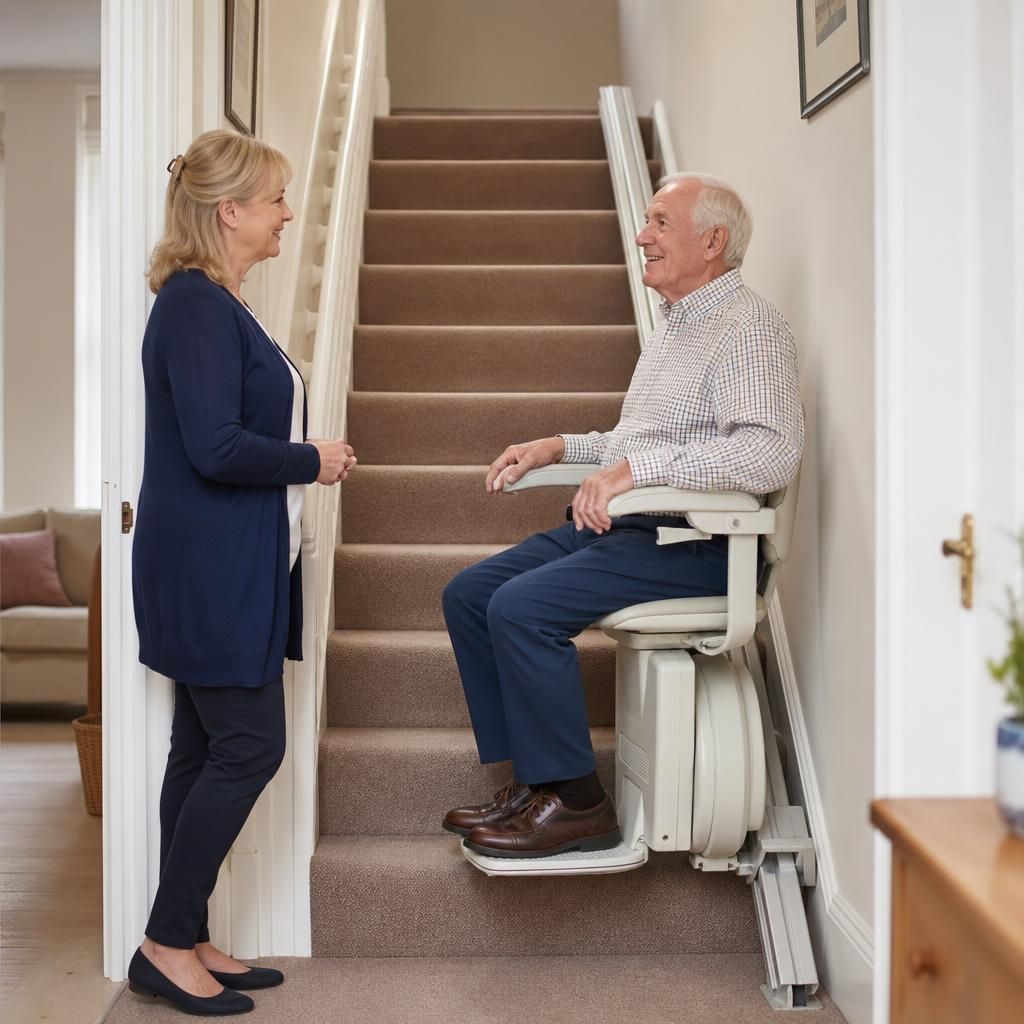
Discuss your straight stairlift customisation options
Discuss your straight stairlift customisation options with Independent Stairlifts to find a specification suited to your mobility, transfer needs and staircase layout. Arrange an assessment to review seating, controls, safety features and rail configuration.