
What are the key considerations when choosing a stairlift for straight stairs?
When choosing a stairlift for straight stairs, consider the staircase layout, available space, user’s mobility and weight requirements, seat comfort, safety features, power options, installation needs and total cost. A professional assessment helps confirm that the model fits the stairs correctly and can continue to meet the user’s needs as their mobility changes.
Choosing a stairlift for straight stairs involves checking that the rail will fit the staircase, the lift can be used safely and comfortably by the intended user, and the installation is suitable for the home. The main considerations are the staircase layout, available space, user’s mobility and weight requirements, seat design, safety features, power supply, installation method, ongoing support and the total cost of ownership. A professional assessment should confirm the suitability of the chosen model before you buy.
Assess the staircase and surrounding space
A straight stairlift is generally suitable where the stairs run continuously between two levels without a bend, curve or intermediate landing requiring the rail to change direction. However, the staircase still needs to be assessed in detail. The width of the stairs, the position of doors, radiators and handrails, the clearance at the top and bottom, and the shape of the landings can all affect the installation.
A rail may be installed close to the steps, but the lift must leave enough usable space for people to pass safely where this is required. At the bottom, the position of the parked seat is particularly important if it could obstruct a doorway, hallway or route through the home. At the top, the user needs adequate space to get off the lift without stepping into a hazardous area. A hinged, sliding or shortened rail may help where a doorway or walkway is close to the stairs, but the appropriate solution depends on the property.
Match the lift to the user’s mobility
Consider how the user transfers on to the seat, whether they can remain seated upright during the journey, and how much support they need when getting on and off. Someone with limited balance may benefit from a powered swivel seat, while a person who finds bending difficult may need a seat that is easier to access or a different seating position. If more than one person will use the stairlift, controls and adjustments should be practical for everyone.
It is also worth considering how the user’s condition may change. A model that is suitable now may become less convenient if standing, bending, grip strength or balance deteriorates. Discuss likely future needs during the assessment so that features such as powered swivelling, a larger seat, adjustable armrests or a powered footrest can be considered from the outset.
Check weight capacity and seating dimensions
Every stairlift has a specified maximum user weight and seating dimensions. These limits must be checked against the user’s requirements rather than estimated. The seat should provide stable support without restricting movement, and the armrests should be positioned to help the user remain secure throughout the journey. Larger or heavy-duty models may be available where a standard seat is not appropriate, but they may require additional space on the staircase.
Take account of clothing, walking aids and any equipment the user may need to carry. A fold-down seat, arms and footrest can help preserve access to the stairs when the lift is not in use. A manual or powered swivel at the landing can make transfers safer, particularly where the user cannot comfortably twist their body.
Prioritise practical safety features
Safety features should support the user’s actual risks and abilities. Common features to consider include a seat belt, safety sensors that stop the lift if an obstruction is detected, a secure swivel mechanism, non-slip footrest surfaces, comfortable arm supports and controls that are easy to operate. The handset and armrest control should be reachable without forcing the user to lean or stretch.
Check how the lift behaves if the user releases the control, encounters an obstruction or needs to stop part-way. The user should understand how to use the emergency stop, call controls and manual lowering or recovery arrangements where provided. A stairlift is not a substitute for safe transfers, so the area around the seat should remain clear and the user should follow the operating guidance supplied after installation.
Consider charging and power arrangements
Most modern stairlifts use rechargeable batteries, allowing them to operate during a power cut for a limited period. Ask where the lift charges when parked and whether the charging points remain accessible at the top, bottom or both ends of the rail. The user should know how to park the lift correctly so that the batteries remain charged.
Battery condition, charging behaviour and the availability of a manual release or emergency assistance procedure should be explained during handover. If the property is affected by frequent power interruptions, this should be discussed during the assessment so the chosen system and operating plan are appropriate.
Look at the installation requirements
Straight stairlifts are normally fitted to the stairs rather than the wall, so the installer must check that the steps and supporting structure can accept the rail fixings. The assessment should also identify skirting boards, unusual step construction, narrow landings, doors and any other features that could affect the rail position. Installation should not obstruct essential access or create a new trip hazard.
Ask what preparation is required, how long the work is expected to take, and whether any alterations to the staircase or surrounding area are necessary. A properly planned installation should leave the stairway usable for other household members wherever possible and should include instruction in safe operation.
Compare the complete cost
The purchase price is only one part of the decision. Compare the cost of the assessment, installation, delivery, warranty, servicing, battery replacement and any optional features. A reconditioned stairlift may reduce the initial cost, but check its condition, warranty, suitability for the user and the availability of future servicing before making a decision. For a new lift, clarify what is included and whether additional work is charged separately.
Do not choose solely on the lowest quotation. A lower-cost model may lack seating adjustments or features that become important as the user’s mobility changes, while an unnecessarily complex model may not offer useful benefits for the particular staircase. The most appropriate option is the one that provides a safe fit, suitable support and manageable ongoing costs.
Check aftercare and future support
Before ordering, establish how to report a fault, the expected response process, and what routine servicing is recommended. Ask how batteries and other wear components are handled and whether support is available if the user’s needs change. Clear operating instructions should be provided to the user and anyone who may assist them.
For a reliable choice, arrange a home assessment rather than relying on general measurements or photographs alone. The assessment should consider the staircase, the user, other people in the household and likely future requirements. This allows the specification, seating position, controls and parking arrangements to be agreed before installation, reducing the risk of choosing a lift that is technically compatible but inconvenient or unsuitable in daily use.
Choosing a stairlift for straight stairs means matching the lift to both the staircase and the person who will use it. A home assessment checks the stair width, landings, doors, handrails, available clearance and suitable parking positions before a model is specified.
The user’s mobility is equally important. Consider how easily they can sit down, remain upright, operate the controls and step off at the landing. Features such as a swivel seat, adjustable armrests, a powered footrest or a larger seat may improve safety and comfort, particularly if their mobility is likely to change.
It is also important to compare the complete cost, including installation, warranty, servicing and battery replacement. The most suitable stairlift is not necessarily the one with the lowest purchase price, but the one that fits the staircase correctly, supports safe transfers and remains practical to use every day.
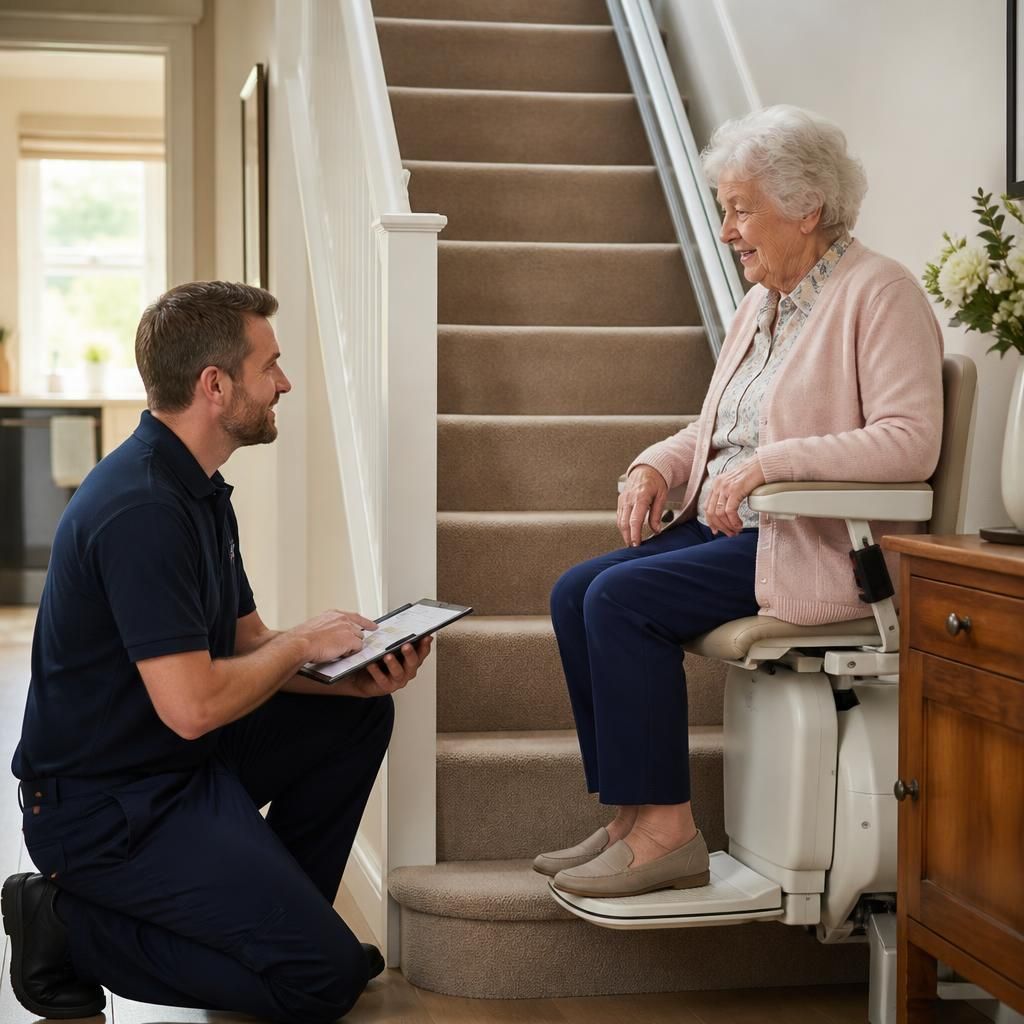
Arrange Your Straight Stairlift Assessment
Arrange a home assessment to confirm that a straight stairlift suits your staircase, available space and current or future mobility needs. We can discuss suitable features, installation requirements and the complete cost before you make a decision.