
What steps can I take to troubleshoot if my straight stairlift stops working unexpectedly?
If your straight stairlift stops unexpectedly, check that the power supply, key switch and on/off controls are switched on, then make sure it is correctly positioned on its charging point and that the seat, armrests and safety belt are fully engaged. Remove any visible obstruction without forcing the lift or opening its covers; if it still will not operate, switch it off and contact Independent Stairlifts for a qualified inspection.
If your straight stairlift stops working unexpectedly, carry out a few safe external checks before arranging a repair. Confirm that the lift is receiving power, the key switch and controls are enabled, the seat and safety features are correctly positioned, and the carriage is properly aligned with a charging point. Do not remove covers, bypass a safety switch or force the lift to move. If these checks do not restore operation, switch the stairlift off where possible and contact Independent Stairlifts for qualified assistance.
Start with safety
- If the stairlift has stopped on the stairs, remain seated if it is safe to do so, keep the seat belt fastened and avoid leaning towards the landing or staircase.
- Ask someone to help only if they can do so without lifting or pushing you on the stairlift. Do not attempt to carry the user while the staircase is obstructed unless there is an immediate danger.
- If there is a burning smell, smoke, unusual heat, damaged wiring or evidence of a battery leak, stop using the lift immediately. Turn off the power supply if this can be done safely and contact an engineer.
Check the power supply
Look at the stairlift’s power indicator or charging light, if fitted. Check that the mains plug is connected securely and that the nearby switched socket is turned on. If the stairlift has a separate isolation switch, make sure it has not been switched off. You can check whether other equipment works from the socket, but do not use an extension lead or alter the stairlift’s wiring.
If the household electricity has tripped, reset the relevant switch only if there is no sign of damage, moisture, smoke or overheating. If it trips again, leave the stairlift switched off and arrange professional help rather than repeatedly resetting it.
Check the key switch and operating controls
- Make sure the key switch is inserted and turned to the operating position.
- Check that the on/off control has not been pressed accidentally.
- If your stairlift uses a remote control, confirm that it is switched on and has working batteries. Keep the remote pointed towards the stairlift when operating it, and check that another control has not been pressed at the same time.
- Try the control gently in the intended direction. Do not hold it down continuously if the lift does not respond or make repeated attempts to overcome a fault.
Confirm that the safety features are engaged
A straight stairlift will normally refuse to move if one of its safety interlocks is open. Check that the seat is fully in its normal travelling position, the armrests are down, the footrest is clear and the safety belt is fastened correctly. On some models, the seat or armrests must be fully returned to their operating position before the controls will work. If the seat has been swivelled at the top or bottom of the stairs, return it carefully to the travel position without forcing it.
Check for clothing, bags, toys, pet items or other objects caught around the footrest, carriage or track. Remove only items that are clearly visible and can be taken away without reaching into moving parts. Keep hands, feet and tools away from the mechanism, and never remove a guard or cover.
Check the lift’s position on the track
If the stairlift stopped at the top or bottom of the stairs, check whether it is sitting over its charging point. Some models charge only when the carriage is positioned accurately, while others have charging points at more than one location. If the lift has stopped just short of a charging point, use the control briefly and gently to see whether it will move. Stop immediately if it makes an abnormal noise, moves unevenly or fails to respond.
If the lift is stranded on the track and there is no safe way to return it to a charging point, do not push it, pull it or attempt to release the drive mechanism. A lift that has lost power may also have low batteries, and repeated operation can reduce the available charge further.
Allow for a low-battery condition
A stairlift may stop or refuse to move when its batteries are insufficiently charged. This can happen if the lift has been left away from its charging point, the power supply has been interrupted or the batteries are no longer holding charge properly. Restore the mains supply and leave the stairlift at its charging point as instructed for your model. If the charging indicator does not appear, or the lift repeatedly loses power after charging, the batteries or charging system may require inspection.
Do not try to charge the stairlift with an unrelated charger or replace batteries unless the work is approved for that model and carried out by a suitably qualified person. Incorrect parts or connections can damage the equipment and create a safety risk.
Consider what happened immediately before the failure
Tell the service team whether the stairlift stopped during travel, would not start, made a sound, displayed a warning or had recently been moved away from its charging point. Also note whether the fault affects the handset, remote control or both. This information can help distinguish a power or control issue from a problem involving the batteries, charging contacts, safety interlock or drive system.
When to stop troubleshooting
Contact Independent Stairlifts for an inspection if the basic checks do not resolve the fault, if the stairlift stops again, or if it moves slowly, jerks, cuts out, emits unusual noises or shows a warning indicator. Arrange assistance promptly if the user cannot safely leave the staircase or is reliant on the stairlift for essential access.
Keep the stairlift switched off until advice is provided if there is visible damage, a burning smell, smoke, water exposure, a persistent electrical trip or any risk that the lift could move unexpectedly. Provide the model details if available, describe the position of the lift and explain the checks already completed. An engineer can then assess the stairlift without you opening the equipment or risking further damage.
If your straight stairlift stops on the stairs, treat it as a safety issue rather than trying to force it to move. Keep the seat belt fastened, remain seated if you are secure, and avoid leaning towards the landing or reaching for the track.
Check only the external controls and visible area. Do not push or pull the stairlift, release the drive mechanism, remove covers or bypass a safety switch. Contact Independent Stairlifts promptly if there is no safe way to reach a charging point, or if the lift shows any of these signs:
- a burning smell, smoke or unusual heat;
- damaged wiring, water exposure or a battery leak;
- repeated power trips or failure to charge;
- jerky movement, unusual noises or unexpected stopping; or
- no response after the power, key switch and safety features have been checked.
Tell the service team where the stairlift stopped, whether it was moving or starting up, and what indicators or sounds you noticed. This helps the engineer assess the fault without you opening the equipment or risking further damage.
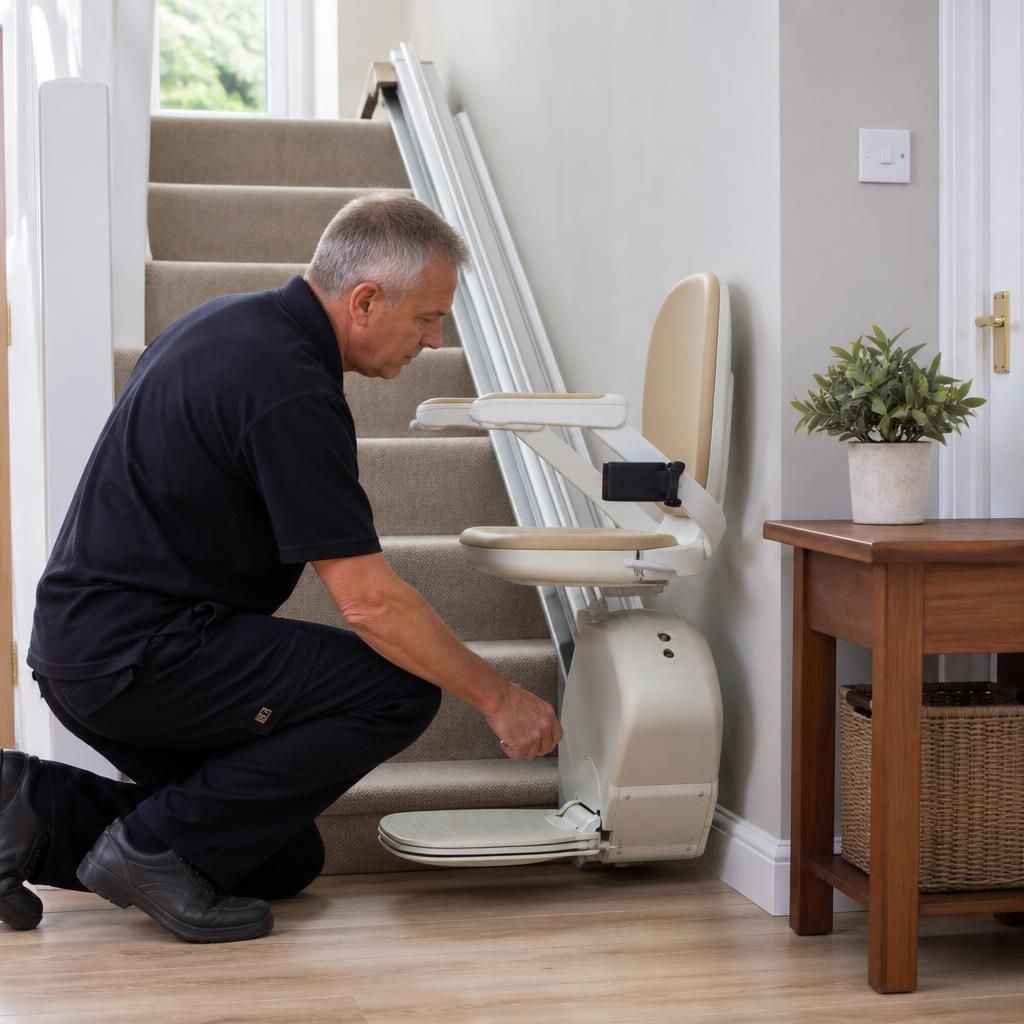
Contact Independent Stairlifts for Straight Stairlift Troubleshooting Support
If your straight stairlift is still not working after these external checks, contact Independent Stairlifts for qualified troubleshooting and repair support. Tell us where it stopped and what you observed so we can advise on the next safe step.