
What should I do if my straight stairlift suddenly stops working?
If your straight stairlift suddenly stops working, stop using it, check that it is switched on and correctly positioned on its charging point, and look for any obvious obstruction or loose connection. If it still does not operate, do not force the controls or attempt an electrical repair; contact Independent Stairlifts for advice and an engineer assessment.
If your straight stairlift suddenly stops working, stop using it, remain seated if it is safe to do so, and check the simple operating conditions before contacting Independent Stairlifts. Confirm that the power is switched on, the key is inserted, the seat and safety controls are correctly positioned, and the lift is parked on a charging point. Do not force the joystick, repeatedly operate the controls or attempt an electrical repair.
First, make sure you are safe. If the stairlift has stopped on the stairs, keep your seatbelt fastened and avoid trying to climb over or around it. If you can safely reach a landing, follow the manufacturer’s normal method for dismounting. If you cannot move safely, use a telephone, alarm or other agreed method to contact a relative, carer or emergency service. Do not ask someone to lift you from the stairlift or move it manually.
Check the following points if it is safe to do so:
- Make sure the main power switch is on. This may be beside the stairlift, at the top or bottom of the staircase, or near the charging point.
- Check that the key is inserted and turned to the operating position, if your model has a key switch.
- Confirm that the seat is fully swivelled back into the travelling position and that the armrests are lowered. Some stairlifts will not operate unless these safety interlocks are engaged.
- Check that the footrest, seat belt and any hinged or folding parts are correctly positioned.
- Look along the staircase for an obstruction, such as footwear, toys, furniture or a loose carpet edge. Do not reach underneath the lift or place your hands near the rail, carriage or drive mechanism.
- If the stairlift has stopped at the top or bottom, check whether it is correctly aligned with its charging contacts. A lift that is not parked properly may not charge or may show a low-battery warning.
- Check the handset or diagnostic display for a warning light or audible alert. Note what you see or hear, as this can help the engineer identify the fault.
- If you use a remote control, check that it is switched on and has a working battery. A faulty or unresponsive remote does not necessarily mean that the stairlift itself has failed.
After correcting an obvious issue, allow the stairlift to remain on its charging point and try the control once. If it still does not move, stop troubleshooting and contact Independent Stairlifts. Tell us whether the lift is at the top, bottom or part-way up the stairs, whether it gives an alarm or error indication, whether it will move in either direction, and whether there has been a recent power cut, obstruction or unusual noise.
Do not attempt these repairs yourself:
- Do not remove covers, alter wiring or disconnect the batteries.
- Do not bypass the seat belt, swivel-seat or other safety switches.
- Do not push or pull the stairlift along the rail.
- Do not use a household charger, lubricant or replacement component unless it has been specifically approved for your stairlift and fitted by a qualified engineer.
- Do not continue using the lift if it jolts, stops repeatedly, smells of burning, shows signs of damaged wiring or makes a new grinding or electrical noise.
A sudden failure can result from a flat or ageing battery, a loss of mains power, an obstruction, an incorrectly positioned seat, a charging fault, a handset issue or a problem with the control or drive system. Some faults are intermittent, so mention any earlier warning signs even if the stairlift starts working again. Continuing to use it may leave you stranded or allow a minor fault to develop into a more serious repair.
Independent Stairlifts can assess the fault, identify whether a repair or replacement part is required, and check the stairlift’s safety functions before it is returned to service. Keep the lift switched off until you have received advice if there is visible damage, a burning smell, liquid contamination or any other sign that operation could be unsafe. A service visit can also establish whether the batteries, charging points, rail, controls or safety interlocks need attention rather than simply resetting the symptom.
When arranging assistance, have the stairlift model or installation details available if you can find them without dismantling anything. It is also useful to explain the position of the lift, the indicator lights or sounds, and the exact control used when it stopped. This information helps us provide appropriate advice and prepare for the engineer’s assessment.
A straight stairlift that stops suddenly should be treated as a safety issue until the cause is known. Keep the seatbelt fastened, do not try to climb over the lift or move it by hand, and check only the accessible controls and power supply if you can do so safely.
Confirm that the mains switch is on, the key is in the operating position and the seat, armrests and footrest are correctly positioned. If the stairlift remains unresponsive, gives an alarm, or shows a warning light, stop using it and contact Independent Stairlifts. Tell us where it has stopped and describe any unusual noise, smell or error indication so an engineer can assess the fault safely.
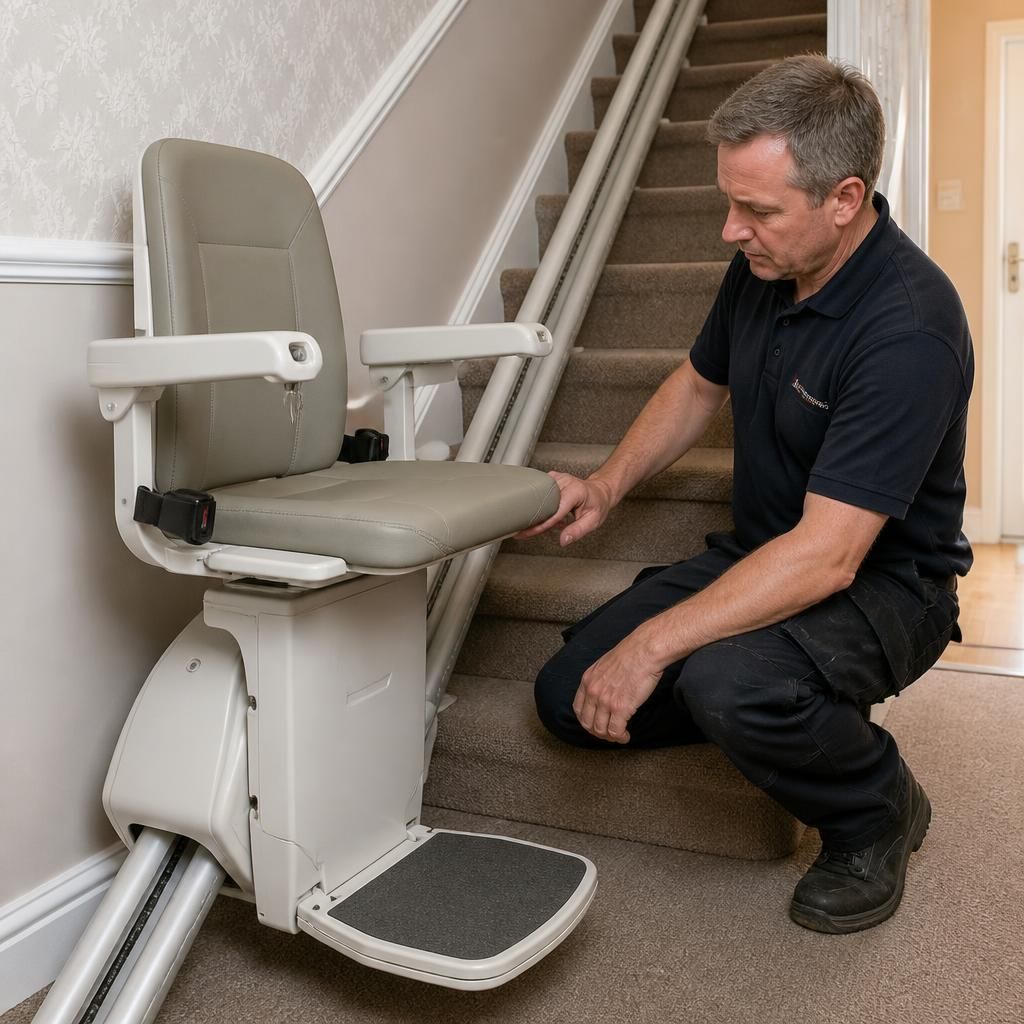
Arrange a Straight Stairlift Repair Assessment
If your straight stairlift remains unresponsive or shows signs of a fault, contact Independent Stairlifts to arrange a repair assessment. Tell us where it stopped and describe any warning light, alarm, unusual noise or smell so our engineer can prepare appropriately.