
What maintenance is required to keep my straight stairlift operating smoothly over time?
Keeping a straight stairlift operating smoothly involves regular cleaning, keeping the batteries charged, checking the seat, armrests and controls, and arranging professional servicing at the recommended intervals. Do not attempt to repair mechanical or electrical faults yourself; contact Independent Stairlifts if you notice unusual noises, jerky movement, reduced battery performance or warning lights.
Keeping a straight stairlift operating smoothly requires routine cleaning, correct charging, basic safety checks and professional servicing at the intervals recommended for your particular model. Most day-to-day care can be carried out by the user or a family member, but mechanical, electrical and battery faults should always be assessed by a qualified stairlift engineer.
Keep the rail and surrounding area clean. Dust, pet hair and other debris can collect around the rail, carriage or charging contacts and may affect movement or charging. Wipe accessible surfaces with a soft, dry or slightly damp cloth, following the instructions supplied with the stairlift. Do not pour water or cleaning products onto the lift, rail, controls or electrical components. Keep the staircase and the area around the top and bottom parking positions clear so that the stairlift can travel and park safely.
Do not apply oil, grease or other lubricant to the rail unless the manufacturer or an engineer specifically instructs you to do so. Some stairlift rails and drive systems are designed to operate without user-applied lubrication, and unsuitable products can attract dirt or interfere with the drive mechanism.
Use the charging points correctly. Park the stairlift at its designated charging position whenever it is not being used, unless your model’s instructions state otherwise. Regular charging helps maintain battery performance and ensures the lift is ready when required. If the stairlift has more than one charging position, use them as described in the operating instructions. Avoid leaving the lift stopped away from a charger for extended periods, particularly when it is not in regular use.
Rechargeable batteries gradually lose capacity with age. Signs that they may need attention include shorter travel between charges, the stairlift stopping before reaching the end of the rail, repeated low-battery warnings or difficulty operating after a period of non-use. Battery replacement should be completed by an engineer, as the correct battery type and safe electrical isolation are important.
Check the user-contact parts regularly. Before using the lift, look over the following items:
- the seat, swivel mechanism and seat belt;
- the armrests, footrest and any folding sections;
- the handset and controls, including the direction buttons;
- the safety edges and sensors, where fitted;
- the key switch, isolation switch and visible cables; and
- the display, indicator lights and audible warnings.
Controls should respond consistently, the seat should lock in its intended position and the belt should fasten securely. Keep handsets in their usual locations and replace batteries in a handset when required. Do not bypass a key switch, sensor, safety edge or other safety feature.
Arrange professional servicing as recommended. The appropriate service interval depends on the model, how often it is used, the age and condition of the lift, and whether it is installed indoors or outdoors. Check the user manual, service documentation or installation records for the recommendation. During a service, an engineer can inspect the drive system, rail, carriage, braking and safety mechanisms, charging equipment, batteries, seat assembly and electrical connections. They can also test the lift under operating conditions and identify wear before it develops into a breakdown.
A service is not a substitute for reporting a fault as soon as it appears. Contact Independent Stairlifts promptly if you notice:
- jerky, hesitant or unusually slow movement;
- grinding, clicking, squeaking or other unfamiliar noises;
- repeated stopping or failure to start;
- warning lights, error messages or unusual beeping;
- poor battery performance or failure to charge;
- a loose seat, armrest, footrest or belt;
- difficulty using the swivel seat or folding mechanism; or
- damage to the rail, covers, wiring or controls.
If the stairlift behaves unpredictably, smells of overheating, shows exposed wiring or has suffered impact or water damage, stop using it and keep others away until it has been checked. Do not remove covers, adjust the rail, dismantle the carriage or attempt electrical repairs yourself. A fault may affect the lift’s safety systems even when it still appears to operate.
Additional care may be needed for a stairlift used outdoors. Outdoor models are designed for external conditions, but they still need protection from unnecessary exposure where possible. Keep the lift parked in its recommended position, use any supplied cover correctly, remove leaves and dirt from the rail and charging area, and report corrosion, water ingress or deterioration of seals. Do not use a cover that prevents ventilation or traps moisture against the equipment. Follow the model-specific guidance for cleaning and weather protection.
Good records also help with ongoing support. Keep the manual, installation details and service reports together, and note any warning messages or changes in performance. If the stairlift is rarely used, operate it in accordance with the manufacturer’s guidance and ensure it remains charged rather than assuming that occasional use will maintain the batteries.
In practical terms, the most important routine is to keep the rail and controls clean and dry, park the lift on charge, check the seat and safety components, and report changes in performance early. Professional servicing then provides the detailed inspection and testing that cannot safely be completed as part of normal household maintenance.
Keeping the stairlift parked on its designated charging point whenever it is not in use is one of the simplest ways to protect battery performance. Regular charging helps ensure the lift is ready when needed and reduces the risk of the batteries becoming deeply discharged after periods of limited use.
If the stairlift travels a shorter distance than usual, gives low-battery warnings, stops unexpectedly or fails to charge, arrange an engineer’s inspection. Batteries are consumable components and should be replaced with the correct type by a qualified professional rather than removed or tested as a household repair.
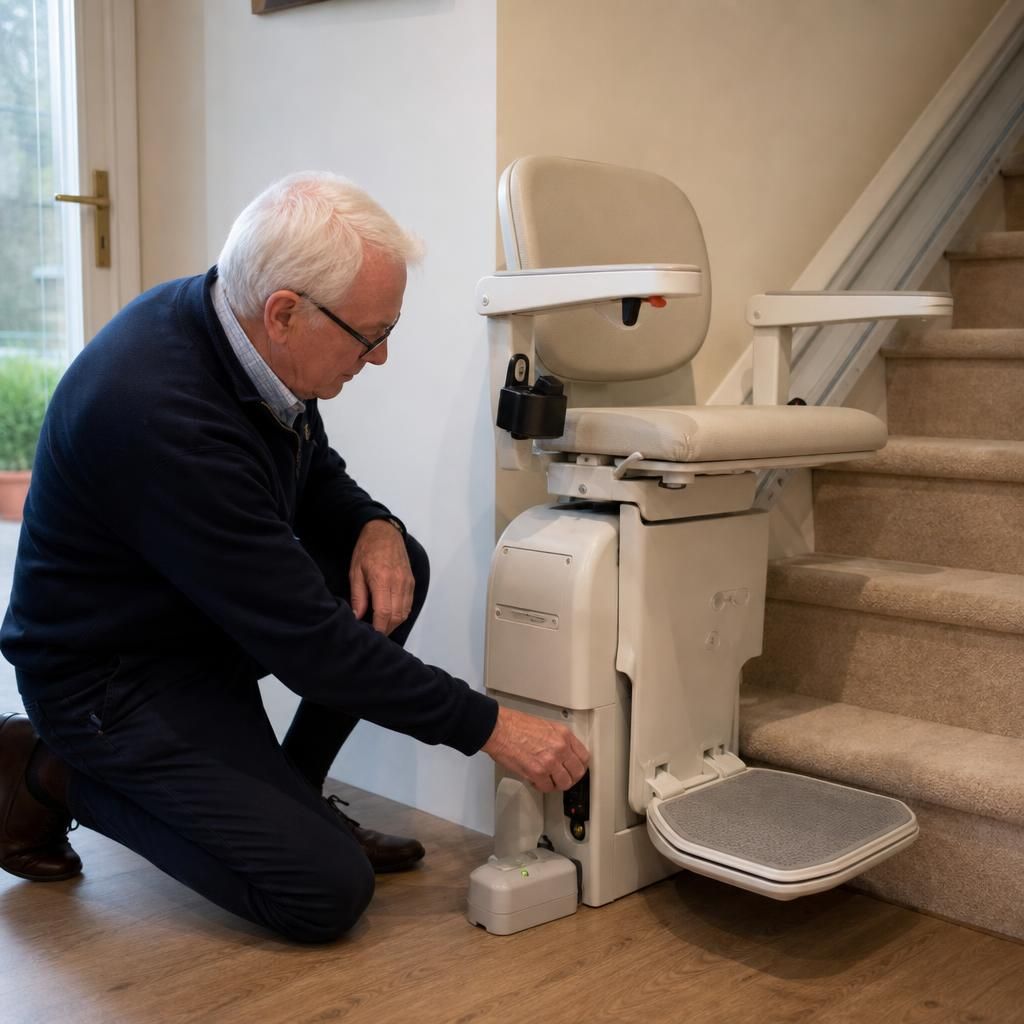
Need help with your straight stairlift maintenance?
Need help with your straight stairlift maintenance? Contact Independent Stairlifts to arrange professional advice, servicing or an engineer’s inspection.