
What is the typical installation process for a straight stairlift?
A straight stairlift installation typically begins with a home assessment to check the staircase, access requirements and the most suitable equipment. The installer then fits the rail securely to the stairs, connects and tests the lift, and demonstrates its safe operation before completing the handover.
A straight stairlift installation usually involves a home assessment, selection of suitable equipment, secure fitting of a straight rail to the staircase, comprehensive safety checks and a practical handover. Because the rail follows one continuous flight, the installation is generally more straightforward than fitting a curved stairlift, although the exact work depends on the staircase, access requirements and the chosen model.
1. Home assessment and measurements
An experienced installer first assesses the staircase and the way you intend to use the stairlift. This normally includes checking:
- Whether the staircase is genuinely straight, including any changes in angle, landings or obstructions.
- The available width for the stairlift and for other people using the stairs.
- The position of the top and bottom landing, including whether a short overrun would improve access.
- The location of doors, radiators, bannisters, furniture and other potential obstructions.
- Where the stairlift can be parked and charged safely.
- Your mobility needs, such as whether you can transfer easily into the seat and operate the controls.
The survey also helps identify practical requirements that may not be obvious from photographs or measurements alone. If the staircase has an unusual shape, a half-landing or a tight entrance at either end, the installer should explain whether a standard straight model is appropriate or whether an alternative arrangement is needed.
2. Recommendation and quotation
Following the assessment, you should receive a recommendation based on the staircase and your requirements rather than simply the lowest-cost equipment. The quotation should make clear what is included, such as the stairlift, rail, installation, demonstration and any agreed additional work. It should also identify optional features, removal of an existing stairlift and any circumstances that could affect the final price.
This is the right stage to discuss seat style, swivel or powered functions, controls, upholstery, weight capacity, folding parts and whether a new or reconditioned stairlift is most suitable. If more than one person will use the stairlift, tell the assessor so that the controls and seat configuration can be considered properly.
3. Preparing for the fitting
Before the installer arrives, keep the staircase and both landings as clear as reasonably possible. Remove loose items, toys and fragile objects from the route, and make sure the installer can reach the electrical supply and charging points. You do not normally need to remove the bannister or alter the wall, as most straight stairlifts are fixed to the stair treads rather than supported by the wall. However, any required changes should be explained before installation.
If an existing stairlift is being replaced, confirm whether its removal is included. It may also be useful to decide where the stairlift should be parked when it is not in use, particularly if it is near a doorway or at the bottom of a narrow hall.
4. Fitting the rail and stairlift
The installer positions and secures the rail along the staircase using suitable brackets fixed to the treads. The rail is aligned to provide a safe, practical route while allowing the seat, footrest and moving parts to clear nearby walls and fixtures. The carriage, seat, footrest, controls and safety components are then fitted to the rail.
A suitable electrical connection is provided for charging the batteries. Depending on the model and the property, this may use an existing socket or require an agreed electrical arrangement. Battery-powered stairlifts normally charge when parked at a designated charging point, so the installer will explain where the lift should be left between journeys.
Installation does not usually require major structural work. Nevertheless, drilling into the stair treads creates some dust and noise, and the installer may need access to the full staircase throughout the fitting. Any unusual flooring, fragile surfaces or restricted access should be mentioned during the assessment.
5. Testing and safety checks
After fitting, the installer tests the stairlift through its complete operating route. Checks normally cover the movement of the carriage, smooth starting and stopping, charging, controls, seat rotation if fitted, the folding footrest and the operation of safety sensors. The seat belt and armrests are also checked, along with clearance from walls, doors and other obstructions.
The installer should not treat the job as complete until the stairlift operates reliably and the installation is left tidy. If anything feels uncomfortable or difficult to use during testing, raise it immediately. Small adjustments to the position of controls, the seat or the parking point may make a significant difference to everyday use.
6. Demonstration and handover
You should receive a clear demonstration before using the stairlift independently. This should cover:
- How to sit down, fasten the seat belt and position your feet.
- How to operate the controls and, where provided, the remote controls.
- How to use the swivel seat, folding mechanisms and any powered options.
- How to stop the stairlift safely if an obstruction or problem occurs.
- Where and how the stairlift charges.
- What the warning sounds or indicator lights mean.
- How to keep the rail, seat and sensors free from obstructions.
Ask the installer to repeat any part of the demonstration that is unclear, and make sure other regular users receive the same guidance. You should also be given the operating instructions, warranty information and details of who to contact for servicing, faults or emergency advice.
After installation
Use the stairlift exactly as demonstrated and keep the travel path clear. Do not carry people, pets or bulky items on the lift unless the equipment is specifically designed and approved for that use. Keep the charging points unobstructed and report unusual noises, jerky movement, warning signals or repeated battery problems rather than continuing to use a stairlift that may need attention.
A straight stairlift can often be installed with limited disruption, but the actual process varies with the staircase, the model and any additional work identified during the survey. A proper assessment and a thorough handover are therefore as important as the physical fitting itself. If your circumstances or mobility needs change after installation, contact Independent Stairlifts so the equipment and its settings can be reviewed.
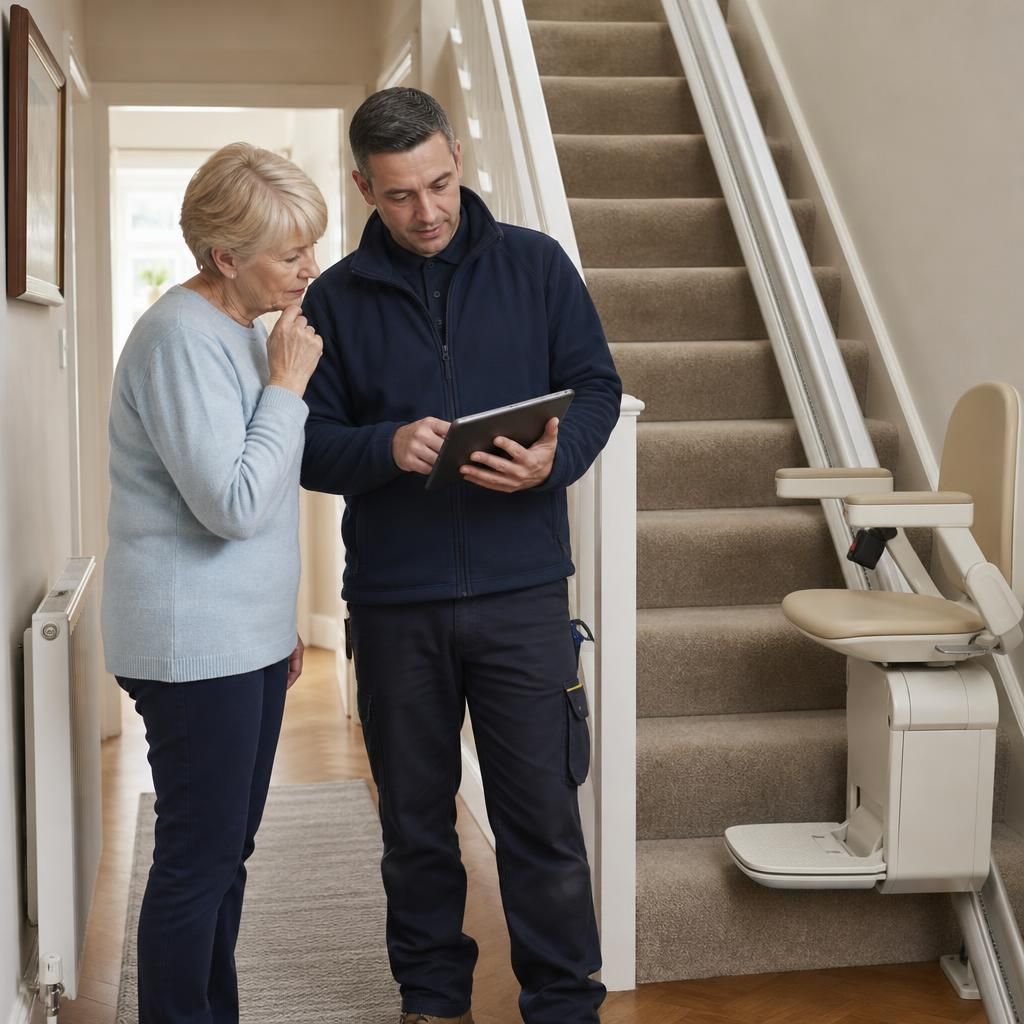
The home assessment is the first practical stage of a straight stairlift installation. An installer checks that the staircase has one continuous flight, measures the available space and identifies obstructions such as doors, radiators, bannisters and furniture.
The assessment also considers how you will use the stairlift. Seat height, swivel controls, armrests, footrest position, parking points and charging locations should all be discussed. This allows the recommended model and rail position to suit both the staircase and your mobility needs, rather than relying on a standard fitting.
Most straight stairlifts are secured to the stair treads using supporting brackets, so installation does not normally require major changes to the wall. Any unusual access, flooring or structural considerations should be identified before fitting and included in the quotation.
Book Your Straight Stairlift Assessment
Book your straight stairlift assessment with Independent Stairlifts to review your staircase, access needs and the most suitable installation options. Our team can explain the process and provide a clear quotation before fitting.